
Reality check: you and your driver’s license do not always agree. Your chronological age is the birthday math. Your biological age is how your cells, muscles, brain, and immune system are actually performing today.
Here’s the plot twist from the front lines of aging science: a growing wave of geriatric research says we can often slow—and sometimes partially reverse—biological aging with the right playbook, measured in the right way. That’s the promise of precision gerontomedicine.
Pull up a chair. I’ll translate the science, ditch the hype, and give you a 4-week starter plan you can use now.
A story you might recognize
Meet Sam, 72. Two neighbors, same birth year. One is sharp, walks fast, hears well, learns new tech for fun. The other is winded by the mailbox, avoids stairs, and struggles to keep track of meds. Same decades on Earth. Different biology.
The question isn’t “Why is Sam special?” It’s “Which knobs were turned and can we turn them for more people?”
Biological age 101 (without the jargon)
Think of your body as a city. Biological age is how well the city runs: roads (vessels), power grid (mitochondria), sanitation (autophagy), traffic control (immune system), communications (nervous system). We estimate this with biomarkers (blood, imaging, physical tests, even multi-omic panels) and with something geriatricians call intrinsic capacity, the practical bundle of mobility, cognition, mood, energy, and sensory function that predicts independence.
Key point: biological age is malleable. It responds to what you do, what you’re exposed to, and how you recover.
Meet the “gerogenes” idea (and why it matters)
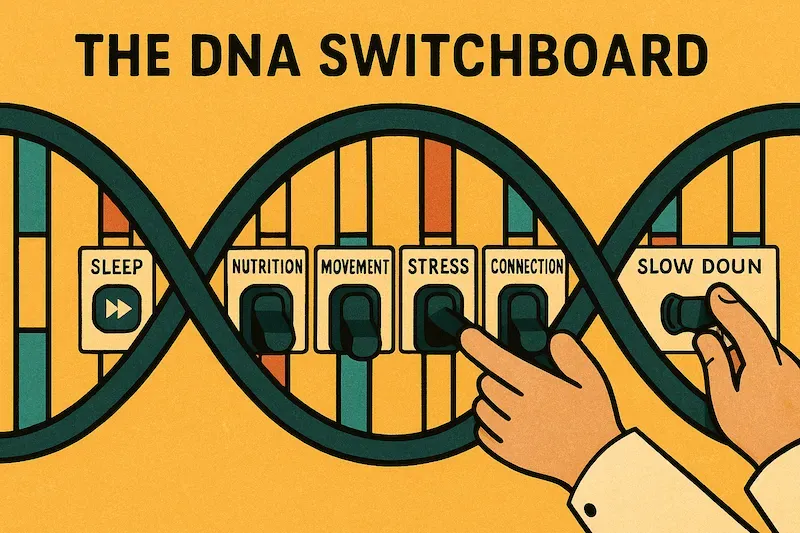
You’ve heard of oncogenes (push toward cancer) and tumor suppressors (brakes). Aging researchers use a similar frame for gerogenes (signals that accelerate aging biology) and suppressor genes (signals that slow it). Lifestyle, environment, stress, sleep, nutrition, movement, and social connection tug on those switches. The goal of geroscience: target the shared biology that drives multiple age-related diseases, rather than whack-a-mole each condition.
This isn’t science fiction. It’s showing up in large programs and clinical trials focused on preserving intrinsic capacity.
Precision gerontomedicine in practice
At leading centers, teams are combining:
- Personal biomarker panels (genetic, proteomic, inflammatory, metabolic)
- Function testing (gait speed, grip strength, cognitive batteries, hearing/vision)
- AI-assisted risk maps that match the right intervention to the right person
- Non-drug interventions delivered at scale—think WHO’s ICOPE framework: reduce sedentary time, protect nutrition, stimulate cognition, support mental health, and maintain hearing/vision
The mission is not a younger face. It’s a younger function: faster feet, clearer memory, steadier mood, sharper senses.
Wait—can people really “age younger”?
Across cohorts, newer generations at the same chronological age often perform better on strength, speed, and cognition than prior generations. That implies biology can be improved by circumstance and behavior. Early trials suggest packages of targeted, nonpharmacologic interventions can shift biomarker trajectories and real-world function, especially when started before disability sets in.
Big initiatives (like ICOPE-INTENSE, competing in the XPRIZE Healthspan challenge) are testing whether personalized, multi-domain programs can slow or reverse the biology that predicts dependency, tracking outcomes in motor performance, cognition, and immune function.
Is every knob turn dramatic? No. But small gains across multiple systems compound, just like interest.
What actually moves the dial (the boring truth that works)
1) Move on purpose—then move a little faster
- Gait speed is a brain-and-body vital sign. Do 10 meters at your best comfortable pace each week. Write down the seconds. Try to shave 0.5 second off over a month.
- Aim for 150 minutes/week of moderate activity, plus 2 strength sessions and short balance drills (single-leg stands near a counter). Short, frequent bouts beat perfect plans you never do.
2) Eat for muscle, vessels, and microbes
- Base meals on a Mediterranean pattern: plants, legumes, nuts, whole grains, fish, olive oil.
- Protein anchor each meal (aim ~25–35 g per meal, adjust with your clinician).
- Add fermented foods (yogurt, kefir, kimchi) and prebiotic fibers (oats, beans, onions/as tolerated). Your microbiome talks to your immune and brain aging pathways.
3) Sleep like it’s medicine
- Consistent 7–9 hours in bed, morning light within an hour of waking, dimmed lights before bed.
- Snoring or unrefreshing sleep? Screen for sleep apnea. Treating it protects brain, heart, and muscle.
4) Train attention, not just trivia
- Do one focused 20-minute block daily: learn a language phrase set, instrument pattern, or new dance steps. Attention is the doorway to memory.
5) Protect mood and connection
- Low anxiety and depression track with better late-life cognition and function. If mood is heavy, address it early—therapy, group programs, movement, sunlight, and sleep hygiene help.
- Put two meaningful social touches on your weekly calendar. Loneliness ages biology; engagement buffers it.
6) Guard the “big four” risks
- Keep blood pressure, A1c, LDL, and smoking status in the green. These are aging accelerators you can tame.
7) Hear and see well
- Treat hearing loss and correct vision early. Sensory strain quietly drains cognitive reserve and social engagement.
The 4-Week “Intrinsic Capacity Upgrade”
Week 1 — Baseline & rhythm
- Record: gait speed (10 m), 30-second sit-to-stand, bedtime/waketime.
- Add two 10-minute brisk walks daily and a 20-minute focus block, 3 days.
- Protein with each meal; one fermented food/day.
Week 2 — Strength & senses
- Two short strength sessions (squats to chair, wall push-ups, band rows).
- Schedule hearing and vision checks if overdue.
Week 3 — Balance & buddies
- Daily 3-minute balance practice (single-leg stands holding the counter).
- Book one social plan (coffee, class, volunteer hour).
Week 4 — Fine-tune & retest
- Repeat gait speed and sit-to-stand.
- Adjust: keep what helped energy and mood; trim what you didn’t sustain.
If numbers don’t budge at first, don’t bail. Aging biology is a flywheel, slow to start, powerful once it’s turning.
Where “precision” comes in
A clinician trained in aging medicine can layer on personalized markers (inflammation, muscle mass, insulin resistance, nutrient status, cognition), then target your plan: more resistance work if muscle is low, sleep focus if cognition is drooping, hearing aids if conversations strain you, nutrition upgrades if you’re losing weight without trying. The right lever beats more effort on the wrong one.
What about “anti-aging” pills?
If you have a documented deficiency (vitamin D, B12, iron), correct it. Beyond that, pills promising global age reversal haven’t matched the benefit you can get from sleep + strength + speed + social + sensory + vascular control. When credible gerotherapies prove real-world gains, I’ll be the first to help you use them. Until then, invest where ROI is highest.
When to check in with your clinician
- New falls, unintentional weight loss, or noticeable memory decline
- Persistent low mood or anxiety
- Snoring, daytime sleepiness, or non-refreshing sleep
- Blood pressure, sugar, or cholesterol not at goal
- Hearing or vision strain, or you’ve been avoiding social settings
Early tweaks prevent downstream spirals.
The takeaway
Biological age is not fixed. With the right inputs, many people can slow it—and some can nudge it back. Precision gerontomedicine isn’t about never getting older. It’s about staying capable longer: faster steps, clearer thinking, steadier mood, better connection.
You bring the consistency. I’ll bring the blueprint.
This article is for education only and isn't a substitute for advice from your own doctor. If something feels off, talk to your care team.