
Quick thought experiment. Imagine sitting next to an 85-year-old who remembers names, stories, and directions better than your group chat. No crossword flex, no special brain tonic. Just crisp recall and a spark you can feel.
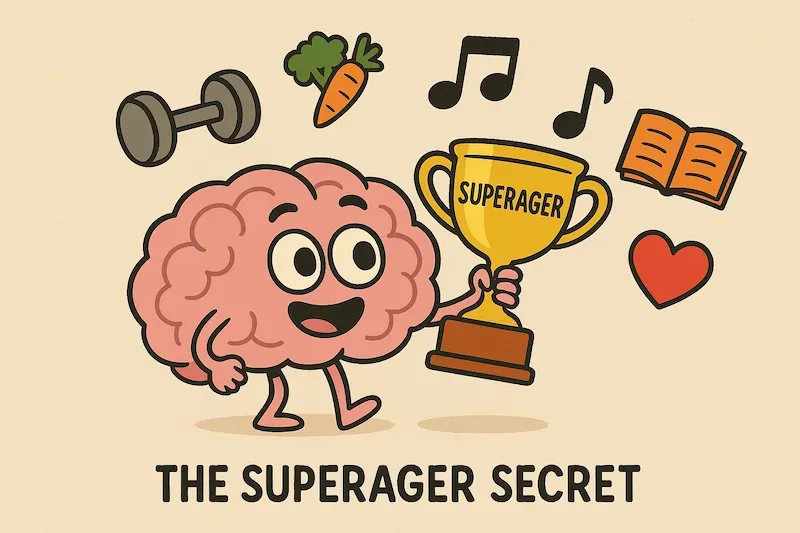
That person has a name in science: a superager. Let’s unpack what makes them tick, what their brains look like, and how you can steal the most practical parts of their routine right now.
A story you might recognize
Meet Rosa. She is 82, volunteers twice a week, takes a short dance class, and has a calendar full of coffee dates. She tells a story once and never repeats the details out of order. Her doctor runs standard cognitive tests and Rosa scores like someone decades younger.
Is Rosa a unicorn? Not exactly. She is rare, but she shows us what can go right in the aging brain.
What is a superager
In research programs, superagers are people 80 and older who score like folks in their 50s or 60s on tough memory tests, and who perform at least age-appropriately in other thinking skills. Roughly one in ten healthy older adults qualify under strict criteria. The point is not exclusivity. It is a blueprint.
What their brains reveal
Brain scans paint a clear picture.
- Thicker “control hubs.” Regions like the anterior cingulate cortex stay robust. These areas support attention, motivation, and social engagement, which matches how superagers live.
- Preserved memory circuit. Hippocampus and friends hold up better, and they shrink more slowly with time. This looks like resilience, not just a lucky head start.
- Movement matters. Faster gait speed and strong physical function show up again and again in superagers. The brain loves a body that moves.
- Calmer mood terrain. Lower anxiety and depression scores are common. Mental health is not a side quest. It is part of the circuitry.
Under the microscope, you see hints of less tangling from harmful proteins, sturdier memory cells, and fewer inflammatory signals in key pathways. Translation for daily life: the system stays tidy and responsive.
So is it genes or habits
The honest answer: likely both. Some people may start life with protective wiring. Others seem to build buffers through how they live, connect, move, and challenge their brains. No single road gets you there, which is good news. It means you have options.
The “Superager Stack” you can start this month
You do not need a lab. You need a short list you will actually do. Pick three to five and commit.
1) Move like your memory depends on it
- Aim for 150 minutes a week of moderate activity plus two sessions of strength. Short, brisk walks count. If you can add light balance or dance, even better.
- Use the talk test. Slightly breathless but still able to speak in short phrases.
2) Guard your sleep window
- Most brains run best with 7 to 9 hours in bed, same schedule daily.
- Get morning light within an hour of waking. Dim lights in the hour before bed. Tired brains learn poorly.
3) Train attention, not just trivia
- Do one task at a time. Give it full focus for 20 to 30 minutes.
- Try simple attention drills: read aloud for two minutes, then summarize from memory. Or learn a short poem. Focus is the doorway to memory.
4) Learn out loud and with your hands
- Take a class that forces new skills: language, instrument, woodworking, coding, drawing.
- Combine movement + cognition. Dance steps, tai chi, or pickleball challenge timing, balance, and recall.
5) Build a social calendar on purpose
- Schedule two meaningful interactions per week. Coffee with a friend. Volunteer hour. Club meeting.
- Join groups where you are a beginner. Superagers often score high on warm, trusting relationships and engagement. The brain likes people.
6) Protect mood like you protect blood pressure
- Treat anxiety and depression early. Therapy, peer groups, exercise, sunlight, and sleep hygiene all help.
- If your moods are heavy or persistent, talk to your clinician. Mental health is brain health.
7) Eat for vessels and microbes
- Think Mediterranean pattern: plants, legumes, nuts, fish, olive oil, fermented foods.
- Keep blood pressure, lipids, and glucose in range. Healthy vessels = steady brain supply.
8) Make movement speed your vital sign
- Do a 10-meter brisk walk once a week. Count seconds. Try to shave a half second over a month.
- Add sit-to-stand repeats for 30 seconds. Legs are brain pumps.
A 14-day “Superager Sprint” to try
Week 1
- Fixed sleep and wake times, morning light daily
- 10 minutes brisk walking after two meals
- One new social touchpoint on the calendar
- One focused learning block, 20 minutes, three times this week
Week 2
- Add two short strength sessions: simple squats, wall push-ups, sit-to-stands
- Swap one refined carb for beans or whole grains
- One fermented food daily: yogurt, kefir, kimchi, or miso
- Repeat the learning block and do a quick recall test at the end
Track energy, mood, and one memory task, like recalling three items you set in the morning. You will feel the difference.
What about supplements and brain games
Pills that promise memory boosts rarely deliver on real-world function. If you have a documented deficiency, treat it. Otherwise invest in sleep, movement, social learning, and vascular health. As for brain games, they train the game. Choose skills that transfer: languages, music, complex hobbies, and anything that mixes memory with movement.
When to check in with a clinician
- New or worsening memory problems that disrupt daily tasks
- Word-finding trouble that is increasing
- Depression, anxiety, or sleep issues that linger
- Vascular risks not at goal: blood pressure, cholesterol, blood sugar
- Snoring with daytime sleepiness or unrefreshing sleep
Early evaluation helps you target the right levers and rule out fixable causes.
The takeaway
Superagers show us that sharp memory in late life is possible. Their brains are thicker in the right places, their bodies move, their moods are steadier, and their calendars hum with people and purpose. You do not need perfect genetics to borrow their playbook. You need a handful of consistent, boring habits that compound into something remarkable.
This article is for education only and isn't a substitute for advice from your own doctor. If something feels off, talk to your care team.