Can you get cirrhosis without drinking? Yes, you can. Fatty liver and hepatitis B or C (two viruses that infect the liver) can each leave a liver hard and badly scarred, and that’s what cirrhosis is [1]. Autoimmune disease (your immune system attacking your own liver), inherited iron or copper overload, and some medicines or supplements can too, whether or not you’ve ever had a drink [1]. Fatty liver on its own affects about 37% of American adults, so odds are you know someone with it [2].
The short version
- The non-alcohol cause most people miss? Fatty liver tied to weight, blood sugar and cholesterol. Its new name is MASLD, a mouthful that boils down to metabolic fatty liver disease.
- Hepatitis B and C can hide for decades. That’s why the CDC (the US Centers for Disease Control and Prevention) wants every adult tested for both at least once.
- Don’t wait to feel sick. In one national survey, 69% of people with cirrhosis didn’t know they had it [3].
The grandma who got me writing this
“Cute innocent grandma with end stage cirrhosis liver disease, how can that be?”
That’s the message I sent my team, word for word. She didn’t match the picture most people carry around of cirrhosis.
End-stage means the liver is so badly damaged it stops working, which doctors also call liver failure [4].
If you’re picturing a heavy drinker, I get it. That’s the image most of us grew up with, and alcohol really is a common cause [1]. But “only heavy drinkers get cirrhosis” is a myth. Cirrhosis isn’t a judgment on how someone lived, and plenty of its causes have nothing to do with a glass of wine.
What causes cirrhosis besides alcohol?
So what is cirrhosis, exactly? It’s what’s left after long-term damage: scar tissue where healthy liver used to be [4]. Picture a road crew patching the same stretch of highway, year after year, until there’s more patch than road. Almost any liver disease that keeps doing damage long enough can get there [1].
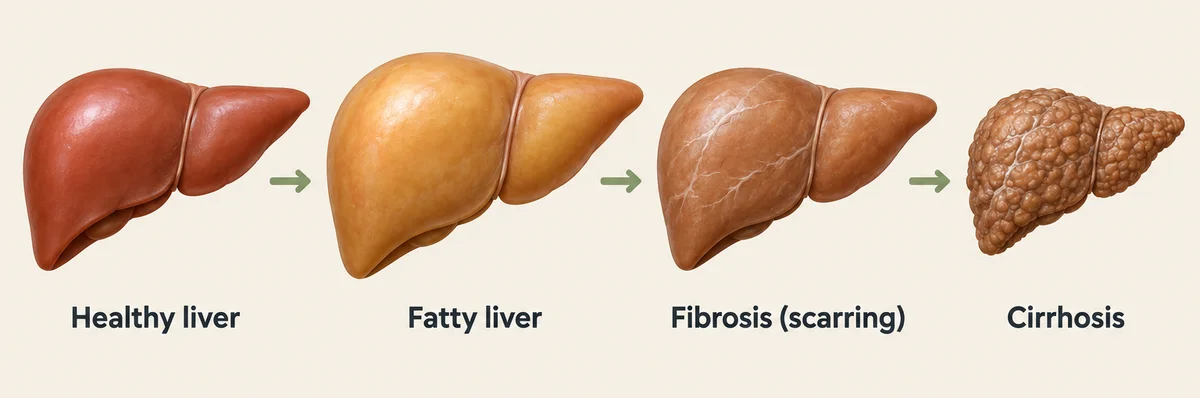
Without alcohol, five main groups of causes can get a liver there [1]. Fatty liver and the hepatitis viruses are the ones you’ve probably heard of. The other three get less airtime: an immune system that turns on the liver or its bile ducts (the little drainpipes for bile), inherited iron or copper overload, and certain medicines and supplements.
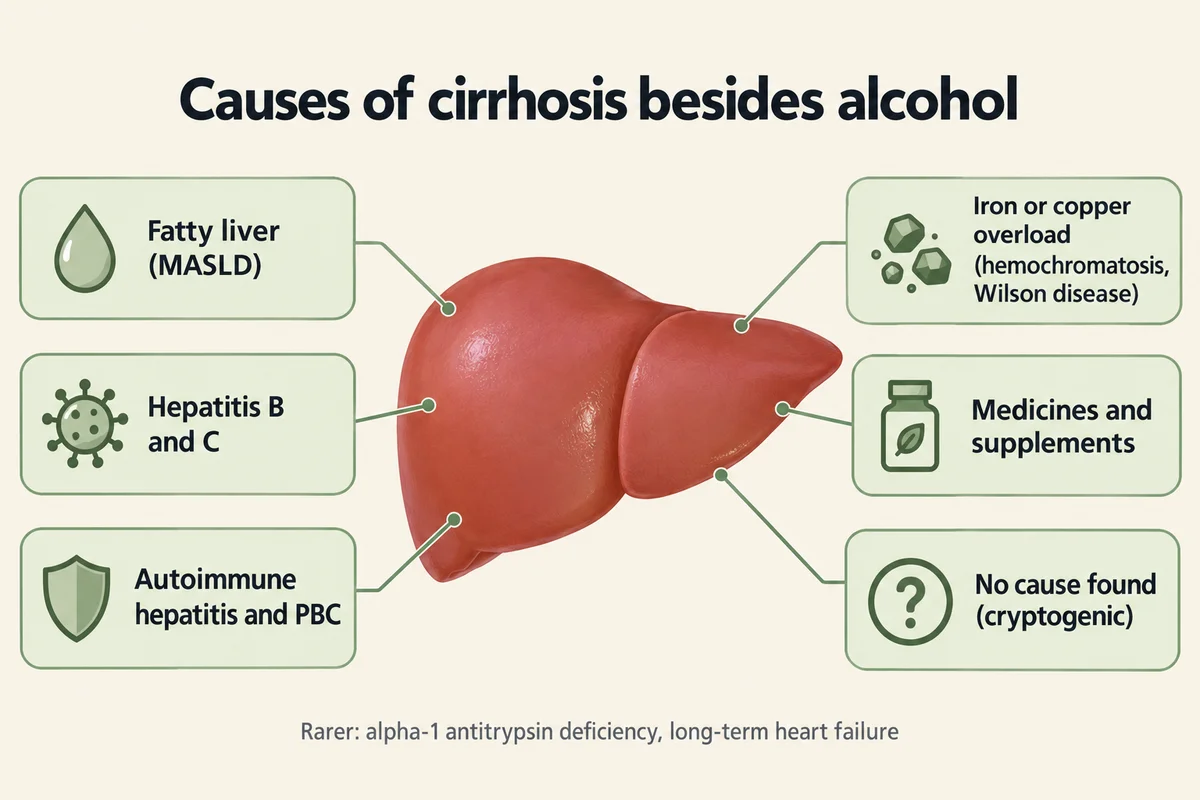
A couple of rarer ones round out the list. Alpha-1 antitrypsin deficiency is an inherited shortage of a protein that protects the lungs and liver. And long-term heart failure can back blood up into the liver, the way a clogged drain backs water up the pipe [1].
Fatty liver: the cause most people miss
You may know it by its old initials, NAFLD, short for non-alcoholic fatty liver disease. In 2023, the major liver societies renamed it MASLD, short for metabolic dysfunction-associated steatotic liver disease (steatotic just means fatty). Try saying that three times fast. Why bother renaming it? It’s partly about stigma: 61% of the experts polled found “nonalcoholic” stigmatizing, and 66% felt that way about “fatty” [5].
To have MASLD, you need fat in the liver plus at least one metabolic risk factor [6]. Is your waist on the large side, or your blood sugar creeping up? Those count. So do high blood pressure, high triglycerides (a type of fat in your blood) and a low HDL (high-density lipoprotein, the “good” cholesterol) on your cholesterol panel [6]. Once that fat inflames the liver, it’s called MASH. Same mouthful, except the H is for steatohepatitis, a fatty liver that’s also inflamed.
Most people with it don’t feel a thing [7]. No pain, no warning light on the dashboard. That’s the trap.
Here’s the number that speaks to my grandma question. It’s right in the US liver experts’ 2023 guidance: MASH cirrhosis is already the top reason for liver transplants in women and in people over 65 [7].
Where alcohol still fits
Don’t pour alcohol on top of a fatty liver. There’s even a new label, MetALD, for people with MASLD who drink more than light amounts [5]. Your doctor should ask how much you drink, and once there’s real scarring, you’re told to stop completely [7]. My own view? Alcohol is literally a poison. For what it does further down the gut, read Cheers or Tears? How Alcohol Quietly Fuels GI Cancers.
What actually helps a fatty liver
Weight loss is still the main tool. Lose 3-5% of your weight and liver fat drops, though it usually takes more than 10% to calm MASH and the scarring [7]. If you weigh 200 pounds, 10% is 20 pounds. One study followed 293 people with MASH for a year [8]. Of those who lost 10% or more, 90% saw the inflammation clear and 45% saw their scarring improve [8].
Like your morning coffee? Three or more cups a day, regular or decaf, goes with less advanced liver disease [7]. That’s a link, not proof, so nobody’s writing you a prescription for espresso.
And there’s medicine now, too. The FDA (the US Food and Drug Administration) has approved two for MASH with moderate to advanced scarring that hasn’t reached cirrhosis: resmetirom (Rezdiffra) in 2024, and the weight-loss drug semaglutide (Wegovy) in 2025, each used with diet and exercise [9][10][11]. Gutsavi has no ties to either company. Neither one is approved once it’s cirrhosis [9][11]. One more reason to catch it early.
Hepatitis C and B: years without a peep
Hepatitis C is a virus you get through blood. More than 2.4 million Americans had it in 2017-2020, most with no symptoms at all [12]. And in a national survey, only about 56% of people with it had ever been told [13]. It’s a slow leak behind the drywall. Left alone, hepatitis C scars the liver slowly, and within 10 to 20 years, roughly 5-25% of those with long-term infection get cirrhosis [12].
The upside? It’s curable. A course of pills, usually 8 to 12 weeks, cures more than 95% of people [12][13].
Don’t count on hepatitis B to announce itself, either. Somewhere between 580,000 and 2.4 million people in the US live with it, and two thirds might not know [14]. It isn’t curable. Still, medicine, regular checkups and liver cancer screening cut the risk of serious harm [14].
Autoimmune hepatitis and PBC: mostly women
With autoimmune hepatitis, your immune system, the body’s security crew, turns on your own liver. It can start at any age, and 71-95% of adults who get it are women [15]. Many already have cirrhosis by the time they’re diagnosed [15]. Caught in time, treatment with steroids (strong anti-inflammatory medicines) and azathioprine, a pill that calms the immune system, can prevent or even reverse liver damage in many people [16].
Primary biliary cholangitis (PBC) slowly wears away the tiny bile ducts inside the liver, the tubes that carry bile (a digestive juice) out. Women get it about four times as often as men, mostly in middle age [17]. Tired and itchy? Those are its two most common symptoms, and they’re easy to shrug off. Yet about 60% of people find out before they feel anything, often from a routine blood test [18]. If you’re diagnosed, a daily medicine called ursodiol can slow the damage [19].
Iron and copper: born with it, found late
Hemochromatosis makes your body hoard iron, like a pack rat. About 1 in 15 people of Northern European ancestry carry one copy of the main gene change [20]. Don’t expect symptoms before 40. In women they tend to come about 10 years later than in men, often after menopause, once monthly periods stop shedding iron [20]. And the treatment? It’s removing blood on a schedule, a lot like donating it [21].
Wilson disease traps copper in the liver and brain. It’s rare, about 1 in 30,000 by older estimates. You’d expect it in someone between 5 and 40, but doctors have seen first symptoms in adults over 70 [22]. Between 35% and 45% of people diagnosed already have cirrhosis [22].
Medicines and supplements: “natural” isn’t a safety rating
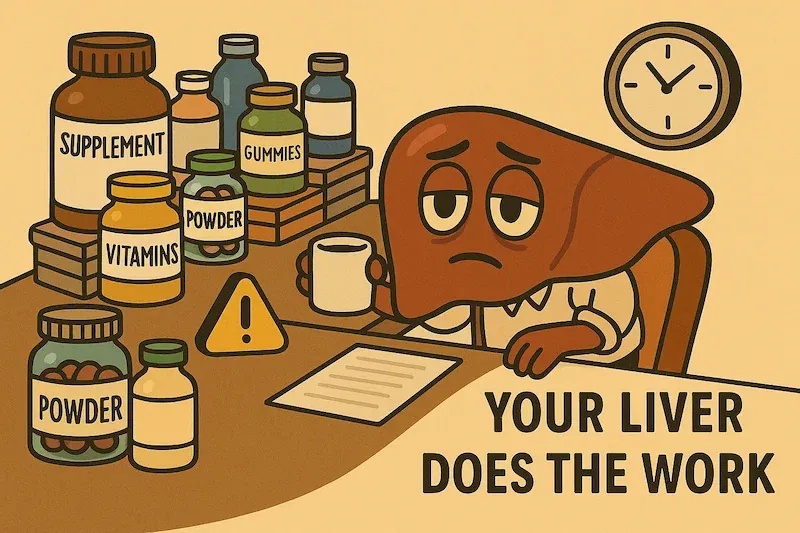
In the West, drug-related liver injury most often comes from infection drugs like antibiotics, herbal and dietary supplements, or some cancer drugs [23]. It can be as quiet as an odd blood test or as loud as jaundice (yellowing of the skin and eyes) and liver failure [23]. Some cases don’t go away, and linger as long-term hepatitis [23]. Long-term use of certain medicines, or high daily doses of vitamin A, can lead to cirrhosis [1].
“Natural” on the label tells you where it came from. It tells you nothing about what it does to your liver. In a US research network on liver injury, herbs and supplements went from 7% to 20% of cases over about a decade [24]. And who had the most serious injuries? Mostly middle-aged women, taking supplements that weren’t for bodybuilding [24]. Those cases ended in death or a transplant more often than injuries from prescription drugs: 13% versus 3% [24].
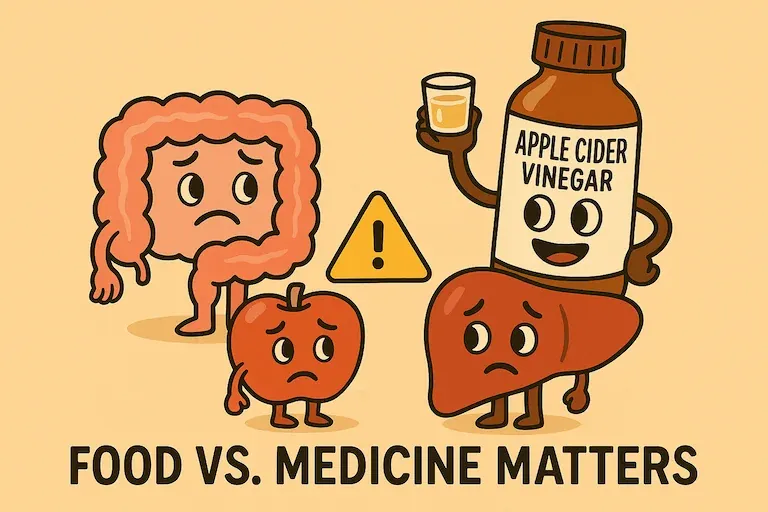
Tell your doctor about every pill, powder and tea you take. We’ve gone deeper on this in Your Liver Isn’t a Filter Fairy, and in the story of an apple cider vinegar habit that hurt one woman’s liver.
When nobody can find the cause
What if every test comes back clean? About 5-10% of cirrhosis has no cause anyone can find. Doctors call it cryptogenic cirrhosis, from the Greek for “hidden origin,” and gene testing is starting to crack some of these cases [25]. Sometimes “we don’t know yet” is the honest answer.
Why cirrhosis is found so late
Early on, you may have no symptoms at all [1]. Often they don’t show up until the liver is badly damaged [1]. Until then, the liver keeps doing its job with what’s left. It’s a short-staffed factory that still gets the orders out the door.
When symptoms come, they’re easy to blame on getting older. Feeling tired or weak? A poor appetite, some nausea, itchy skin, a few pounds gone without trying [1]? That’s how a grandmother can reach end-stage disease before anyone says the word cirrhosis. And that’s why, in the national survey I mentioned, 69% of Americans with cirrhosis didn’t know [3].
Who should get checked?
Let’s start with two blood tests. If you’re 18 or older, the CDC says you should be tested once for hepatitis C, and once for hepatitis B with a three-part panel that checks for current infection, past infection and immunity [12][14]. You don’t have to explain why you want them [13][14]. Just ask.
For fatty liver, US guidelines suggest a risk check if any of these fit you [2][7]:
- You have type 2 diabetes.
- Obesity plus another metabolic problem, such as high blood pressure.
- Two or more metabolic risk factors.
- A scan showed fat in your liver, or a blood test showed raised liver enzymes (proteins that leak into your blood when liver cells are hurt).
- Has anyone in your family had cirrhosis?
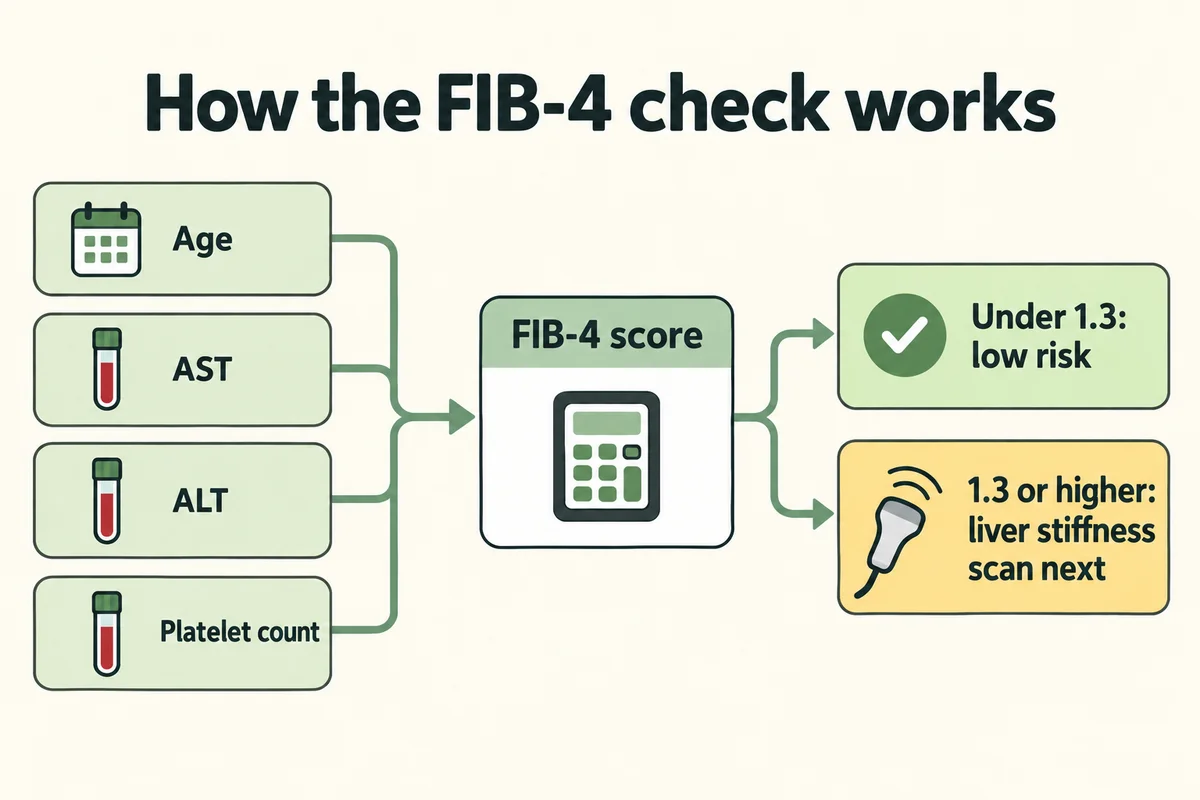
The usual first step is FIB-4 (short for fibrosis-4, fibrosis being the doctor’s word for scarring), a score worked out from your age, two liver enzymes (AST and ALT, short for aspartate and alanine aminotransferase) and your platelet count, the clotting cells in your blood [7]. It’s just math on a regular blood draw. Under 1.3, your risk is low [7]. Above that, you’ll likely get a liver stiffness scan next, which works much like an ultrasound [7].
Say you barely drink, and you’ve got scarring or odd liver tests anyway. Let’s figure out why. I usually start with blood tests for hepatitis B and C, iron and autoimmune markers (blood signs that the immune system may be going after the liver), then a liver stiffness scan.
When to call your doctor
Call soon if you notice:
- Your eyes or skin turn yellow, or your urine looks like tea.
- Swelling in your belly, legs or ankles.
- Bruising from almost nothing? Mention it.
- Itching that’s severe and won’t let up.
Vomiting blood, or bleeding from your bottom? Get emergency help right away. Do the same for new confusion or a change in alertness in someone with liver disease [26].
Frequently asked questions
Is cirrhosis always from alcohol?
How many years does it take to develop cirrhosis?
Usually many years, since it forms after long-term liver damage [1][4]. Take hepatitis C: about 5-25% of people get cirrhosis over 10 to 20 years [12]. Some causes don’t show until the scarring’s already there. Many people with autoimmune hepatitis, and 35-45% with Wilson disease, have cirrhosis at diagnosis [15][22].
Can you recover from non-alcoholic cirrhosis?
If it’s caught early, scarring can get better. In one study, 45% of people with MASH who lost 10% or more of their weight saw it improve [8]. Once it’s cirrhosis, the goal changes: treat the cause, keep it from getting worse, and watch for complications such as liver cancer [7]. Curing hepatitis C or treating autoimmune hepatitis can protect what’s left [12][16].
How long can you live with cirrhosis if you don’t drink?
That depends on the stage you’re in. Early on, before complications, many people feel nothing at all [1]. Once complications appear, the outlook gets worse. That’s why it pays to treat the cause early. Ask your liver doctor where you stand; your blood tests and scans will tell you both.
Get the next one in your inbox
Want Dr. Ted’s take on questions like this one? Join the Gutsavi newsletter, or browse more of his explainers on the Learn page.
Sources
- National Institute of Diabetes and Digestive and Kidney Diseases (NIDDK). Symptoms & causes of cirrhosis. niddk.nih.gov
- Kanwal F, Shubrook JH, Adams LA, et al. Clinical care pathway for the risk stratification and management of patients with nonalcoholic fatty liver disease. Gastroenterology. 2021;161(5):1657-69. doi:10.1053/j.gastro.2021.07.049
- Scaglione S, Kliethermes S, Cao G, et al. The epidemiology of cirrhosis in the United States: a population-based study. J Clin Gastroenterol. 2015;49(8):690-6. doi:10.1097/MCG.0000000000000208
- NIDDK. Definition & facts for cirrhosis. Reviewed June 2023. niddk.nih.gov
- Rinella ME, Lazarus JV, Ratziu V, et al. A multisociety Delphi consensus statement on new fatty liver disease nomenclature. Hepatology. 2023;78(6):1966-86. doi:10.1097/HEP.0000000000000520
- American Association for the Study of Liver Diseases (AASLD). New MASLD nomenclature. aasld.org
- Rinella ME, Neuschwander-Tetri BA, Siddiqui MS, et al. AASLD practice guidance on the clinical assessment and management of nonalcoholic fatty liver disease. Hepatology. 2023;77(5):1797-1835. doi:10.1097/HEP.0000000000000323
- Vilar-Gomez E, Martinez-Perez Y, Calzadilla-Bertot L, et al. Weight loss through lifestyle modification significantly reduces features of nonalcoholic steatohepatitis. Gastroenterology. 2015;149(2):367-78. doi:10.1053/j.gastro.2015.04.005
- US Food and Drug Administration. FDA approves first treatment for patients with liver scarring due to fatty liver disease. March 14, 2024. fda.gov
- AASLD. AASLD applauds FDA approval of first GLP-1 therapy for MASH, expanding use of popular weight loss drug to liver disease. August 19, 2025. aasld.org
- Novo Nordisk. Wegovy (semaglutide) injection: FDA-approved prescribing information. DailyMed, US National Library of Medicine. Updated June 30, 2026. dailymed.nlm.nih.gov
- Centers for Disease Control and Prevention (CDC). Clinical overview of hepatitis C. cdc.gov
- Schillie S, Wester C, Osborne M, et al. CDC recommendations for hepatitis C screening among adults, United States, 2020. MMWR Recomm Rep. 2020;69(2):1-17. doi:10.15585/mmwr.rr6902a1
- Conners EE, Panagiotakopoulos L, Hofmeister MG, et al. Screening and testing for hepatitis B virus infection: CDC recommendations, United States, 2023. MMWR Recomm Rep. 2023;72(1):1-25. doi:10.15585/mmwr.rr7201a1
- NIDDK. Definition & facts for autoimmune hepatitis. niddk.nih.gov
- NIDDK. Treatment for autoimmune hepatitis. niddk.nih.gov
- NIDDK. Definition & facts for primary biliary cholangitis. niddk.nih.gov
- NIDDK. Symptoms & causes of primary biliary cholangitis. niddk.nih.gov
- NIDDK. Treatment for primary biliary cholangitis. niddk.nih.gov
- NIDDK. Definition & facts for hemochromatosis. niddk.nih.gov
- Kowdley KV, Brown KE, Ahn J, Sundaram V. ACG clinical guideline: hereditary hemochromatosis. Am J Gastroenterol. 2019;114(8):1202-18. doi:10.14309/ajg.0000000000000315
- NIDDK. Definition & facts for Wilson disease. niddk.nih.gov
- Chalasani NP, Maddur H, Russo MW, et al. ACG clinical guideline: diagnosis and management of idiosyncratic drug-induced liver injury. Am J Gastroenterol. 2021;116(5):878-98. doi:10.14309/ajg.0000000000001259
- Navarro VJ, Barnhart H, Bonkovsky HL, et al. Liver injury from herbals and dietary supplements in the U.S. Drug-Induced Liver Injury Network. Hepatology. 2014;60(4):1399-408. doi:10.1002/hep.27317
- Nalbantoglu I, Jain D. Cryptogenic cirrhosis: old and new perspectives in the era of molecular and genomic medicine. Semin Diagn Pathol. 2019;36(6):389-94. doi:10.1053/j.semdp.2019.07.003
- MedlinePlus (US National Library of Medicine). Cirrhosis. Medical Encyclopedia. medlineplus.gov
This article is for education only and isn’t medical advice. Talk with your own doctor about your care.
This article is for education only and isn't a substitute for advice from your own doctor. If something feels off, talk to your care team.