
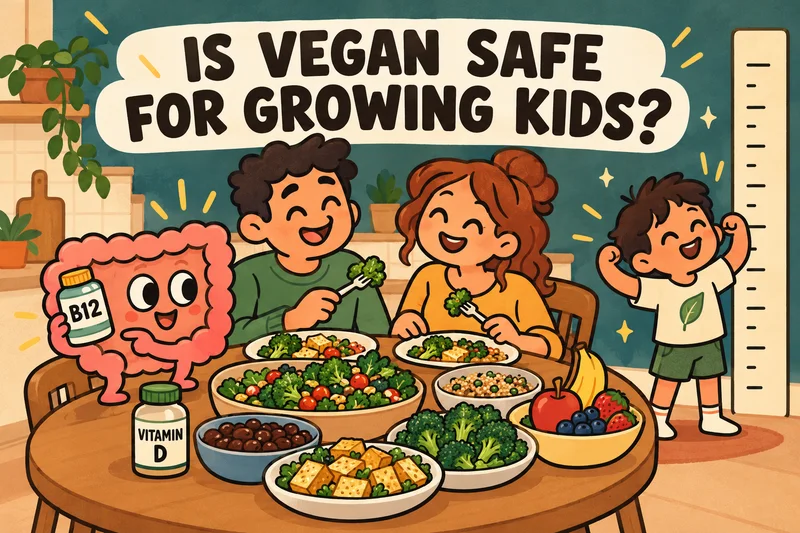
Is a vegan diet safe for kids? Yes, it can be. But somebody in the house has to run the plan. Growing kids need B12 every day, no exceptions, and someone has to keep tabs on vitamin D, iodine, iron, zinc, calcium and plain old calories. Leave those to chance and the risks are real, especially for babies and toddlers [3][5].
If you read nothing else
- B12 isn’t optional. No plant food makes it, so it comes from a supplement or fortified foods [9].
- Vegan kids in studies run a bit shorter and leaner, with better cholesterol. The gap the big review flags for vegan kids, low B12, is one supplements fix [6][8].
- Get your pediatrician and a dietitian in on it early. Watch the growth chart.
Your family, your call. I just want the kids growing
Look, I’m not going to talk anybody out of eating vegan. Some families do it for their health, some for the animals or the planet, plenty for all of it. My job is narrower. I want your kids growing on schedule while you do it.
Kids aren’t small adults. An adult who runs low on B12 for a year might feel wiped out. A young child who runs low can end up with nerve damage that doesn’t fully come back [5]. Same vitamin, much higher stakes.
Where the big medical groups land
They don’t fully agree, and you’ll see both sides quoted online.
In North America, the Academy of Nutrition and Dietetics says a well-planned vegan diet works at every age, infancy and childhood included [1]. It adds, right in the same statement, that vegans need a reliable B12 source [1].
Europe sounds more cautious. The German Nutrition Society used to advise against vegan diets for children outright. In its 2024 update it says there isn’t enough data to recommend for or against, and strongly recommends counseling from a qualified nutrition expert [2]. ESPGHAN (the European society for children’s gut, liver and nutrition doctors) says vegan diets for babies need medical or dietitian supervision, and that parents should understand the serious consequences of skipping supplements [3]. A French group of pediatric gut and nutrition specialists says B12 and vitamin D supplements are always necessary [4].
My read? They’re closer than the headlines make it sound. Nobody serious says “go for it, wing it.” And nobody says it can’t be done. All of them say plan it, supplement it and keep an eye on it.
What the studies on vegan kids actually show
The research is thinner than any of us would like. A 2024 review pooled 18 studies and rated the certainty of the evidence low or very low across the board [7]. So take these numbers as a sketch, not a verdict.
The most detailed study looked at 187 children aged 5 to 10 in Poland, 52 of them vegan [6]. Compared with kids who ate meat:
- Vegan kids were shorter, about 3 cm (just over an inch) on average [6][18].
- They had less bone mineral, about 4% less across the body and almost 6% less in the lower spine, even after accounting for size [6].
- On the heart side they came out ahead: LDL, the “bad” cholesterol, ran 24 mg/dL lower [6].
- More of them were short on B12 or iron, and more had iron-deficiency anemia, where iron runs so low the body can’t make enough red blood cells [6].
The part I’d underline: in that study, supplements fixed the low B12 and low vitamin D [6].
A bigger 2025 analysis of 59 studies, with 1,289 vegan children in the mix, found the same pattern [8]. Vegan kids were leaner and a little shorter, ate notably little calcium, and had lower cholesterol. Most group averages still sat inside normal ranges for kids, but the odds of B12 deficiency were higher [8].
So it’s a trade. Better heart numbers, more nutrient gaps. The gaps are the part you can do something about.
The nutrients a growing vegan kid can’t skip
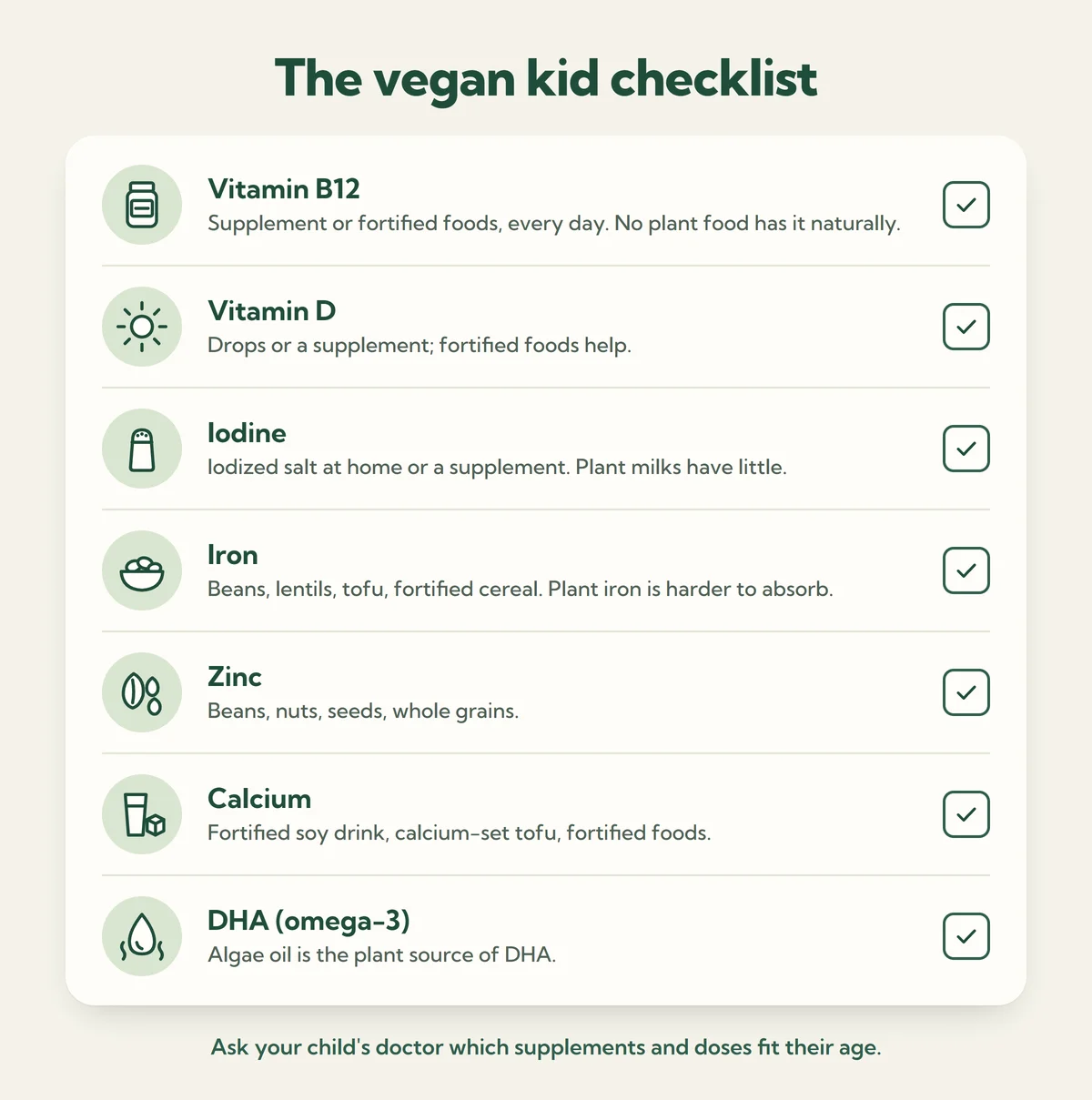
Vitamin B12: the one you never gamble on
B12 isn’t naturally present in plant foods at all [9]. Some foods have it added, like many breakfast cereals and nutritional yeast [9]. How much? From 0.4 micrograms a day for a young baby up to adult amounts by the teen years [9]. Drops, chewable, fortified cereal: which one, and how much, I’d hash out with your pediatrician. Standing in the vitamin aisle anyway? Here’s how supplement labels play tricks on you.
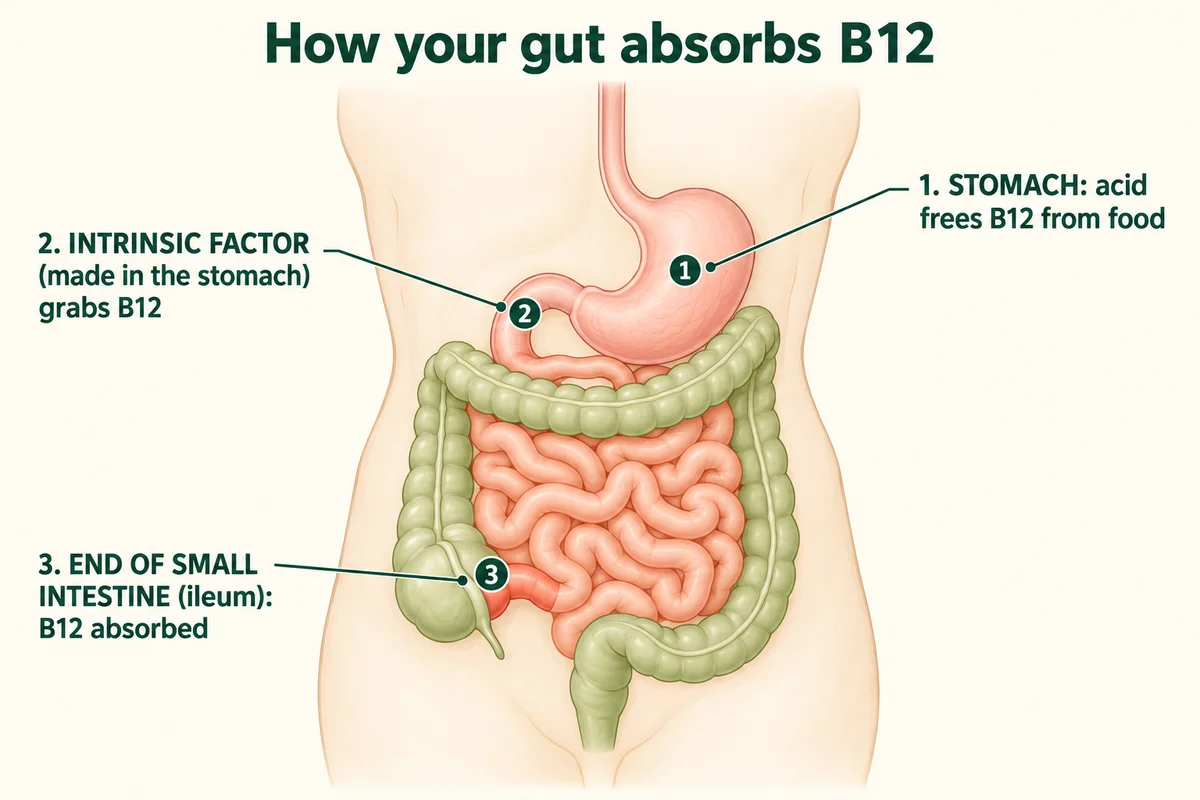
Now the gut doctor part, since this is my turf. B12 takes a long trip. Stomach acid pries it loose from food. Then it hooks up with intrinsic factor, a protein your stomach makes, and the pair rides all the way down to the ileum, the last stretch of the small intestine, before it gets absorbed [9]. That’s a lot of gut that has to work right, and none of it helps if the B12 was never in the meal or the vitamin to begin with.
Breastfeeding on a vegan diet? Then mom’s B12 matters too. Babies of vegan mothers are one of the groups at risk of running low [9].
Vitamin D
Kids need 400 to 600 IU a day, depending on age [13]. Deficiency is more common on a vegan diet [13], and most Americans get theirs from fortified foods like milk [13]. The French pediatric group calls a vitamin D supplement always necessary for vegan kids [4].
Iodine
This one sneaks up on families. Iodine feeds a child’s developing brain, and even milder shortfalls in kids are linked to somewhat lower IQ scores [10]. Vegans may not get enough [10]. Soy and almond drinks have only small amounts, and packaged foods almost never use iodized salt [10].
What about seaweed? The iodine in it swings wildly, from about 16 to almost 3,000 micrograms per gram [10]. One sheet might give your kid too little and the next way too much. So no, seaweed isn’t an iodine plan. Use iodized salt when you cook, or a supplement your doctor chooses.
Iron and zinc
Plants carry iron in a form that’s harder to absorb, so vegetarians need more of it than meat eaters [11]. What else is on the plate matters too: vitamin C and phytates (compounds in whole grains and beans) both change how much plant iron gets in [11]. Beans, nuts, vegetables and iron-fortified breads and cereals are where plant iron comes from [11].
Zinc runs into the same absorption problem [12]. It also matters for growth. A real shortfall can slow a child’s growth [12]. Beans, nuts, seeds and whole grains are the plant sources [12].
Calcium
Kids need anywhere from 200 to 1,300 mg a day, climbing with age [16]. Vegan kids in studies eat noticeably less of it [7][8]. Some plants lock their calcium up so the gut can’t get much of it [16]. That’s where fortified plant drinks and calcium-set tofu come in.
DHA (an omega-3 fat)
Fish don’t make DHA. They get it from algae [14]. That means a vegan family can skip the middleman: algae-oil supplements usually give 100 to 300 mg of DHA, and in a small study the body took it up as well as DHA from cooked salmon [14]. The French pediatric group suggests DHA case by case, along with iron, calcium and zinc [4].
A belly full of beans isn’t always a fed kid
Here’s a problem nobody warns you about. Plant food is bulky. Fiber is great for an adult gut (I’ve written a whole piece on it), but a toddler only has so much room. Strict vegan diets can leave small kids short on calories because the food is low in energy and high in bulk [17]. Some vegan kids eat up to three times the fiber the American Academy of Pediatrics suggests as a maximum [17]. Too much fiber can also get in the way of absorbing some nutrients [5].
So pack the calories in. Soy foods, nuts and nut butters help [17], and so do avocado and cooking oils. I’d rather see a vegan toddler eating peanut butter toast and avocado than a third bowl of broccoli. The broccoli’s fine. It just can’t be the whole meal.
Babies and toddlers: the highest-stakes years
The younger the child and the stricter the diet, the bigger the risk [5]. A few hard lines:
- Under 12 months, plant drinks (soy, oat, almond, rice) aren’t a substitute for breast milk or formula [15].
- From 1 to 5, a plant drink shouldn’t fully replace dairy milk unless there’s a medical reason or a family choice like veganism, and then only with your doctor in the loop [15].
- Doctors still report cases of malnutrition and lasting nerve damage from B12 deficiency in kids who weren’t supplemented [5]. That’s the scenario all of this is meant to prevent.
How I’d set up a vegan family
None of this means you need a lab in your kitchen. It means a plan.
- Tell your pediatrician the whole family eats vegan. Don’t let it come up by accident at the 2-year checkup.
- Book a registered dietitian, ideally one who works with kids, when you start or when a baby starts solids [2][3].
- B12 and vitamin D go in from day one. Not next month [4].
- I’d ask for a blood check of B12, ferritin (your iron reserve) and vitamin D once. Repeat it if your kid seems off.
- Eyeball that growth chart at every visit, because the Canadian pediatricians want growth followed closely [17].
- At home? Iodized salt in the pot. Fortified plant drink in the fridge. Calcium-set tofu a couple of nights a week, peanut butter within reach.
Out of dinner ideas? Chef Savi can turn what’s in your pantry into a recipe in seconds.
When to call your child’s doctor
Don’t wait on these:
- Pale, wiped out, no energy for the playground [9]
- Falling off the growth curve at a checkup, or not gaining weight [17]
- Is your baby or toddler missing milestones, or losing skills they already had? Call that week [5][9].
- A sore, red tongue along with being tired. That combination can go with low B12 [9].
- Breastfeeding on a vegan diet and you haven’t been taking B12 yourself
Frequently asked questions
Can a vegan diet stunt a child’s growth?
A little, on average. In one Polish study the vegan kids stood about 3 cm shorter and carried less fat [6][18]. The bigger 2025 analysis still found most growth and nutrient averages inside normal ranges for kids [8]. The serious harm in case reports has come from diets that weren’t planned or supplemented [5]. That’s why the growth chart at each checkup matters so much.
Do vegan kids need supplements?
Yes. B12 for sure, since no plant food has it naturally [9]. Vitamin D too, per a French pediatric nutrition group [4]. Beyond those two, look at what your kid really eats. One child gets enough iodine, iron, zinc, calcium and DHA from fortified foods, another needs a supplement [4][10]. The right dose depends on age, and that’s a job for a doctor or dietitian.
Is a vegan diet safe for toddlers?
It’s the riskiest age to get it wrong. Toddlers can fill up on bulky plant food before they get enough calories [17], and they’re growing fast. Can it work? It can. Cover B12 and vitamin D, serve lots of calorie-dense food, pick a fortified plant drink with your doctor [15] and get a dietitian on board.
Can vegan kids get enough protein?
Most of them, as long as beans, lentils, soy, nuts or seeds turn up every day. On average they still eat less protein than kids who eat meat [7]. Picky eater who’d live on plain pasta if you let them? Watch that one closer.
Raising vegan kids, one plate at a time
Hunting for dinners your kids won’t push away? Chef Savi can help. Our Learn hub has more, there’s a whole piece on fiber and your gut, and the Gutsavi newsletter brings new ones to your inbox.
Sources
- Melina V, Craig W, Levin S. Position of the Academy of Nutrition and Dietetics: vegetarian diets. J Acad Nutr Diet. 2016;116(12):1970-80. doi:10.1016/j.jand.2016.09.025
- Klug A, Barbaresko J, Alexy U, et al. Update of the DGE position on vegan diet: position statement of the German Nutrition Society (DGE). Ernährungs Umschau. 2024;71(7). ernaehrungs-umschau.de
- Fewtrell M, Bronsky J, Campoy C, et al. Complementary feeding: a position paper by the European Society for Paediatric Gastroenterology, Hepatology, and Nutrition (ESPGHAN) Committee on Nutrition. J Pediatr Gastroenterol Nutr. 2017;64(1):119-32. doi:10.1097/MPG.0000000000001454
- Lemale J, Mas E, Jung C, Bellaiche M, Tounian P; GFHGNP. Vegan diet in children and adolescents. Recommendations from the French-speaking Pediatric Hepatology, Gastroenterology and Nutrition Group (GFHGNP). Arch Pediatr. 2019;26(7):442-50. doi:10.1016/j.arcped.2019.09.001
- Kiely ME. Risks and benefits of vegan and vegetarian diets in children. Proc Nutr Soc. 2021;80(2):159-64. doi:10.1017/S002966512100001X
- Desmond MA, Sobiecki JG, Jaworski M, et al. Growth, body composition, and cardiovascular and nutritional risk of 5- to 10-y-old children consuming vegetarian, vegan, or omnivore diets. Am J Clin Nutr. 2021;113(6):1565-77. doi:10.1093/ajcn/nqaa445
- Koller A, Rohrmann S, Wakolbinger M, et al. Health aspects of vegan diets among children and adolescents: a systematic review and meta-analyses. Crit Rev Food Sci Nutr. 2024;64(33):13247-58. doi:10.1080/10408398.2023.2263574
- Lotti S, Panizza G, Martini D, et al. Lacto-ovo-vegetarian and vegan diets in children and adolescents: a systematic review and meta-analysis of nutritional and health outcomes. Crit Rev Food Sci Nutr. 2026;66(13):2453-73 (online 2025). doi:10.1080/10408398.2025.2572983
- NIH Office of Dietary Supplements. Vitamin B12: fact sheet for health professionals. ods.od.nih.gov
- NIH Office of Dietary Supplements. Iodine: fact sheet for health professionals. ods.od.nih.gov
- NIH Office of Dietary Supplements. Iron: fact sheet for health professionals. ods.od.nih.gov
- NIH Office of Dietary Supplements. Zinc: fact sheet for health professionals. ods.od.nih.gov
- NIH Office of Dietary Supplements. Vitamin D: fact sheet for health professionals. ods.od.nih.gov
- NIH Office of Dietary Supplements. Omega-3 fatty acids: fact sheet for health professionals. ods.od.nih.gov
- Healthy Eating Research. Healthy beverage consumption in early childhood: recommendations from key national health and nutrition organizations (Academy of Nutrition and Dietetics, American Academy of Pediatrics, American Academy of Pediatric Dentistry, American Heart Association). 2019. aapd.org (PDF)
- NIH Office of Dietary Supplements. Calcium: fact sheet for health professionals. ods.od.nih.gov
- Amit M; Canadian Paediatric Society. Vegetarian diets in children and adolescents. Paediatr Child Health. 2010;15(5):303-8. PMC2912628
- University College London. Vegan diets in children may bring heart benefits but pose growth risks. UCL News, June 2021. ucl.ac.uk
This article is for education only and isn’t medical advice. Talk with your own doctor about your care.
This article is for education only and isn't a substitute for advice from your own doctor. If something feels off, talk to your care team.