
Med Opinion: Dr. Ted’s personal view on a healthcare issue, backed by the evidence below. Agree or disagree? Tell us in the comments.
Are GLP-1 drugs safe? If you’re in the group these weight-loss and diabetes medicines were tested in, the results look strong. In the big trials, adults with obesity lost about 15% to 21% of their body weight [1][2]. Got heart disease? One of these drugs cut heart attacks, strokes and heart deaths [3]. Step outside those trials, though, and the questions get a lot harder.
The short version
- Over a million US adults with no recorded diabetes or qualifying obesity got a GLP-1 prescription from 2021 to 2025, and a third of them had a normal weight [4].
- You can buy them online, at a medical spa, or as copies the FDA (the US Food and Drug Administration) hasn’t reviewed [9][10].
- Expect an upset stomach at first. A few gut problems are rarer and serious, and they’re worth knowing by name [7].
- So, is this the new anabolic steroid, the lab-made testosterone some people take to bulk up? I’ve laid out the case for and against. You make the call, then tell me where you land.
Why I asked the steroid question
I sent my team one line about it: “Are GLP-1s … the modern day anabolic steroid hidden in plain sight?”
Let me be clear about the target. My worry isn’t the medicines. It’s how some people are using them: to change how they look, and often without their doctor in the loop.
So what could a diabetes shot and a muscle-building steroid have in common? Start with how anabolic steroids get used. Most people take them for looks or performance, not to treat a disease [8]. They’re often bought outside normal medical care [11], and plenty of users never mention them to a doctor [11].
Do GLP-1 medicines fit that pattern? Partly, going by the evidence. Unlike steroids taken for looks, though, these are real medicines with big trials behind them. That’s the fair place to start.
What GLP-1 medicines do well
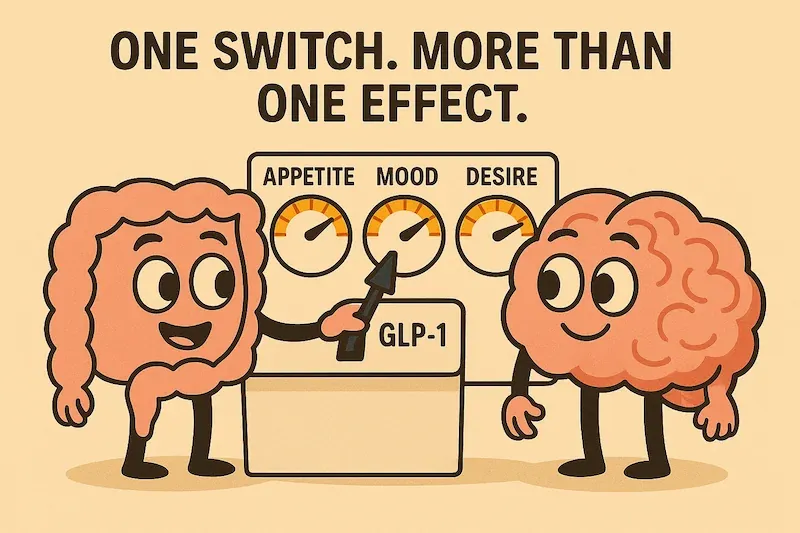
GLP-1 is short for glucagon-like peptide-1, which is why nobody says the long version. The drugs copy this gut hormone, which tells your brain you’re full and slows how fast your stomach empties [7]. In other words, they turn up the volume on your gut’s own “that’s enough” message. The stomach part is why they land in my lane as a gastroenterologist.
What do the big trials show? Trial names apparently have to sound like a gym poster: STEP, SURMOUNT, SELECT, SUSTAIN.
- STEP 1 put almost 2,000 adults with obesity or overweight on semaglutide, a GLP-1 drug, as a weekly shot for 68 weeks. They lost 14.9% of their weight on average, against 2.4% on placebo, a dummy shot [1].
- Tirzepatide copies GLP-1 plus a second gut hormone. In SURMOUNT-1 it went further: up to 20.9% at the highest dose after 72 weeks [2].
- SELECT was the big heart trial. It followed 17,604 people with heart disease and extra weight, but no diabetes, for over three years. Heart attacks, strokes or heart deaths hit 6.5% on semaglutide and 8.0% on placebo [3].
- Have type 2 diabetes and high heart risk? The SUSTAIN-6 trial found a similar drop there, 6.6% versus 8.9% [5].
Who are they approved for? This is where the brand names come in, because semaglutide is sold under two of them, for different jobs. Ozempic is approved for type 2 diabetes, not weight loss [6]. Wegovy is the weight version, for adults with obesity, or overweight plus a weight-related condition like high blood pressure [7].
Now notice who’s missing. Those trials only took people with a BMI (body mass index, a weight-for-height score) of at least 27 or 30 [1][2]. At a normal weight and hoping to drop a few pounds? Nobody studied you.
Where the steroid comparison fits
Taking it for the mirror
How common is use outside the label, meaning for reasons the FDA didn’t approve? A 2026 study of electronic health records looked at 92 million adults with no diabetes and no qualifying obesity on file [4]. More than 1.1 million of them were prescribed a GLP-1 drug, and that rate rose 15-fold from 2021 to 2025. About 35% had a normal BMI. And 85% were women.
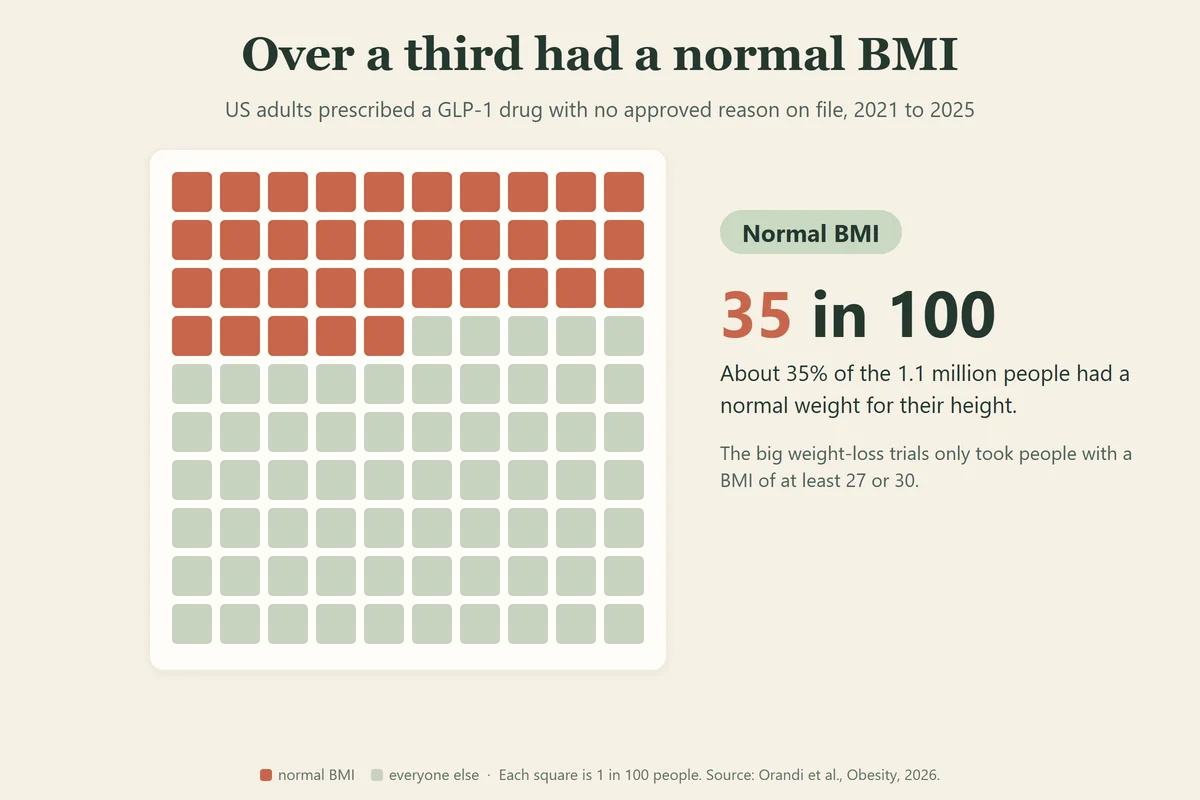
The authors are careful here. Records can miss a diagnosis, and they don’t say why a drug was prescribed [4]. Their bottom line is still worth quoting: “The risk-benefit profile in these populations remains uncertain.” And eating disorders? They showed up six times as often in the people prescribed one, 1.8% versus 0.3% [4].
Getting it outside regular care
If you’re on one, odds are your own doctor prescribed it. That was true for about 76% of users in a 2025 poll by KFF, a health policy research group [9]. But 17% got them from an online provider, and 9% from a medical spa or aesthetic center [9].
Then there’s the gray market. The FDA has found counterfeit Ozempic in the US supply [10]. What you buy illegally may hold the wrong ingredient, the agency warns, or too much, too little, or none at all. It’s the same deal as brake pads sold out of a car trunk: the box can say whatever it wants. Some are labelled “for research purposes” or “not for human consumption,” and they get sold to people anyway [10]. That label isn’t fooling anybody, the sellers included.
What about compounded versions? Pharmacies mix these themselves. They aren’t FDA-approved, so nobody at the FDA checks their safety, quality or dose before you get them [10]. By May 2026, the agency had about 990 adverse event reports (reports of possible harm) for compounded semaglutide and more than 730 for compounded tirzepatide. Some came from dosing mistakes that put people in the hospital [10]. And the agency says that’s likely an undercount.
Keeping it from your doctor
With steroids, we’ve got numbers. In one study of weightlifters, 56% of steroid users had never told any doctor, and 40% trusted their dealer’s advice at least as much as a physician’s [11].
For GLP-1s, I couldn’t find good data on how many people leave them off their medication list. So before any scope, a camera exam of the gut, I ask about them directly.
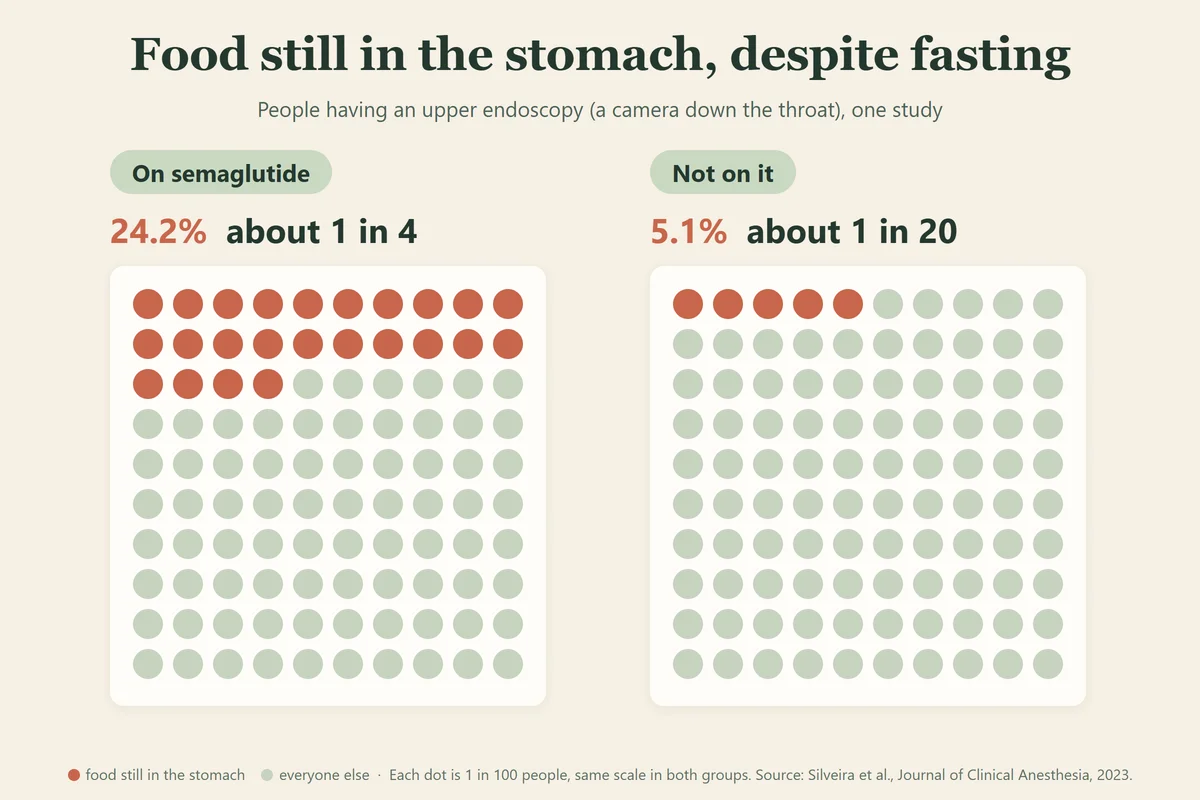
Here’s why that matters in my world. These drugs slow your stomach down, the way a sink drains slower with the stopper half closed. In one study of upper endoscopies, where the camera goes down your throat into the stomach, food was still sitting in the stomach in 24.2% of people on semaglutide, against 5.1% of everyone else, despite fasting [12]. If you’re sedated, that food can end up in your lungs. It’s rare, but the FDA label lists it and tells you to mention the drug before any procedure [7].
You can probably keep taking it before a scope or surgery, under 2024 guidance from five medical societies [13]. At higher risk of stomach side effects? You may be asked to drink only liquids for 24 hours first. Your care team can only plan for that if they know you’re on it.
Where the comparison breaks down
Now let me argue against my own question. Steroids taken for looks can lead to early heart attacks, strokes, liver tumors and kidney failure [8]. In the right patients, GLP-1 medicines did the opposite for the heart [3][5].
Muscle runs the other way, too. Steroids build it. On a GLP-1 drug, part of what you lose is lean mass, meaning muscle, organs and water. That’s anywhere from about 15% to as much as 60% of the weight lost, depending on the study [14]. One expert review argues the muscle change mostly matches what you’d expect from the weight you drop. If you’re older, you have less to spare [14].
Can you get hooked? By one estimate, about 32% of people who misuse steroids become dependent [8]. For GLP-1s there’s only a reporting signal so far: FDA safety reports flagged “drug abuse” and use without a prescription more often for semaglutide than for other GLP-1 drugs [16]. Worth watching. Not proof of addiction.
And when you stop? In the STEP 4 trial, everyone took semaglutide for 20 weeks, then some were quietly switched to a dummy shot. Over the next 48 weeks, the switched group gained back 6.9% of their body weight, while the ones who stayed on it lost another 7.9% [15]. Want to keep the benefit? You’ll likely need to stay on treatment. A thermostat holds the room’s temperature only while it’s switched on, and these drugs behave much the same.
What these drugs do to your gut
Now we’re on my turf. In the weight-loss trials behind Wegovy, 44% of people had nausea, against 16% on placebo [7]. Vomiting was four times as common (24% versus 6%), and constipation about doubled [7].
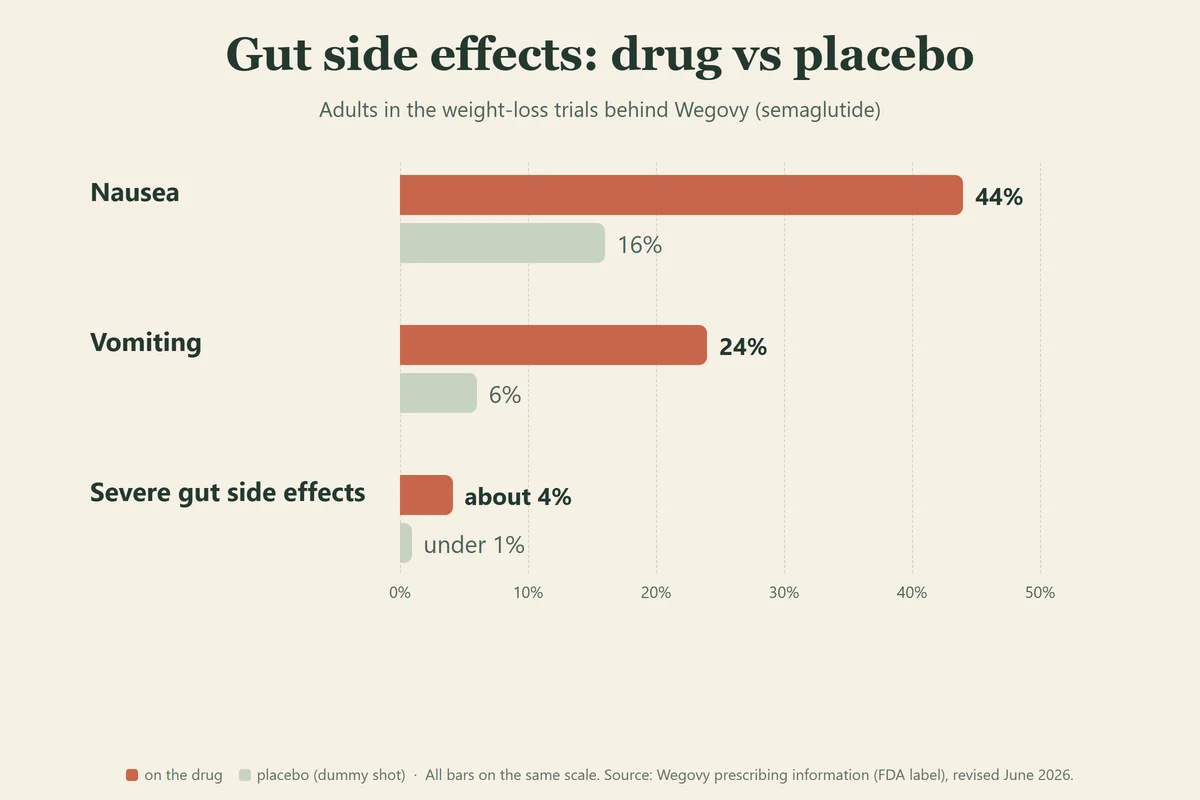
Most of that isn’t severe. Still, about 4% had severe GI (gut) side effects, against under 1% on placebo, and roughly 7% quit the drug over side effects of some kind [7].
The rarer problems are the ones that need a doctor:
- Gallbladder. Gallstones showed up in 1.6% on the drug and 0.7% on placebo [7]. A review of 76 trials found the risk climbs with higher doses, longer use, and when it’s used for weight loss [18].
- Pancreatitis, an inflamed pancreas, is on the label too. It can be severe, though that’s rare [7].
- A stalled gut. In a 2023 insurance-claims study, people taking GLP-1s for weight loss had a higher rate of gastroparesis, a slow-emptying stomach, than people on another weight-loss pill. That’s about 9 cases per 1,000 people a year on semaglutide, versus 3 [17]. Pancreatitis and bowel blockage were more common too. All of it was rare, though, and a study like this can’t prove the drug caused it.
In my clinic, nausea and constipation are what I hear about most from people on these drugs.
Some side effects aren’t in the gut at all. I’ve written separately about how these drugs can change sex drive. See our abdominal pain and bloating guide for everyday bloating and belly pain.
Questions worth arguing about
I’d like this to start an argument, the polite kind. Here are five questions worth turning over, each with a case on both sides:
- Who should prescribe them? A doctor who knows your history can screen for gallbladder disease, thyroid cancer in the family, or pregnancy plans [7]. The FDA tells you to be wary of online sellers that skip screening [10]. Then again, online care reaches people who can’t get an appointment.
- Should anyone at a normal weight get one? In that 2026 study, over a third of people prescribed one without a clear indication (an approved medical reason) weren’t overweight at all [4], and no big trial tested the drugs in that group [1][2]. Is that your call to make, or a line doctors shouldn’t cross?
- Compounded or nothing? Compounded versions can cost you less, and that matters when 56% of users say the drugs are hard to afford [9]. But the FDA doesn’t check them first [10].
- Is it a lifelong drug? If you stop, the weight tends to come back [15]. Should you hear that up front, the way you would for a blood pressure pill?
- Should telling your doctor be non-negotiable? It changes how we’d plan your scope or surgery [7][13]. Most steroid users in that study never told a doctor [11]. Will GLP-1 users be any different?
Tell me in the comments. Which question would you answer first? Are you on one, and did your doctor know before your last procedure?
When to call your doctor
If you take a GLP-1 medicine, don’t sit on these. Call your doctor if you have:
- belly pain that’s severe or won’t go away, especially if it spreads to your back. Pancreatitis can feel like that [7].
- Pain in the upper right belly, with fever or yellow skin or eyes? That can be your gallbladder.
- vomiting you can’t stop, or no fluids staying down, since dehydration from GI side effects has led to kidney injury [7]
- Bloated, vomiting, and no bowel movement or gas? Get checked for a blockage [7].
- a lump in your neck, trouble swallowing, or hoarseness that won’t go away [7]
- a pregnancy, or plans for one. The label says to stop the drug [7].
Planning a scope, surgery or anything with sedation? Tell the team you take it, even if it came from a website.
Frequently asked questions
Is long-term use of GLP-1 drugs harmful?
So far, the longest outcome trial, the kind that counts heart attacks and strokes instead of pounds, doesn’t suggest that. SELECT followed people for a little over three years and found fewer heart attacks and strokes, not more [3]. That’s still short next to a drug you might take for decades. Since weight tends to come back after stopping [15], long-term use is often the plan. So work out with your doctor how you’ll be monitored.
What happens if you take a GLP-1 and don’t need it?
We don’t know well, because the big trials only included people with obesity, overweight plus a condition, or diabetes [1][2][5]. You’d still face the same side effects, like nausea, constipation and gallstones [7]. A 2026 study called the risk-benefit balance in people without an approved reason “uncertain” [4].
Why do people stop taking GLP-1s?
Are compounded GLP-1s safe?
You can’t be sure, because they aren’t FDA-approved and nobody checks their safety, quality or dose before you get them [10]. The FDA has hundreds of adverse event reports, some from dosing mistakes that led to hospital stays [10]. If you use one, get it with a prescription from a state-licensed pharmacy, and measure every dose carefully.
Want the next Med Opinion?
Join the Gutsavi newsletter for more evidence-checked takes, gut health first. Got a question about your own medicines? Send it through Ask Dr. Ted, or browse more on the Gutsavi blog.
Sources
- Wilding JPH, Batterham RL, Calanna S, et al. Once-weekly semaglutide in adults with overweight or obesity. N Engl J Med. 2021;384(11):989-1002. doi:10.1056/NEJMoa2032183
- Jastreboff AM, Aronne LJ, Ahmad NN, et al. Tirzepatide once weekly for the treatment of obesity. N Engl J Med. 2022;387(3):205-16. doi:10.1056/NEJMoa2206038
- Lincoff AM, Brown-Frandsen K, Colhoun HM, et al. Semaglutide and cardiovascular outcomes in obesity without diabetes. N Engl J Med. 2023;389(24):2221-32. doi:10.1056/NEJMoa2307563
- Orandi BJ, Yan L, Levan ML, et al. Trends in GLP-1 receptor agonist prescribing without an apparent FDA-approved indication. Obesity (Silver Spring). 2026. doi:10.1002/oby.70301
- Marso SP, Bain SC, Consoli A, et al. Semaglutide and cardiovascular outcomes in patients with type 2 diabetes. N Engl J Med. 2016;375(19):1834-44. doi:10.1056/NEJMoa1607141
- Novo Nordisk. Ozempic (semaglutide) injection: prescribing information. DailyMed. dailymed.nlm.nih.gov
- Novo Nordisk. Wegovy (semaglutide) injection and tablets: prescribing information. Revised June 2026. DailyMed. dailymed.nlm.nih.gov
- National Institute on Drug Abuse. Anabolic steroids and other appearance and performance enhancing drugs (APEDs). nida.nih.gov
- KFF. Poll: 1 in 8 adults say they are currently taking a GLP-1 drug for weight loss, diabetes or another condition, even as half say the drugs are difficult to afford. November 14, 2025. kff.org
- US Food and Drug Administration. FDA’s concerns with unapproved GLP-1 drugs used for weight loss. Updated October 2026. fda.gov
- Pope HG, Kanayama G, Ionescu-Pioggia M, Hudson JI. Anabolic steroid users’ attitudes towards physicians. Addiction. 2004;99(9):1189-94. doi:10.1111/j.1360-0443.2004.00781.x
- Silveira SQ, da Silva LM, de Campos Vieira Abib A, et al. Relationship between perioperative semaglutide use and residual gastric content: a retrospective analysis of patients undergoing elective upper endoscopy. J Clin Anesth. 2023;87:111091. doi:10.1016/j.jclinane.2023.111091
- Kindel TL, Wang AY, Wadhwa A, et al. Multisociety clinical practice guidance for the safe use of glucagon-like peptide-1 receptor agonists in the perioperative period. Clin Gastroenterol Hepatol. 2025;23(12):2083-5. doi:10.1016/j.cgh.2024.10.003. Summary: gastro.org
- Neeland IJ, Linge J, Birkenfeld AL. Changes in lean body mass with glucagon-like peptide-1-based therapies and mitigation strategies. Diabetes Obes Metab. 2024;26(Suppl 4):16-27. doi:10.1111/dom.15728
- Rubino D, Abrahamsson N, Davies M, et al. Effect of continued weekly subcutaneous semaglutide vs placebo on weight loss maintenance in adults with overweight or obesity: the STEP 4 randomized clinical trial. JAMA. 2021;325(14):1414-25. doi:10.1001/jama.2021.3224
- Chiappini S, Vickers-Smith R, Harris D, et al. Is there a risk for semaglutide misuse? Focus on the Food and Drug Administration’s FDA Adverse Events Reporting System (FAERS) pharmacovigilance dataset. Pharmaceuticals (Basel). 2023;16(7):994. doi:10.3390/ph16070994
- Sodhi M, Rezaeianzadeh R, Kezouh A, Etminan M. Risk of gastrointestinal adverse events associated with glucagon-like peptide-1 receptor agonists for weight loss. JAMA. 2023;330(18):1795-7. doi:10.1001/jama.2023.19574
- He L, Wang J, Ping F, et al. Association of glucagon-like peptide-1 receptor agonist use with risk of gallbladder and biliary diseases: a systematic review and meta-analysis of randomized clinical trials. JAMA Intern Med. 2022;182(5):513-9. doi:10.1001/jamainternmed.2022.0338
This Med Opinion is Dr. Ted’s personal view. It’s for education only and isn’t medical advice. Don’t start, stop or change a medicine without talking to your own doctor.
This article is for education only and isn't a substitute for advice from your own doctor. If something feels off, talk to your care team.