
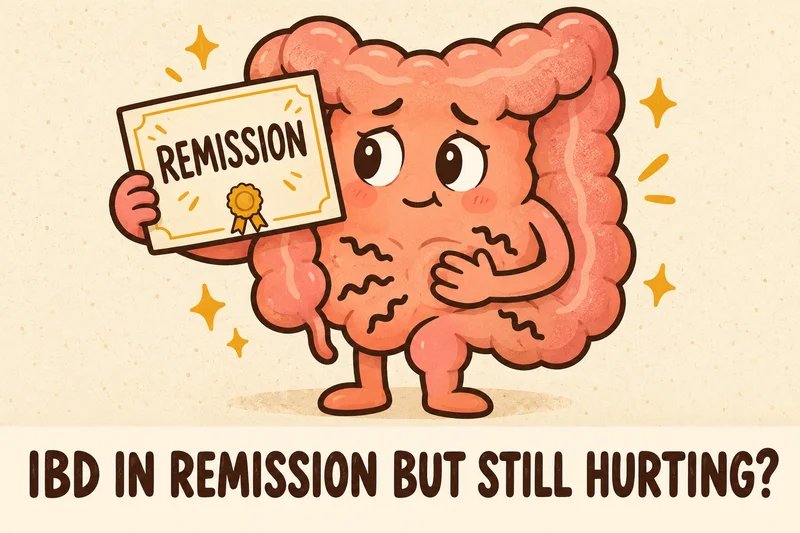
IBD in remission but still have symptoms? Researchers have counted this many times, and the answer keeps coming out the same: roughly a third of people whose Crohn’s or colitis (the two main types of inflammatory bowel disease) is officially quiet still get the cramps, the urgency, the bloating, the extra bathroom trips [2][4]. Often it isn’t a flare, meaning the inflammation coming back. It’s IBS-like symptoms, the kind irritable bowel syndrome causes, sitting on top of quiet IBD. And those, you can treat.
Short on time? Here’s the gist
- First we make sure nothing is still inflamed. That’s a stool test and bloodwork, maybe a drug level or a scope (a camera look inside), plus a look for a few other culprits.
- If everything is quiet, more IBD medicine usually won’t fix it. IBS treatments will.
- These symptoms feel scary, but a 6-year study found they weren’t linked to more flares, steroids or surgery [21].
Can you have IBS and IBD at the same time?
Yes. Having inflammatory bowel disease (IBD) doesn’t get you a free pass on irritable bowel syndrome (IBS). You can have both, and one doesn’t cancel out the other. It’s a super fascinating topic to discuss with patients.
Pool 33 studies and more than 4,000 people in remission, and about 30% have symptoms that fit IBS [4]. What about people whose scope showed a fully healed lining? Still close to 1 in 4. It’s a bit more common in Crohn’s disease than in ulcerative colitis [2]. Older studies that counted everyone with IBD, flaring or not, put the figure closer to 4 in 10 [1].
Your doctor may call it “IBD with IBS-like symptoms.” In 2026, the Rome Foundation (the group behind the official IBS criteria) and the International Organization for the Study of IBD (IOIBD) published joint recommendations on how to sort it out [4]. Expert groups don’t team up over a question nobody asks.
A patient I saw recently
A patient who has lived with Crohn’s for many years came to see me convinced he was flaring. He had diarrhea and belly discomfort, the same feelings he remembered from his worst years.
So we checked everything. His level of biologic, a targeted IBD drug given by shot or drip, was where it should be. His blood count was normal. His inflammation markers (the lab numbers that climb when the gut is inflamed), in both blood and stool, were normal.
He didn’t believe me at first. Who would? When you’ve lived through real flares, your body’s alarm system remembers. But his inflammation was quiet. Here’s how I put it to him: it feels like inflammatory bowel disease, but it’s probably IBS. Which is the better news, since IBS has treatments that make the symptoms better.
Why would a healed gut keep acting up?
Remission means the fire is out. It doesn’t mean somebody reset the smoke alarm. Ever had one that shrieks every time you make toast? No fire, just a jumpy alarm. A gut that spent years inflamed can act a lot like that.
What keeps it jumpy? Often it’s a few of these at once:
- Nerves stuck on high alert. Picture a volume knob cranked up during the bad years that never came back down. A little gas, a normal squeeze of the bowel, and it hurts like something’s wrong.
- Some days you’re racing to the bathroom and other days nothing moves, because your gut never found its old pace again.
- And yes, your brain. After a few close calls, you start mapping every bathroom on the way to work, and all that watching feeds the symptoms. People with IBS-like symptoms in IBD have higher rates of anxiety and depression, and a lower quality of life [2][20]. That’s not “all in your head.” It’s the gut and brain talking to each other.
- Old damage, in Crohn’s, can stay behind. Scarring or narrowing from past inflammation causes symptoms without any active disease.
Chicken or egg? Sometimes IBS was there first and IBD showed up later. For treatment, that matters less than what’s driving your symptoms today.
Flare or IBS? How we find out
Don’t skip this part. Miss real inflammation and the IBD gets worse. Treat inflammation that isn’t there and you take on drug risks for no benefit. The 2026 recommendations specifically warn against stepping up IBD medicine without objective proof of inflammation [4].
You know how your gut feels; the tests show what’s going on inside it. We need both. Here’s how we sort it out:
- Your symptoms. Running to the bathroom at 3 a.m., a fever, weight dropping off, blood: those make me think inflammation. Trouble after a big meal or a rough week that settles once you’ve gone? That leans IBS. Still, symptoms alone can fool any doctor, so we test.
- Fecal calprotectin. Yes, it’s a stool sample. Nobody’s favorite errand, but it beats a camera. The lab looks for a protein that white blood cells release into the gut when it’s inflamed. If you feel well, a result below about 150 µg/g, with a normal CRP (C-reactive protein) blood test, rules out active inflammation without a scope [5][6]. Got symptoms, even mild ones? Then the stool and blood tests can’t settle it on their own, so a scope or scan often comes next [5][6]. Infections and some medicines (like ibuprofen, or acid-lowering pills called proton pump inhibitors, or PPIs) can raise it, and it can miss disease limited to the small bowel, meaning the small intestine [4][8].
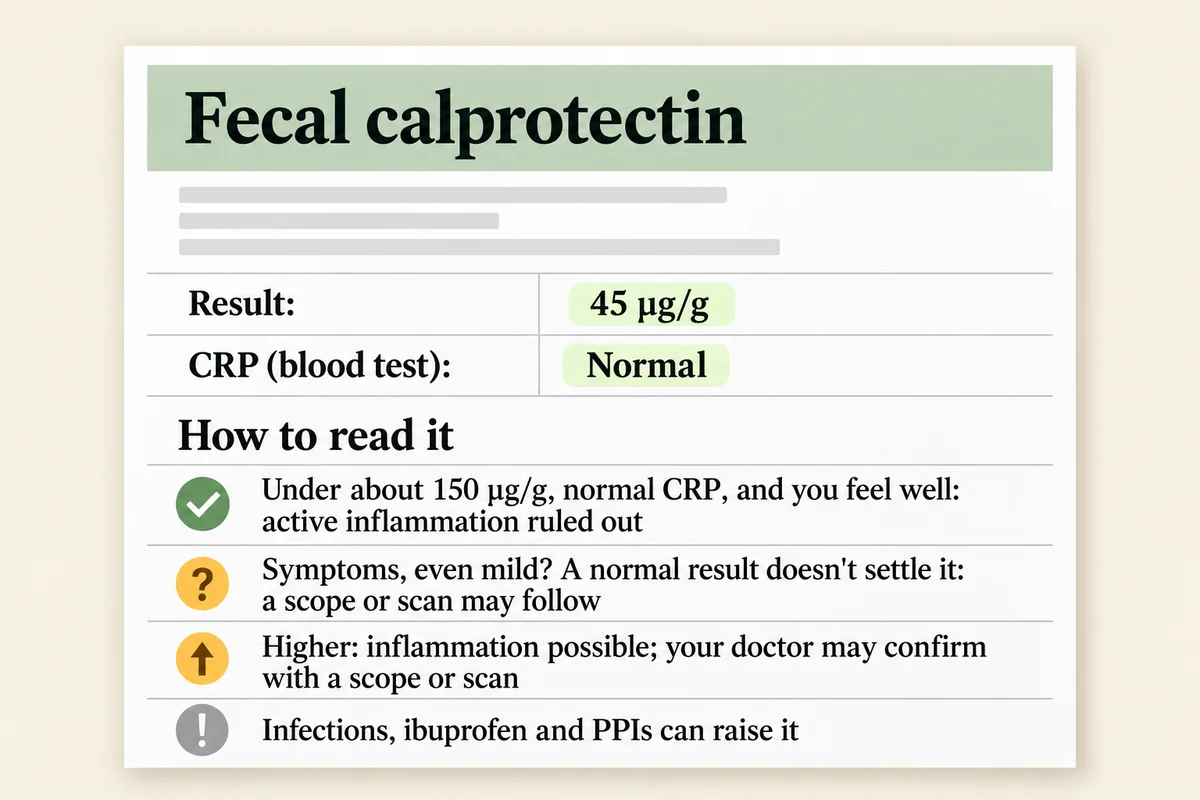
- CRP. This blood test picks up inflammation anywhere in your body. Useful, but about 15% of people don’t raise CRP even during a real flare [4].
- Drug levels. If you take a biologic, we can measure how much drug is in your blood and whether your body has made antibodies against it, the immune system’s way of tagging the drug as an intruder [7][8]. That tells us whether the medicine itself is still doing its job.
- Stool tests for infection. New diarrhea gets checked for infections, including C. difficile, a gut infection often set off by antibiotics [4][13].
- A scope or imaging. A colonoscopy (a camera exam of the colon) with biopsies (tiny tissue samples) is still the final word. For Crohn’s in the small bowel, we may use an MRI, CT, or bowel ultrasound, scans that show the bowel wall without a camera.
Before anyone says “IBS”: the look-alikes
One more step, because a few look-alikes have their own fixes:
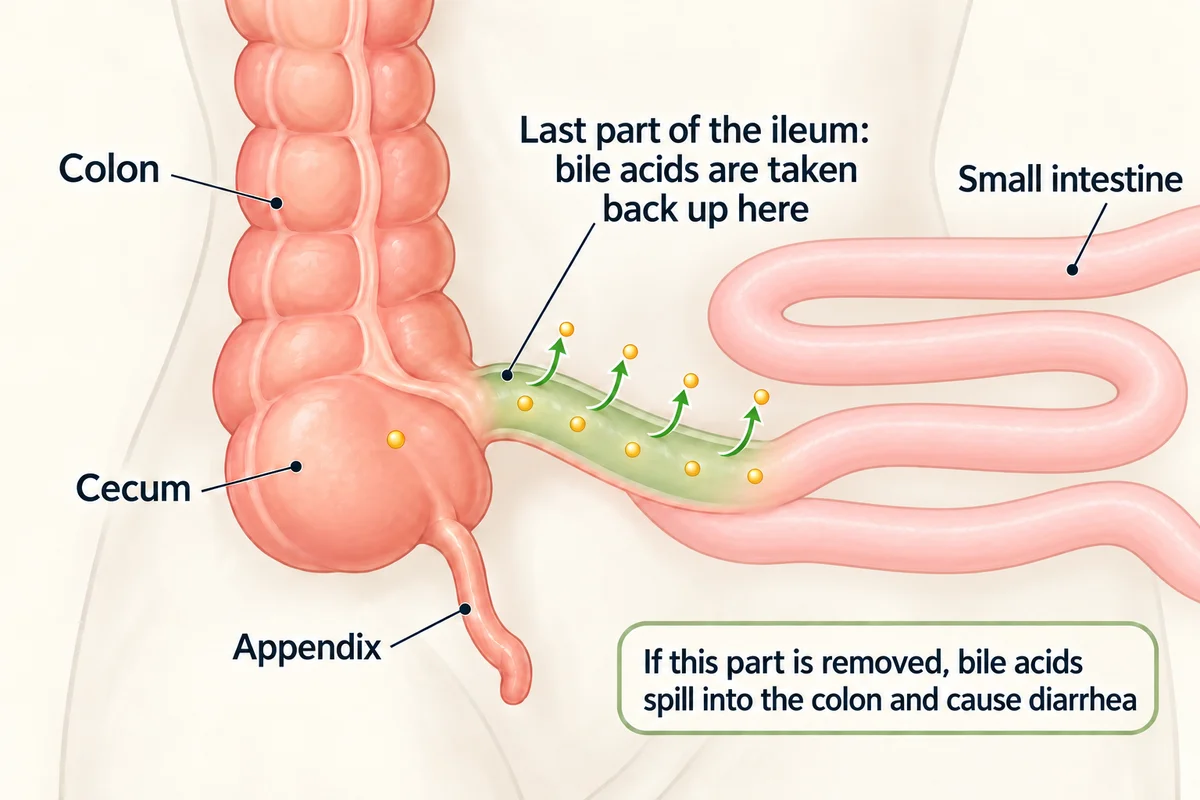
- Bile acids. These are the soap-like part of bile that helps you digest fat, and the last part of your small intestine, the ileum, pulls them back in for reuse. Think recycling plant. If a surgeon removed that stretch, keep this one in mind: in a small 1994 study, 90% of people after that operation had bile acid malabsorption (bile acids aren’t taken back up and spill into the colon) [9]. A bile acid binder, a medicine that soaks up the extra bile, can help [3].
- Too many bacteria in the small intestine (small intestinal bacterial overgrowth, or SIBO) turns up in about 22% of people with IBD, more often after a stricture (a narrowed stretch of bowel) or surgery [10].
- Lactose intolerance, trouble digesting the natural sugar in milk. More likely if your Crohn’s affects the small bowel [11].
- Celiac disease, an immune reaction to gluten. It’s about four times more common when you have IBD [12].
- A stricture. Think of a kinked garden hose: things back up behind the narrow spot. If part of your bowel has narrowed, you may get cramps, bloating and swelling after meals [3].
- Pelvic floor problems. Nobody loves bringing this one up, so I will. Bowel leakage affects about 1 in 4 people with IBD [14]. Pelvic floor therapy, exercises for the muscles that control your bowel, can help with leakage and with trouble emptying [3].
What helps IBS-like symptoms in IBD
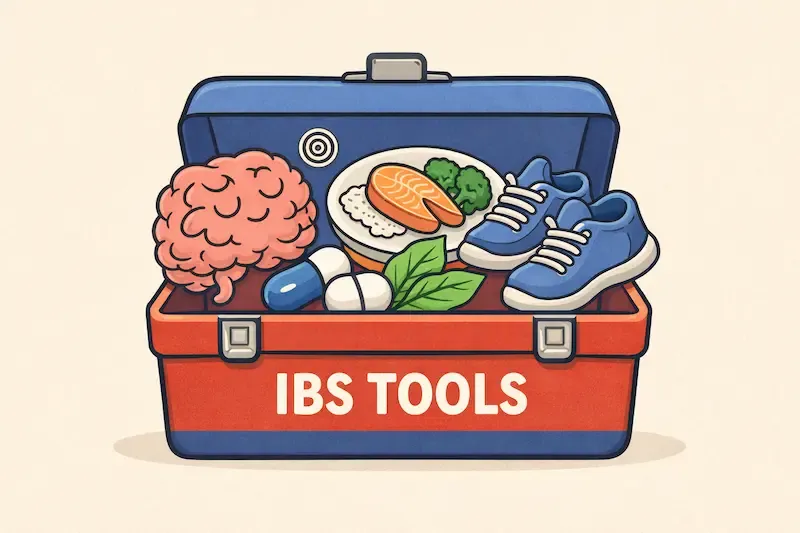
You don’t have to white-knuckle this. But dump the whole toolbox out in week one and you’ll never know which tool did the job. Pick two to four of these, aimed at whatever bothers you most.
My usual first move is a short low FODMAP trial. If symptoms hang on after that, we add a gut-brain therapy or a medicine.
A short low FODMAP trial. FODMAPs are carbs your gut may handle poorly, found in foods like onions, garlic, beans and wheat. In a trial of 52 people with quiet IBD, 52% on a low FODMAP diet said their symptoms were adequately relieved, compared with 16% on a comparison diet [15]. It didn’t change inflammation, so it’s a symptom tool, not an IBD treatment [16]. Give it a few weeks, ideally with a dietitian, then bring foods back to find your triggers. Our Chef Savi low FODMAP recipe generator makes that stretch a lot easier to cook through.
Calming the gut-brain connection. Gut-directed hypnotherapy? I know how that sounds. No, nobody swings a pocket watch at you; it’s guided relaxation aimed at the gut. Look at the studies anyway. It works a lot like gut-focused CBT (cognitive behavioral therapy, a kind of talk therapy) and mindfulness do: your brain learns to stop treating every normal gut signal like an emergency. Experts rated them appropriate unanimously [4], and studies show better mood and quality of life [17].
Medicines for the symptom you have. Once inflammation is ruled out, and depending on your pattern, your GI (digestive) team may suggest:
- loperamide (Imodium) for diarrhea and urgency
- for cramps, an antispasmodic (a gut-relaxing medicine), or peppermint oil in enteric-coated capsules that open past the stomach
- a tricyclic antidepressant at a low dose, which turns down the volume on pain signals from the gut (it isn’t being used for mood here)
- an osmotic laxative, which draws water into the stool, for constipation
- a bile acid binder if bile acids are the cause
Most of the evidence for these comes from IBS research, not IBD trials, so your GI team picks what fits you [4].
Fiber. Psyllium, a fiber supplement like Metamucil, can firm up loose stool and ease constipation. Ever had a stricture with your Crohn’s? Then check with your doctor first [4].
Movement. Experts encourage regular exercise [3]. A daily walk counts, and it’s an easy place to start.
Probiotics? The supplement aisle makes these live-bacteria products sound like a must-have. The evidence is weak so far [3][18]. They’re optional, not a must.
What we avoid: opioid pain medicines (narcotics like oxycodone), which experts advise against for gut pain [3], and stepping up IBD drugs when tests show no inflammation [4].
The two-lane plan
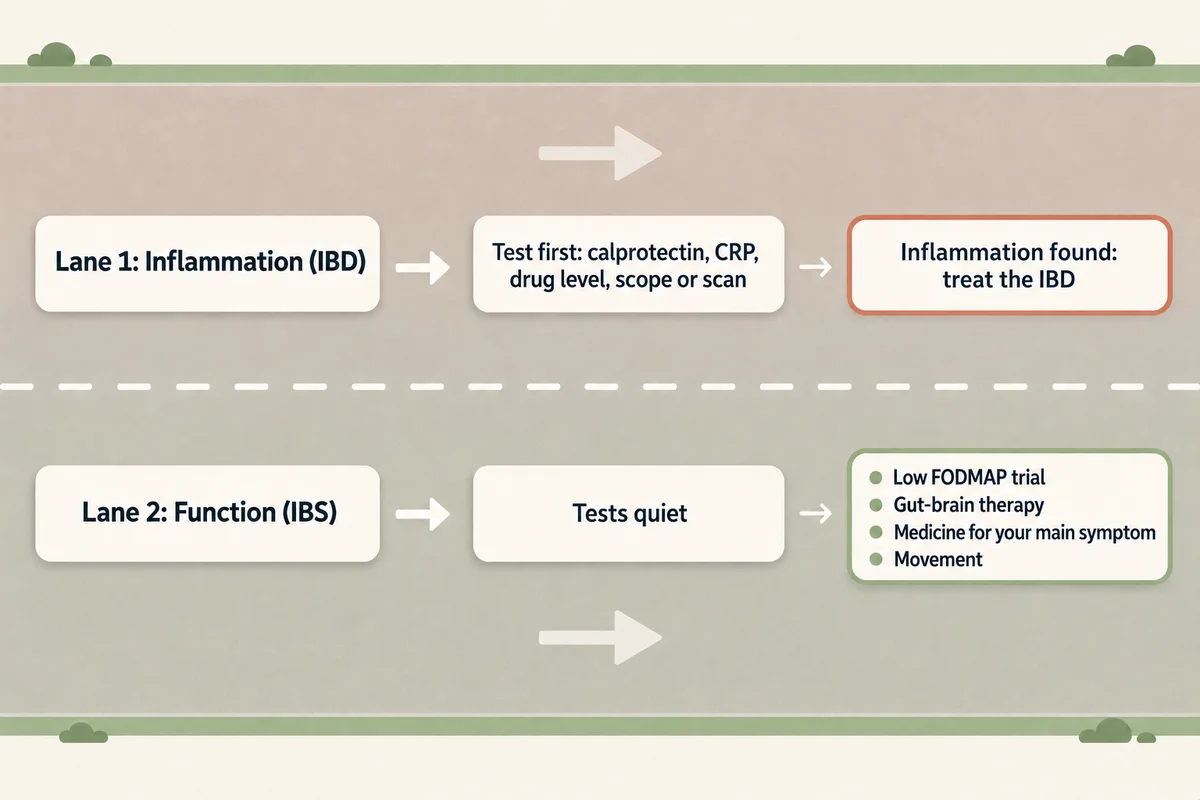
Here’s how I’d draw it: two lanes.
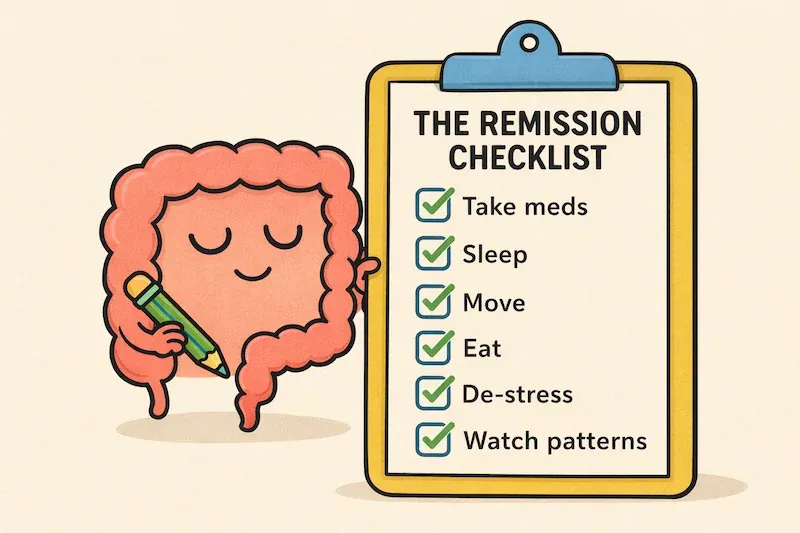
Lane 1, inflammation (IBD). Something feels like a flare? We test before we treat: calprotectin, CRP, a drug level, and a scope or scan if those don’t settle it. Inflammation found means we treat the IBD.
Lane 2, function (IBS). Tests come back quiet? Then more IBD drugs won’t help, and we reach for the IBS toolbox instead: a food trial, gut-brain therapy, medicine for your main symptom, and getting you moving.
Hearing “you’re in remission” while your gut still won’t behave can feel like getting brushed off. It isn’t. Remission is the goal. Then we work on what’s left, together.
When to call your doctor
Don’t push through these. Contact your IBD team if you have:
- Blood in your stool. Bleeding always gets checked, even if your IBD is quiet. IBS doesn’t cause it [4], though harmless causes like hemorrhoids are common in IBD [19].
- a fever, or feeling unwell all over
- weight loss you can’t explain
- Diarrhea that wakes you up at night? Call.
- belly pain that’s severe or getting worse, or you’re throwing up
- dizzy spells or very dark urine (you may be getting dehydrated)
Frequently asked questions
Is my Crohn’s in remission if I still have diarrhea?
It can be. Remission is about inflammation, and you can’t reliably feel inflammation; it shows up on tests. That’s how roughly one in three people in remission still end up with IBS-like symptoms [2]. Want to know for sure? Ask your doctor to check your stool and blood. A drug level or a scope might come next, and so might a look for bile acid diarrhea or an infection.
Does a normal calprotectin mean my IBD is in remission?
Only if you feel well. In that case, a result below about 150 with a normal CRP rules out active inflammation, at least in the colon [5][6]. Still having symptoms, even mild ones? A normal result can’t settle it alone, and a scope or scan often comes next [5][6]. It can also miss Crohn’s that only affects the small bowel, so your doctor may add imaging or a scope if the picture doesn’t fit [4].
Can a low FODMAP diet cause an IBD flare?
Should my IBD medicine be increased?
Not unless tests show inflammation. The 2026 Rome Foundation and IOIBD recommendations warn against stepping up IBD drugs for symptoms alone [4]. If your markers are quiet, IBS treatments are the better fit.
Cook your way through a low FODMAP trial
Trying low FODMAP? Chef Savi turns what’s in your fridge into gut-friendly recipes in seconds. For more from Dr. Ted, read The Remission Playbook, browse our diarrhea guide and low FODMAP recipes, or join the Gutsavi newsletter.
Sources
- Halpin SJ, Ford AC. Prevalence of symptoms meeting criteria for irritable bowel syndrome in inflammatory bowel disease: systematic review and meta-analysis. Am J Gastroenterol. 2012;107(10):1474-82. doi:10.1038/ajg.2012.260
- Fairbrass KM, Costantino SJ, Gracie DJ, Ford AC. Prevalence of irritable bowel syndrome-type symptoms in patients with inflammatory bowel disease in remission: a systematic review and meta-analysis. Lancet Gastroenterol Hepatol. 2020;5(12):1053-62. doi:10.1016/S2468-1253(20)30300-9
- Colombel JF, Shin A, Gibson PR. AGA Clinical Practice Update on functional gastrointestinal symptoms in patients with inflammatory bowel disease: expert review. Clin Gastroenterol Hepatol. 2019;17(3):380-90. doi:10.1016/j.cgh.2018.08.001
- Ma C, Ford AC, Hashash JG, et al. Recommendations for the evaluation and management of inflammatory bowel disease with irritable bowel syndrome-like symptoms: a joint Rome Foundation and IOIBD consensus. Gastroenterology. 2026. doi:10.1053/j.gastro.2026.04.008
- Singh S, Ananthakrishnan AN, Nguyen NH, et al. AGA clinical practice guideline on the role of biomarkers for the management of ulcerative colitis. Gastroenterology. 2023;164(3):344-72. doi:10.1053/j.gastro.2022.12.007
- Ananthakrishnan AN, Adler J, Chachu KA, et al. AGA clinical practice guideline on the role of biomarkers for the management of Crohn’s disease. Gastroenterology. 2023;165(6):1367-99. doi:10.1053/j.gastro.2023.09.029
- Feuerstein JD, Nguyen GC, Kupfer SS, et al. American Gastroenterological Association Institute guideline on therapeutic drug monitoring in inflammatory bowel disease. Gastroenterology. 2017;153(3):827-34. doi:10.1053/j.gastro.2017.07.032
- Moran GW, Gordon M, Sinopoulou V, et al. British Society of Gastroenterology guidelines on inflammatory bowel disease in adults: 2025. Gut. 2025;74(Suppl 2):s1-s101. doi:10.1136/gutjnl-2024-334395
- Nyhlin H, Merrick MV, Eastwood MA. Bile acid malabsorption in Crohn’s disease and indications for its assessment using SeHCAT. Gut. 1994;35(1):90-3. doi:10.1136/gut.35.1.90
- Shah A, Morrison M, Burger D, et al. Systematic review with meta-analysis: the prevalence of small intestinal bacterial overgrowth in inflammatory bowel disease. Aliment Pharmacol Ther. 2019;49(6):624-35. doi:10.1111/apt.15133
- Szilagyi A, Galiatsatos P, Xue X. Systematic review and meta-analysis of lactose digestion, its impact on intolerance and nutritional effects of dairy food restriction in inflammatory bowel diseases. Nutr J. 2016;15(1):67. doi:10.1186/s12937-016-0183-8
- Pinto-Sanchez MI, Seiler CL, Santesso N, et al. Association between inflammatory bowel diseases and celiac disease: a systematic review and meta-analysis. Gastroenterology. 2020;159(3):884-903. doi:10.1053/j.gastro.2020.05.016
- Kucharzik T, Ellul P, Greuter T, et al. ECCO guidelines on the prevention, diagnosis, and management of infections in inflammatory bowel disease. J Crohns Colitis. 2021;15(6):879-913. doi:10.1093/ecco-jcc/jjab052
- Gu P, Kuenzig ME, Kaplan GG, et al. Fecal incontinence in inflammatory bowel disease: a systematic review and meta-analysis. Inflamm Bowel Dis. 2018;24(6):1280-90. doi:10.1093/ibd/izx109
- Cox SR, Lindsay JO, Fromentin S, et al. Effects of low FODMAP diet on symptoms, fecal microbiome, and markers of inflammation in patients with quiescent inflammatory bowel disease in a randomized trial. Gastroenterology. 2020;158(1):176-88. doi:10.1053/j.gastro.2019.09.024
- Ville A, McRae R, Nomchong J, et al. Effects of a low FODMAP diet in inflammatory bowel disease and patient experiences: a mixed methods systematic literature review and meta-analysis. J Hum Nutr Diet. 2025;38(4):e70106. doi:10.1111/jhn.70106
- Riggott C, Mikocka-Walus A, Gracie DJ, Ford AC. Efficacy of psychological therapies in people with inflammatory bowel disease: a systematic review and meta-analysis. Lancet Gastroenterol Hepatol. 2023;8(10):919-31. doi:10.1016/S2468-1253(23)00186-3
- Lacy BE, Pimentel M, Brenner DM, et al. ACG clinical guideline: management of irritable bowel syndrome. Am J Gastroenterol. 2021;116(1):17-44. doi:10.14309/ajg.0000000000001036
- Carvalho T, Leal T, Arroja B, et al. Efficacy and safety of office-based procedures for hemorrhoidal disease in patients with inflammatory bowel disease. Tech Coloproctol. 2025. doi:10.1007/s10151-025-03144-0
- Gracie DJ, Williams CJ, Sood R, et al. Negative effects on psychological health and quality of life of genuine irritable bowel syndrome-type symptoms in patients with inflammatory bowel disease. Clin Gastroenterol Hepatol. 2017;15(3):376-84. doi:10.1016/j.cgh.2016.05.012
- Fairbrass KM, Hamlin PJ, Gracie DJ, Ford AC. Natural history and impact of irritable bowel syndrome-type symptoms in inflammatory bowel disease during 6 years of longitudinal follow-up. Aliment Pharmacol Ther. 2022;56(8):1264-73. doi:10.1111/apt.17193
This article is for education only and isn’t medical advice. Talk with your own doctor about your care.
This article is for education only and isn't a substitute for advice from your own doctor. If something feels off, talk to your care team.