
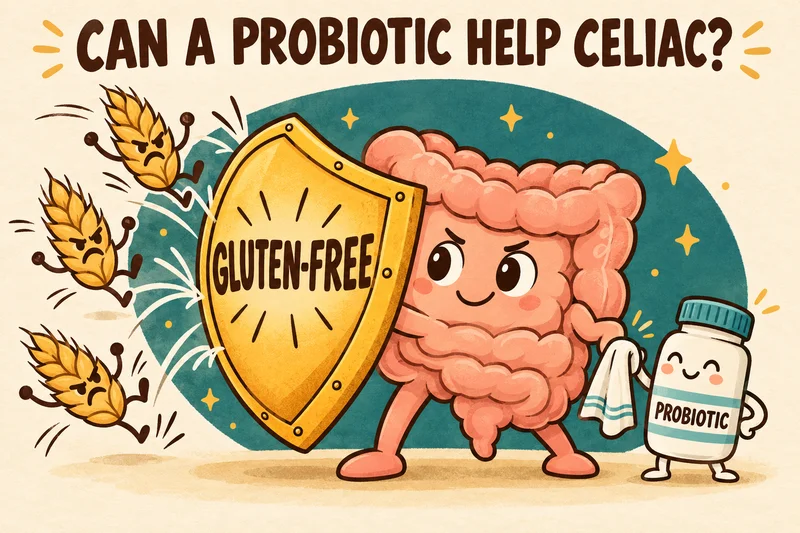
Do probiotics help celiac disease? Not as a treatment. A probiotic can’t undo what gluten does to your small intestine. It can’t make gluten safe either. That job still belongs to one thing: a strict gluten-free diet [1]. Some small trials found a specific strain eased symptoms, so for some folks a probiotic is a fair thing to add on. It’s a side dish, not the meal [3][4].
If you read nothing else
- America’s gastroenterology guideline doesn’t recommend probiotics for celiac disease, and doesn’t recommend against them. The evidence is too thin to call [2].
- One of the few strains tested in adults, Bifidobacterium infantis NLS, helped indigestion in a small trial. It didn’t stop the damage from gluten [4][5].
- Still having symptoms on a gluten-free diet? Hidden gluten and a handful of other conditions come first. A probiotic can’t fix those [1].
A patient asked me this one
A patient asked me this recently: “Do probiotics help celiac, and what ones specifically?” Fair question. If you’ve got celiac disease, you already do the hard part. Every label gets read. Every sauce gets questioned. So sure, you’d love a capsule to carry some of that.
I get it. Go down that aisle and every bottle on it swears your gut will be happier. Fifty billion of this, a dozen strains of that. With celiac disease, though, the details matter more than the marketing, so let’s go through what’s actually been tested.
Why people hope a probiotic will help
Here’s the short version of celiac disease. You eat gluten, a protein in wheat, barley and rye, and your body’s reaction damages your small intestine [10]. Cut gluten out completely, and the goal is a healed gut lining [2].
The trouble is that plenty of people do everything right and still feel lousy. Researchers point to that as the reason probiotics keep getting tested in celiac disease: many patients have symptoms that hang on despite the gluten-free diet [3]. If the diet is the foundation, the hope is that the right bacteria might clean up whatever’s left.
What the guideline says
The American College of Gastroenterology (ACG) is the big American group of GI doctors. Its celiac guideline got an update in 2023. On probiotics it sits right on the fence. Not enough evidence to recommend them, and not enough to recommend against them [2].
That’s not a “no.” It’s a “we don’t know yet.” And that’s an honest answer more health products could stand to give.
What the trials actually found
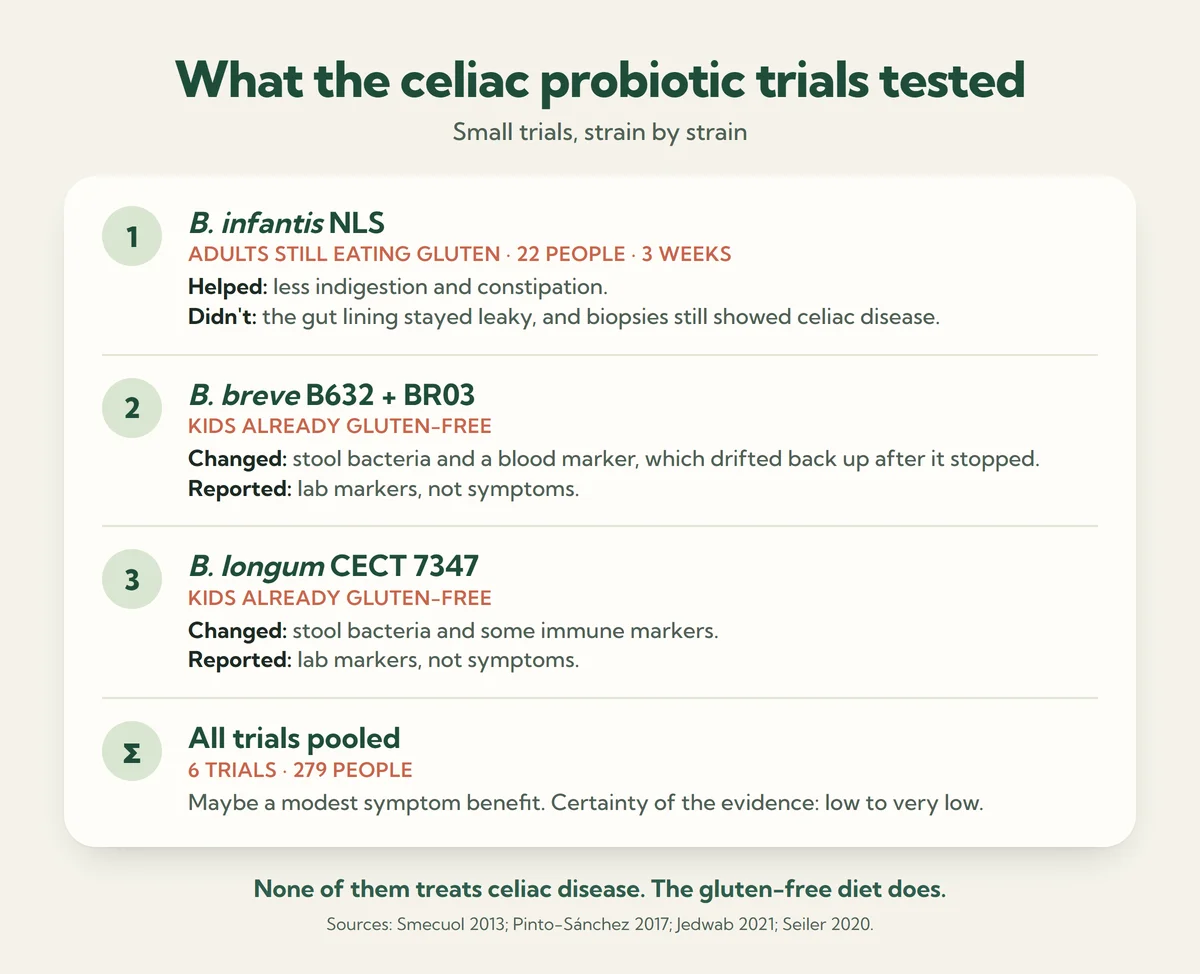
In 2020, researchers rounded up every trial that tested a probiotic against a dummy pill in celiac disease. They found 6. Total people: 279 [3]. Here’s what came out:
- On one common symptom questionnaire, people taking probiotics reported about 29% more improvement than people on a dummy pill [3].
- When the researchers combined the results from all the different questionnaires, that difference disappeared [3].
- Side effects were no more common than with the dummy pill [3].
- The authors rated the certainty of all this as low to very low [3].
So: maybe a modest symptom benefit, from small studies that don’t fully agree. That’s the whole evidence base.
Which probiotics, specifically?
This was the second half of the question, and it’s the right one to ask. Probiotics aren’t interchangeable. Different types can do different things, so a result for one strain tells you nothing about the bottle next to it [9].
Bifidobacterium infantis NLS (adults)
It’s one of the few strains tested in adults with celiac disease [3]. In a small trial, 22 adults with celiac disease who were still eating gluten took either this strain or a dummy pill for 3 weeks [4]. The strain group reported less indigestion and less constipation [4].
But look at what didn’t change. Their gut lining stayed just as leaky as before (doctors call this intestinal permeability), and their biopsies still showed celiac disease [4]. When researchers later compared biopsies, a year on the gluten-free diet cut the number of immune cells in the gut lining more than 6 weeks of the probiotic did [5].
So it may take the edge off symptoms. It doesn’t stop the fire.
Bifidobacterium breve and Bifidobacterium longum (kids)
Kids have had a couple of small trials too. These kids were already off gluten. They took two B. breve strains together (B632 and BR03), or B. longum CECT 7347 [6]. They changed the kids’ stool bacteria and some immune markers in the blood. One of those markers drifted back up after the probiotic stopped [6]. The trials reported bacteria and blood markers rather than how the kids felt, and the reviewers want bigger studies before anyone draws conclusions [6].
Everything else on the shelf
Only a handful of strains have been tested in celiac disease at all [3][6]. A higher CFU count (colony-forming units, the number of live bacteria) on the front of the box doesn’t change that.
A probiotic can’t fix hidden gluten
About 1 in 5 people with celiac disease have symptoms that keep going or come back despite the diet [1]. Before anybody adds a supplement, I want to know why. The usual suspects [1]:
- Gluten sneaking in. Tiny amounts, from cross-contact, sauces or wheat-based additives.
- IBS (irritable bowel syndrome). The gut’s alarm is set too sensitive, with no damage to show for it.
- Lactose intolerance. Milk sugar doesn’t agree with you.
- Microscopic colitis. The colon looks normal on a scope, but a biopsy shows inflammation.
- Pancreas trouble. Not enough of the digestive enzymes your pancreas is supposed to send.
- SIBO (small intestinal bacterial overgrowth). Too many bacteria have set up shop in the small intestine.
- Refractory celiac disease, which is rare: the damage keeps going even on a strict gluten-free diet [1].
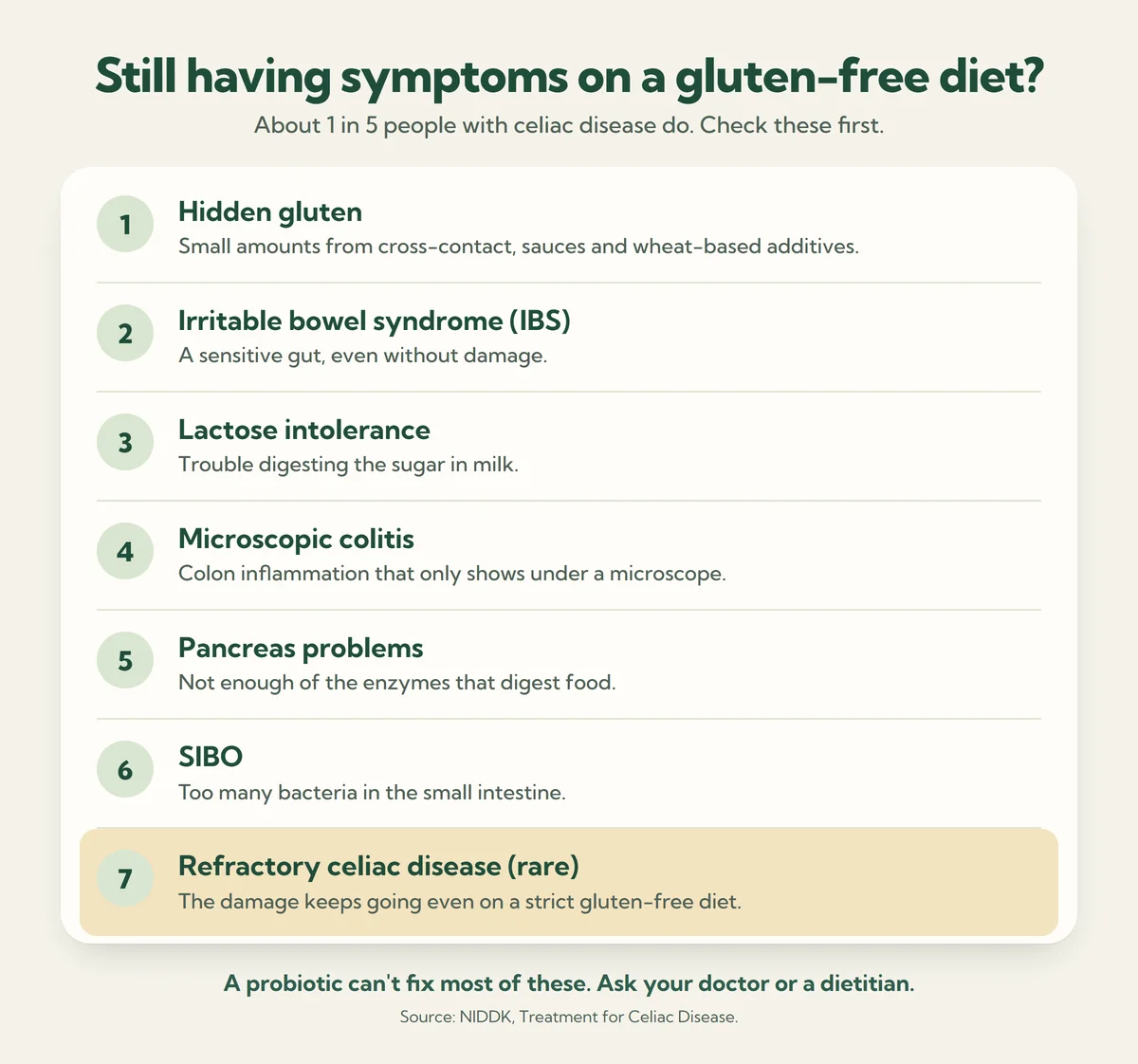
A probiotic won’t touch most of these. If gluten is getting in, the bacteria in a capsule don’t stand a chance against it [4]. A registered dietitian who knows celiac disease is often the fastest way to find the leak [1].
The gluten that might be in the bottle
Here’s a wrinkle. Researchers at Columbia University’s Celiac Disease Center tested 22 top-selling probiotics. Twelve of them had detectable gluten [7]. Four had more than 20 parts per million, the US cut-off for calling something gluten-free [7][8]. More than half of the 22 were labeled gluten-free, and that label didn’t reliably tell you which ones were clean [7].
Now, some perspective. Most people with celiac disease need more than about 10 milligrams of gluten a day before the gut gets damaged. The Columbia team said a contaminated probiotic is unlikely to get you there unless you take mega-doses [7]. Still, it’s one more product to vet.
In the US, the gluten-free labeling rule does cover dietary supplements [8]. It doesn’t make companies test for gluten, though [8]. So look for the gluten-free label, and ask your pharmacist or doctor before you start one [1].
How I’d handle it
If you want to try a probiotic with celiac disease, here’s how I’d do it:
- Get the diet tight first. That’s the treatment. Everything else is extra [1].
- If symptoms hang on, find out why before buying anything (see the list above) [1].
- If you still want to try one, pick a strain that’s been tested in celiac disease, not the biggest number on the shelf. In adults, B. infantis NLS is one [4].
- Give it a few weeks, and stop if nothing changes. Why keep buying a pill that’s doing nothing for you?
- Look for gluten-free on the label, and ask your doctor first [8]. That goes double if you’re seriously ill or your immune system is weak. Probiotics carry more risk there [9].
For what it’s worth, we have no ties to any probiotic maker, and Gutsavi doesn’t sell probiotics.
Eating gluten-free is easier with a few go-to meals. Chef Savi can turn what’s in your pantry into a recipe in seconds.
When to see your doctor
Don’t wait on these:
- Symptoms that keep going, or come back, even though you’re strictly gluten-free [1]
- You’ve started a probiotic hoping it’ll fix symptoms nobody has checked yet. Don’t let it stand in for a visit [9]
- Any plan to loosen your gluten-free diet because of a supplement. Talk to your doctor first [1][9]
Frequently asked questions
Can a probiotic let me eat gluten with celiac disease?
What is the best probiotic for celiac disease?
Are probiotics safe if you have celiac disease?
Should kids with celiac disease take probiotics?
The trials in kids were small and mostly measured bacteria and blood markers, not how kids felt [6]. Talk it over with your child’s doctor before starting one.
The bottom line
Probiotics won’t treat celiac disease. The diet does that. A tested strain might take the edge off lingering symptoms, but only after you’ve ruled out the usual suspects. Our Food intolerances hub has more, and here’s how supplement labels play tricks on you. The Gutsavi newsletter brings new ones to your inbox.
Sources
- National Institute of Diabetes and Digestive and Kidney Diseases (NIDDK). Treatment for celiac disease. Reviewed October 2020. niddk.nih.gov
- Rubio-Tapia A, Hill ID, Semrad C, et al. American College of Gastroenterology guidelines update: diagnosis and management of celiac disease. Am J Gastroenterol. 2023;118(1):59-76. doi:10.14309/ajg.0000000000002075
- Seiler CL, Kiflen M, Stefanolo JP, et al. Probiotics for celiac disease: a systematic review and meta-analysis of randomized controlled trials. Am J Gastroenterol. 2020;115(10):1584-95. doi:10.14309/ajg.0000000000000749
- Smecuol E, Hwang HJ, Sugai E, et al. Exploratory, randomized, double-blind, placebo-controlled study on the effects of Bifidobacterium infantis Natren Life Start strain super strain in active celiac disease. J Clin Gastroenterol. 2013;47(2):139-47. doi:10.1097/MCG.0b013e31827759ac
- Pinto-Sánchez MI, Smecuol EC, Temprano MP, et al. Bifidobacterium infantis NLS super strain reduces the expression of α-defensin-5, a marker of innate immunity, in the mucosa of active celiac disease patients. J Clin Gastroenterol. 2017;51(9):814-7. doi:10.1097/MCG.0000000000000687
- Jedwab CF, Roston BCMB, Toge ABFS, et al. The role of probiotics in the immune response and intestinal microbiota of children with celiac disease: a systematic review. Rev Paul Pediatr. 2021;40:e2020447. PMC8432160
- Columbia University Irving Medical Center. New study finds that many probiotics are contaminated with traces of gluten. Newswise, May 15, 2015. newswise.com
- US Food and Drug Administration. Questions and answers on the gluten-free food labeling final rule. fda.gov
- National Center for Complementary and Integrative Health (NCCIH). Probiotics: usefulness and safety. Updated August 2019. nccih.nih.gov
- NIDDK. Definition & facts for celiac disease. Reviewed October 2020. niddk.nih.gov
This article is for education only and isn’t medical advice. Talk with your own doctor about your care.
This article is for education only and isn't a substitute for advice from your own doctor. If something feels off, talk to your care team.