
Med Opinion: Dr. Ted’s personal view on a health issue, with the evidence linked below. Agree or disagree? Tell us in the comments.
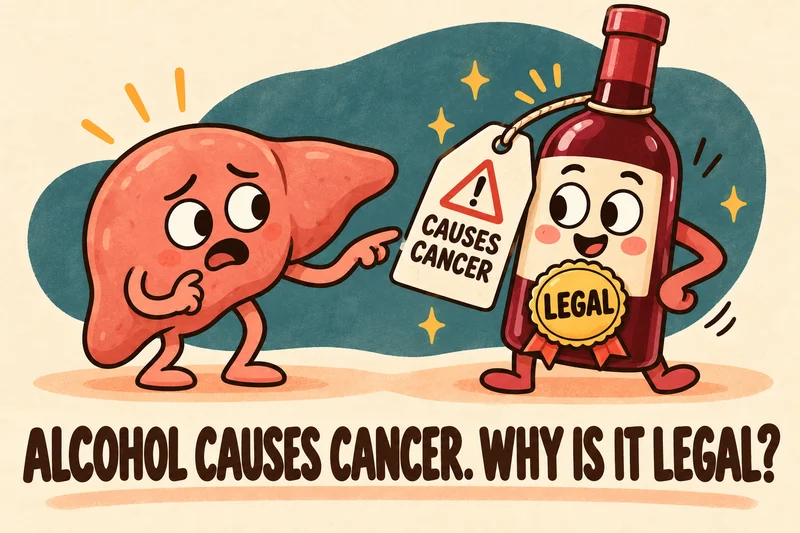
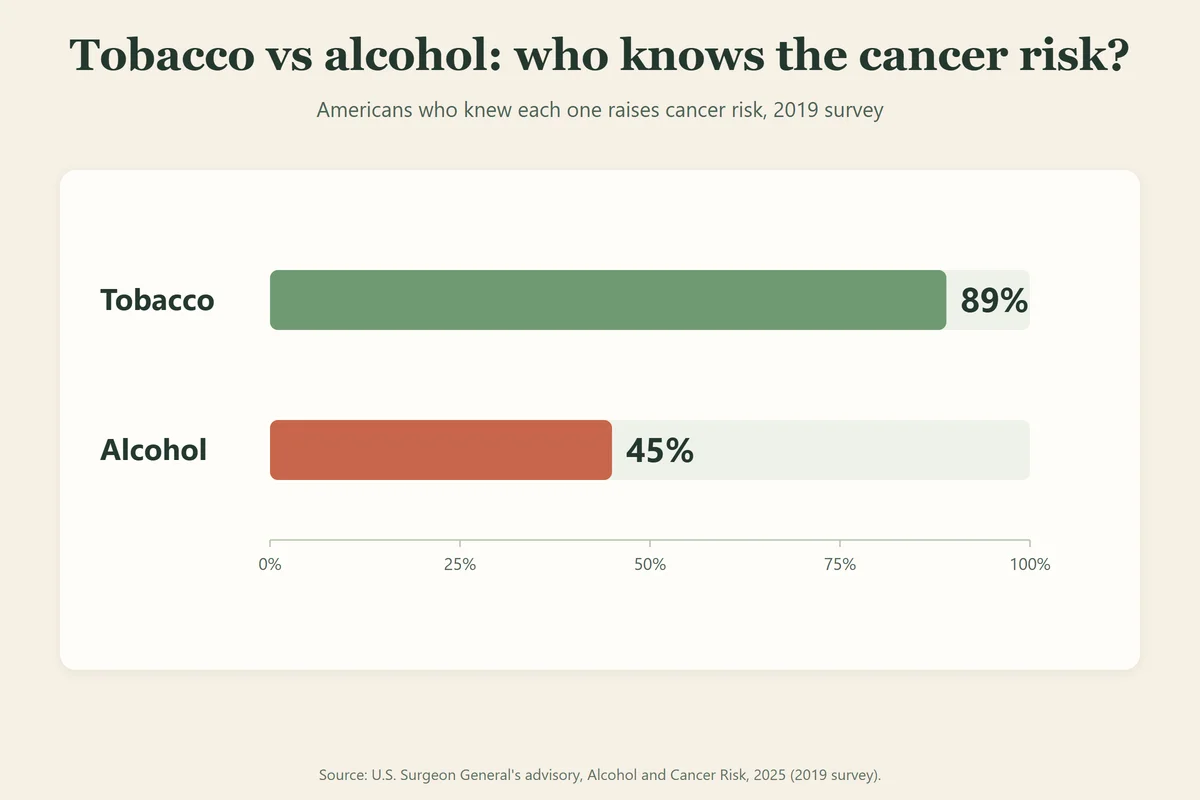
Why is alcohol legal when we’ve known since the late 1980s that it causes cancer [1]? My honest answer: we were toasting with it at weddings and ball games long before the science caught up. We even tried a ban once, and Prohibition lasted from 1920 until the country quit on it in 1933 [14]. And the cancer part? In a 2019 survey, only 45% of Americans knew about it [1].
I don’t think the science is in doubt anymore. Alcohol sits in the same top cancer group as tobacco and asbestos [1]. We’re talking nearly 100,000 US cancer cases a year tied to it, and about 20,000 deaths [1].
Here’s the question I sent my team, word for word: “If alcohol is literally a poison and causes cancer, why do we continue to accept it as a society?”
This piece is my best shot at an answer. I’d like yours in the comments.
The short version
- At least seven cancers go up with drinking, breast and colorectal (colon and rectum) among them [1].
- For a woman, one drink a day moves her lifetime odds of those cancers from about 16.5 in 100 to 19 in 100 [1].
- The warning on a US bottle hasn’t changed a word since 1988, and it says nothing about cancer [1].
- I’ve laid out five fixes below. None of them is a ban, and I want to know which one you’d pick.
Is alcohol really a carcinogen?
Yes. Carcinogen sounds like lab talk. Strip it down and you get “something that can cause cancer,” and alcohol earned that tag decades ago. The World Health Organization (WHO) runs a cancer agency whose whole job is sorting out what causes cancer. It goes by IARC, short for the International Agency for Research on Cancer. Alcohol sits in IARC’s Group 1, its highest level of evidence, right next to tobacco, asbestos and formaldehyde [1]. That link was first established in the late 1980s [1].
So how does a drink hurt a cell? Your body breaks alcohol down into acetaldehyde, and that chemical causes cancer by latching onto your DNA and damaging it [1]. DNA is the instruction manual inside each cell.
Seven cancers are on the list. Breast (in women), colorectal, esophagus (the food pipe), liver, mouth, throat and voice box [1]. Beer, wine or spirits, it makes no difference. Each type raises the risk, and the more you drink, the higher it goes [1]. I’d compare it to a volume knob, not an on-off switch.
Three of those seven are in my lane as a GI (gastrointestinal) doctor: colorectal, esophagus and liver. I went through them in more detail in Cheers or Tears? How alcohol quietly fuels GI cancers.
Counting people, not percentages
“Raises your risk” is one of those phrases that sounds either terrifying or like nothing at all. I’d rather count people.
The 2025 Surgeon General’s advisory did that, using a study of 226,162 Australian adults [1]. Out of 100 people, how many would get one of the seven alcohol-related cancers by age 80? Its estimates:
| Drinking level | Women | Men |
|---|---|---|
| Less than 1 drink a week | about 16.5 in 100 | about 10 in 100 |
| 1 drink a day | 19 in 100 | about 11.4 in 100 |
| 2 drinks a day | about 21.8 in 100 | about 13.1 in 100 |
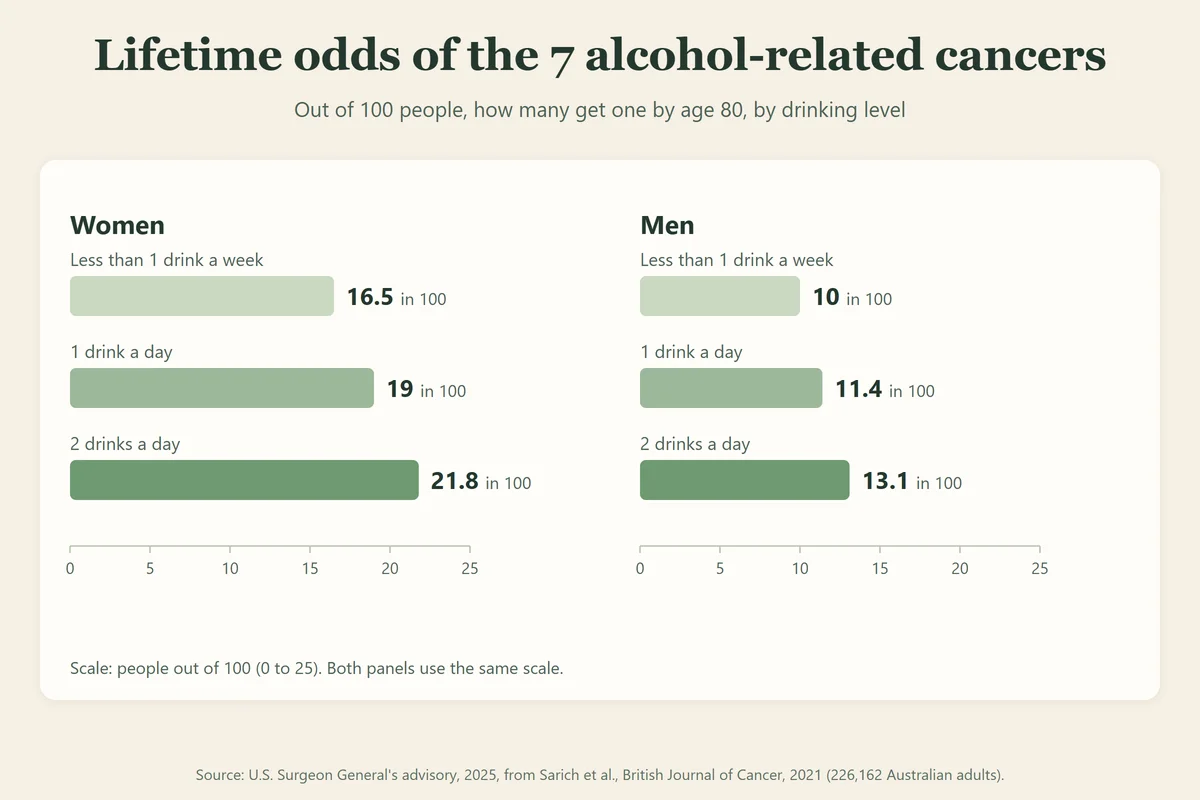
Look at the women’s column. At two drinks a day, that’s about five more cancers in every 100 women. Breast cancer alone climbs from about 11 in 100 to 15 in 100 at that level [1].
Breast cancer makes up about 60% of alcohol-related cancer deaths in women. In men, liver cancer accounts for about a third and colorectal cancer for about a fifth [1]. Here’s the number I’d underline: 17% of those deaths happen in people who stayed within the old “one a day, two a day” limits [1].
So is there a safe amount? For some cancers, like breast, mouth and throat, the Surgeon General’s advisory says risk may start to climb at around one drink a day or less [1].
In fairness, not every expert reads the whole-body picture the same way. The National Academies, America’s top science advisers, looked at it in 2024. With moderate certainty, their review found that moderate drinkers had lower death rates overall than people who’d never drunk [2]. The same review found a higher breast cancer risk with moderate drinking [2]. Those are observational studies, which follow what people already do, so they can’t prove cause. On the cancer part, though, nobody seriously disputes it anymore.
Why is drinking alcohol so accepted?
Because it’s woven into how we live, and it has been for a very long time. In 2019-2020, 72% of US adults had at least one drink a week [1]. We toast the bride, bring a bottle to dinner, crack a beer after a long shift. Nobody thinks twice, and that’s sort of the point.
Then there’s the stuff we were told. I’m sure you remember “a glass of red wine is good for your heart.” That one stuck like gum on a shoe. In a 2020 national survey, only 20% of adults knew wine raises cancer risk [3]. Another 10% believed it lowers it [3]. More than half simply didn’t know [3].
Now look at the back of the bottle. Since 1988, the US label has warned about pregnancy, driving and machinery, plus a vague “may cause health problems” [1]. Cancer doesn’t get a mention. That label is older than a lot of the people reading it, and only Congress can change it [1].
Smoking makes the gap plain. In that same 2019 survey, 89% of Americans knew tobacco causes cancer [1]. For alcohol, it was 45% [1].
I see the same gap in my exam room. When I bring up alcohol, a lot of my patients are surprised to hear it causes cancer.
We’ve changed our minds before
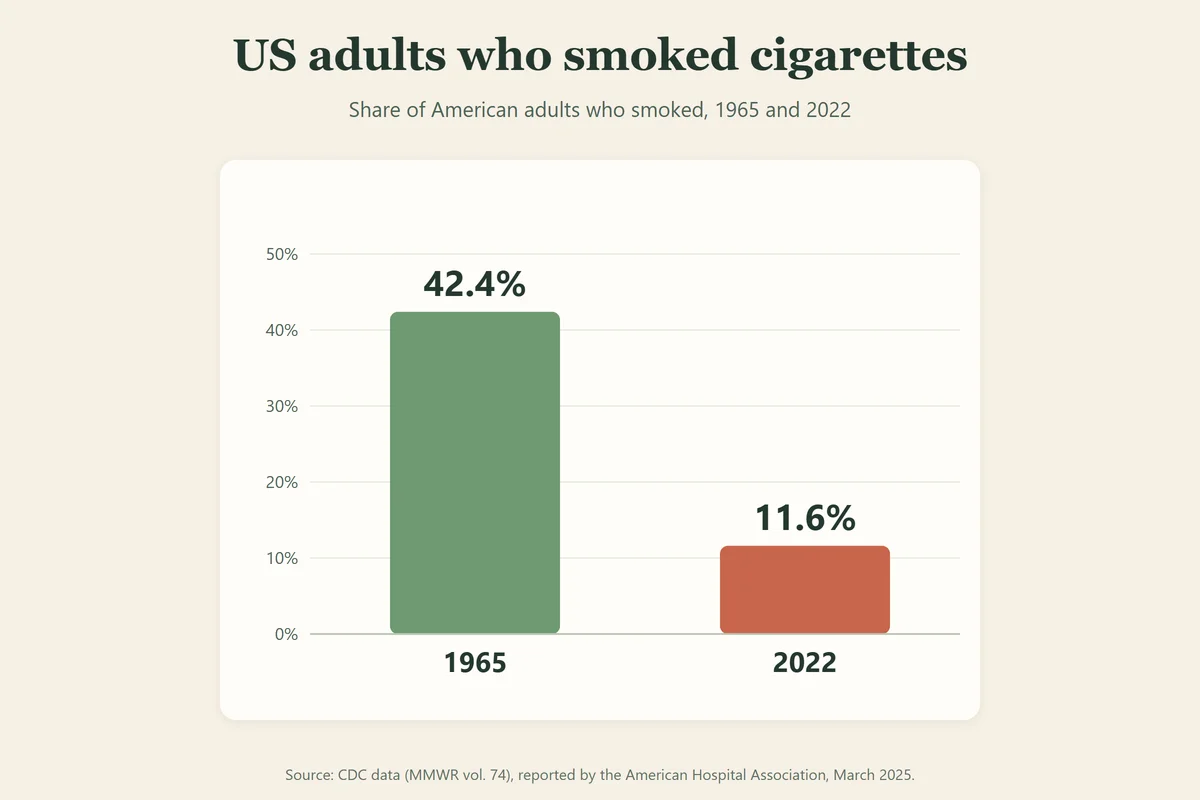
Smoking used to be as ordinary as a cup of coffee. In 1965, 42.4% of American adults smoked cigarettes. By 2022, just 11.6% did [6]. Cigarettes are still legal. What changed was what felt normal.
Something like that may be starting with alcohol. In a July 2025 Gallup poll, 54% of US adults said they drink, the lowest in nearly 90 years of polling [5]. And for the first time, a majority, 53%, said even one or two drinks a day is bad for your health [5].
Where the rules stand in 2026
Back in January 2025, Surgeon General Vivek Murthy put alcohol third on the list of preventable causes of cancer in the US, behind only tobacco and obesity [1]. He asked Congress for two things: a cancer warning on the label, and a label you can actually see [1].
And since then?
- Congress: no bill has moved. In May 2026, a consumer advocate told NPR he’d “be shocked” if a label bill moved in the current Congress [8].
- The 2025-2030 Dietary Guidelines came out on January 7, 2026, and the old numbers are gone. No more one drink a day for women and two for men. Now they just tell you to “consume less alcohol for better overall health” [7][8]. They don’t mention cancer at all. The American Association for the Study of Liver Diseases (AASLD), the liver doctors’ society, pointed that out [7].
- Alaska didn’t wait. Since August 1, 2025, every alcohol retailer there must post a sign saying alcohol can cause cancer, including breast and colon cancer [11]. A similar bill has been introduced in Massachusetts [8].
- Abroad, South Korea already requires a cancer warning [1]. Ireland signed one into law (“There is a direct link between alcohol and fatal cancers”) [1].
Five options worth arguing about
First, the ban, since someone always asks. We tried that. National Prohibition kicked in back in 1920, and by December 1933 the country had repealed it [14]. Me, I’m not calling for a ban. I doubt it would work any better today than it did in the 1920s. So here are five options that leave your drink in your hand. Each one comes with a catch.
1. Put cancer on the label
Most people seem to want it. In the 2020 survey, 65% of Americans supported warning labels [4]. In Yukon, Canada, researchers put new labels, including a cancer warning, on bottles in Whitehorse’s liquor store. Sales of the labelled products dropped about 6.6% compared with control areas [10]. And in a 2024 US survey of people who drink, cancer warnings were among the ones most likely to make them want to cut back [9].
The catch? The Yukon study was cut short after complaints from the alcohol industry [8]. And a label works like a smoke detector. It tells you there’s a problem, and what you do next is up to you.
2. Raise the price
Price has decades of research behind it. A review of 50 studies estimated that doubling alcohol taxes would cut alcohol-related deaths by about 35% on average [12].
The catch: a tax hits people with the least money hardest. Is that fair?
3. Limit the marketing
The WHO counts advertising bans or tight limits among its five most cost-effective alcohol policies [13]. That covers the billboards on your commute and the logos all over the ball game. Americans aren’t sold on it, though. Only 34% supported banning outdoor alcohol ads in 2020 [4]. Where would you draw the line?
4. Make it a little less convenient
That means fewer stores, shorter hours, or no alcohol in certain places. A US panel that reviews what works in prevention, the Community Preventive Services Task Force, backs limiting how many alcohol outlets an area can have, through licensing and zoning [16]. It works more like a speed bump than a roadblock. And who pays? Small shops, restaurants, and anyone who just wants a bottle on a Sunday.
5. Have doctors ask, every time
This one’s closest to home for me. The Surgeon General asked clinicians to tell patients about the cancer link, and to screen for alcohol use [1]. The US Preventive Services Task Force has recommended alcohol screening for every adult in primary care since 2018, with brief counseling for risky drinking [15]. It costs next to nothing, and it happens face to face. The catch is time. Your visit’s already short, and there’s a lot to cover. For what it’s worth, I ask my patients about alcohol as a routine part of the visit.
What would you do?
Now it’s your turn. Tell me in the comments:
- Your pick of the five?
- Before today, had you heard that alcohol causes cancer?
- Would a cancer warning on the bottle change what you buy?
My pick? I’d start with the label. People deserve to know what’s in the bottle before they pour it. Right now, the bottle says nothing about cancer.
Thinking about cutting back?
Changing laws takes years. Your next drink is your call, and here’s what helps:
- Know what one drink is. A standard US drink is 12 ounces of 5% beer, 5 ounces of 12% wine, or a 1.5-ounce shot of 40% spirits [17]. That 12-ounce craft beer at 10%? It counts as two [17].
- Rethinking Drinking, a site from the NIAAA (National Institute on Alcohol Abuse and Alcoholism), and the free check-your-drinking tool from the CDC (Centers for Disease Control and Prevention) can show where you stand [1].
- Pick alcohol-free days, and tell someone your plan.
- Want to talk to someone? The National Helpline run by SAMHSA, the federal Substance Abuse and Mental Health Services Administration, is free, confidential and open 24/7, in English and Spanish: 1-800-662-4357 [18].
Drink heavily every day? Then please don’t stop cold without talking to a doctor first. Withdrawal, your body’s reaction when the alcohol is suddenly gone, usually starts within 8 hours of the last drink, and it can be dangerous [19]. Seizures, a fever, severe confusion, seeing things, or an irregular heartbeat after stopping? Call 911 [19].
Call your doctor soon if you notice yellow eyes or skin, a swelling belly, or you’re bruising or bleeding easily. Those can be signs of liver damage [20].
Frequently asked questions
Is any amount of alcohol safe?
For cancer, nobody’s found a safe amount. For breast, mouth and throat cancers, the Surgeon General says risk may start to climb at around one drink a day or less [1]. Less is still better, because your risk climbs with the amount. For women, one drink a day instead of two means about 3 fewer of those cancers per 100 [1].
When did alcohol become a carcinogen?
What 7 cancers are linked to alcohol?
Will alcohol ever be illegal?
I have a hard time picturing it. The US banned it once, and the 21st Amendment repealed that ban in 1933 [14]. Today’s debate is about labels, prices and guidelines, not a ban. Meanwhile, plenty of Americans aren’t waiting for a law. Only 54% said they drink in 2025, a record low in nearly 90 years of Gallup polling [5].
Want the next Med Opinion?
Join the Gutsavi newsletter for more evidence-checked takes from Dr. Ted. Got a topic you’d like covered? Send it through Ask Dr. Ted. Curious what alcohol does above the neck? Read the quiet brain damage you toast to, or browse more on the Gutsavi blog.
Sources
- U.S. Surgeon General. Alcohol and Cancer Risk: The U.S. Surgeon General’s Advisory. U.S. Department of Health and Human Services. January 2025. hhs.gov
- National Academies of Sciences, Engineering, and Medicine. New report reviews evidence on moderate alcohol consumption and health impacts (Review of Evidence on Alcohol and Health). December 17, 2024. nationalacademies.org
- Seidenberg AB, Wiseman KP, Klein WMP. Do beliefs about alcohol and cancer risk vary by alcoholic beverage type and heart disease risk beliefs? Cancer Epidemiol Biomarkers Prev. 2023;32(1):46-53. doi:10.1158/1055-9965.EPI-22-0420
- Seidenberg AB, Wiseman KP, Eck RH, et al. Awareness of alcohol as a carcinogen and support for alcohol control policies. Am J Prev Med. 2022;62(2):174-82. doi:10.1016/j.amepre.2021.07.005
- Gallup. U.S. drinking rate at new low as alcohol concerns surge. August 13, 2025. news.gallup.com
- American Hospital Association. CDC: Adult smoking hits 60-year low (CDC, MMWR vol. 74). March 6, 2025. aha.org
- American Association for the Study of Liver Diseases. AASLD raises concern over removal of evidence-based alcohol guidance in 2025-2030 Dietary Guidelines for Americans. January 2026. aasld.org
- NPR. Cancer warning labels on alcohol may motivate people to drink less, study says. May 7, 2026. npr.org
- Grummon AH, Lee CJY, D’Angelo Campos A, et al. New alcohol warnings outperform the current U.S. warning in a national survey experiment. J Stud Alcohol Drugs. 2026;87(3):433-43. doi:10.15288/jsad.25-00226
- Zhao J, Stockwell T, Vallance K, Hobin E. The effects of alcohol warning labels on population alcohol consumption: an interrupted time series analysis of alcohol sales in Yukon, Canada. J Stud Alcohol Drugs. 2020;81(2):225-37. doi:10.15288/jsad.2020.81.225
- Homer News. Alaska to require retailers to post warnings about alcohol cancer risk. May 6, 2025. homernews.com
- Wagenaar AC, Tobler AL, Komro KA. Effects of alcohol tax and price policies on morbidity and mortality: a systematic review. Am J Public Health. 2010;100(11):2270-8. doi:10.2105/AJPH.2009.186007
- World Health Organization. The SAFER initiative. who.int
- National Archives. The Constitution: Amendments 11-27 (Amendment XVIII, ratified January 16, 1919; Amendment XXI, ratified December 5, 1933). archives.gov
- US Preventive Services Task Force. Unhealthy alcohol use in adolescents and adults: screening and behavioral counseling interventions. Final recommendation statement, November 13, 2018. uspreventiveservicestaskforce.org
- Community Preventive Services Task Force. Excessive alcohol consumption: regulation of alcohol outlet density. The Community Guide, February 2007. thecommunityguide.org
- National Institute on Alcohol Abuse and Alcoholism. What is a standard drink? niaaa.nih.gov
- Substance Abuse and Mental Health Services Administration. SAMHSA’s National Helpline. samhsa.gov
- MedlinePlus. Alcohol withdrawal. medlineplus.gov
- National Institute of Diabetes and Digestive and Kidney Diseases. Symptoms and causes of cirrhosis. niddk.nih.gov
This Med Opinion is Dr. Ted’s personal view. It’s for education only and isn’t medical advice. Talk with your own doctor about your care.
This article is for education only and isn't a substitute for advice from your own doctor. If something feels off, talk to your care team.