
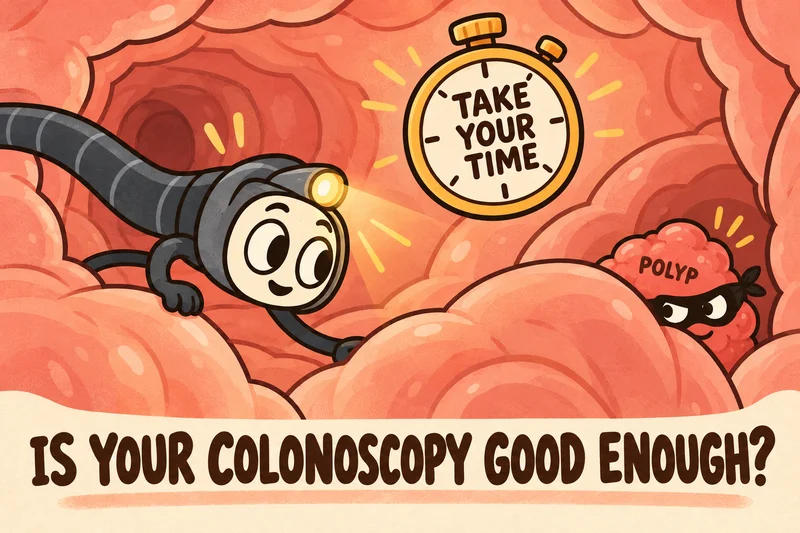
Can a colonoscopy miss cancer? Yes, it can, though it isn’t common. About 1 in 27 colon cancers turns up within 3 years of a colonoscopy that didn’t find it [2]. When that happens, it’s most often because a growth was missed or not fully removed [3]. So how carefully your doctor looks matters, and you’re allowed to ask about it. You and your doctor are on the same side here.
Before your next one, the short version
- Two numbers tell you a lot. The first is your doctor’s adenoma detection rate, how often they find the kind of polyp that can turn into cancer, and you want 35% or higher [1]. (A polyp is a small growth on the lining of the colon.) The second is their average withdrawal time. That’s the minutes spent looking as the scope, the camera tube, comes back out, and you want 8 minutes or more [1].
- Your prep counts too. That’s the laxative clean-out the day before, and if yours was poor, you’ll usually repeat the exam within a year [1].
- Endocuff Vision, a soft cap for the tip of the scope, and AI both help your doctor find more polyps. Whether either one prevents more cancers isn’t proven yet [8][12].
How often does a colonoscopy miss cancer?
Uncommon, yes. Ignorable, no. Pool 12 population studies, and 3.7% of colon cancers were found 6 to 36 months after a colonoscopy [2].
So why does it happen? US researchers pooled 8 large North American studies of people who’d had polyps removed and then kept getting checked [3]. Of the 58 cancers that turned up, about half (52%) were probably missed. Another 19% likely grew from a polyp that wasn’t fully removed, and about a quarter (24%) looked new [3]. Their take: most of these might be avoided by finding and fully removing every polyp [3].
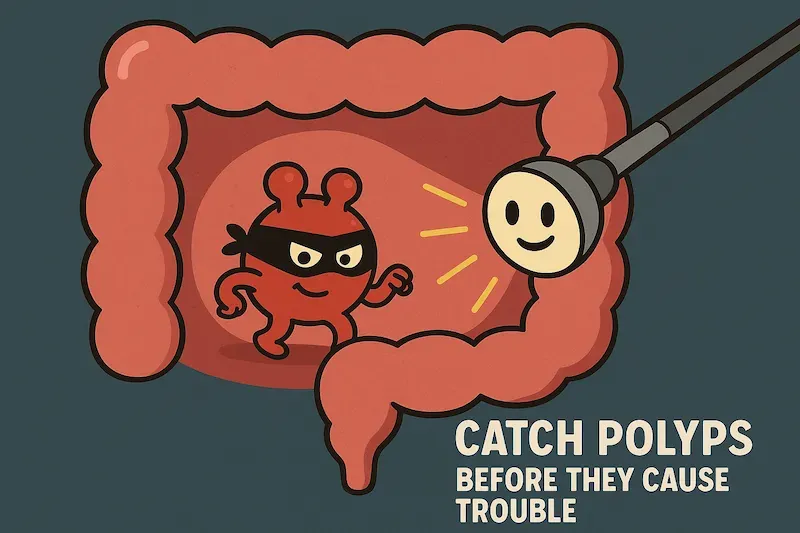
Polyps get missed too. Do two colonoscopies back to back, and the second one turns up about 1 in 4 of the adenomas, the precancerous kind of polyp [4]. Flat ones are the sneakiest, sitting almost level with the lining, and about a third get missed. The advanced ones, the bigger and more worrisome growths, slip past only about 9% of the time [4].
Please don’t read any of this as a reason to skip screening. If you’re 45 to 75, the US Preventive Services Task Force, an independent panel of prevention experts, recommends it for most adults [13]. It’s an argument for a better colonoscopy, not for skipping one.
First you drive in, then you look on the way out
I just taught a colonoscopy class, and that’s what got me thinking about this. There are two stages. First you’re just driving the scope to the beginning of the colon, a pouch called the cecum. Then you withdraw it slowly, looking for polyps and cancer.
Lost earrings get found on the slow walk back, not the sprint down the hall. Same here: most of the looking happens on the way out. That’s when your doctor washes away leftover stool, keeps the colon inflated so the walls stay open, and checks behind each fold [1]. We call it the withdrawal, and its length is often printed on your report. (Yes, it’s a funny name for the part where all the real work happens.)
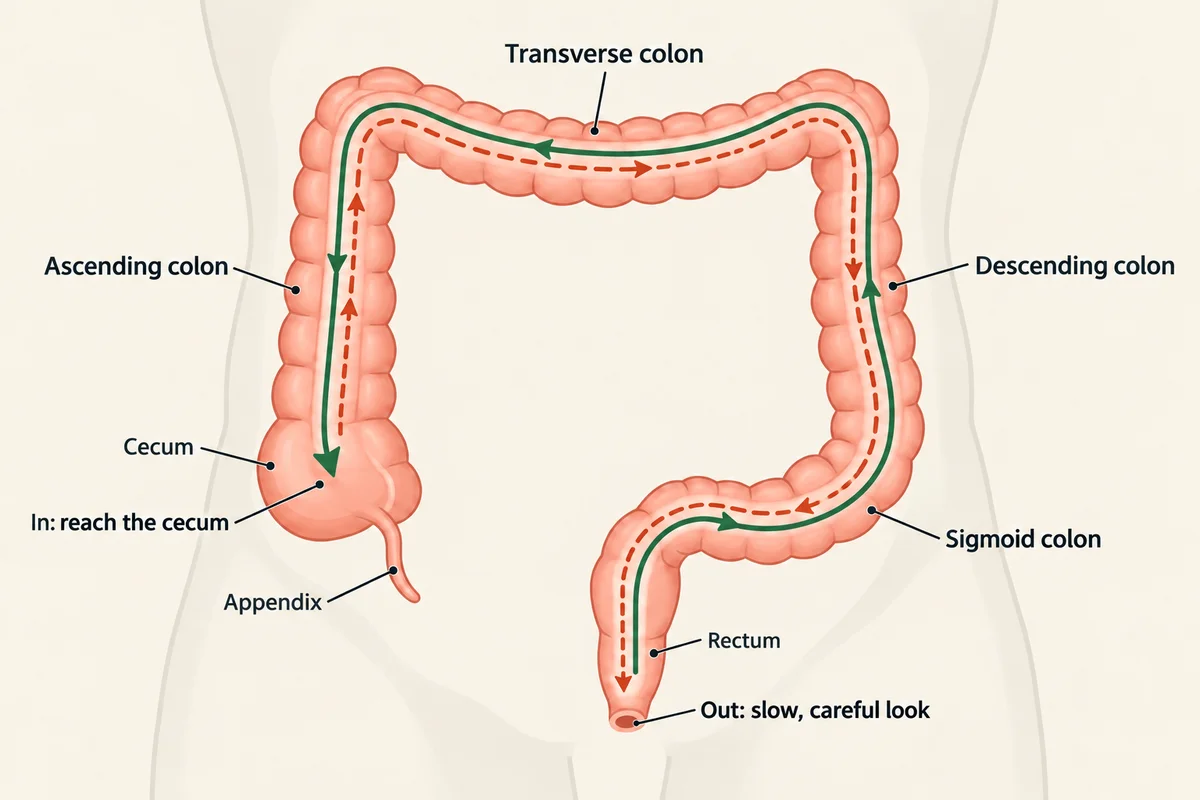
Colonoscopy withdrawal time: the number on your report
Colonoscopy withdrawal time is the clock on the trip back out. It’s measured in exams where nothing was removed, so polyp removal doesn’t pad it. The bar moved in 2024. Quality guidelines from the American College of Gastroenterology (ACG) and the American Society for Gastrointestinal Endoscopy (ASGE) raised the target to an average of at least 8 minutes [1]. Since 2006, it had been 6 [1].
Why move it? Turns out most of us need 8 or 9 minutes to see everything [1]. And doctors vary a lot. In one practice of 12 experienced gastroenterologists (digestive specialists), withdrawal times ran anywhere from 3.1 to 16.8 minutes [5]. In Minnesota, if your doctor averaged under 6 minutes, your risk of a cancer before the next scheduled exam was 2.3 times higher [6].
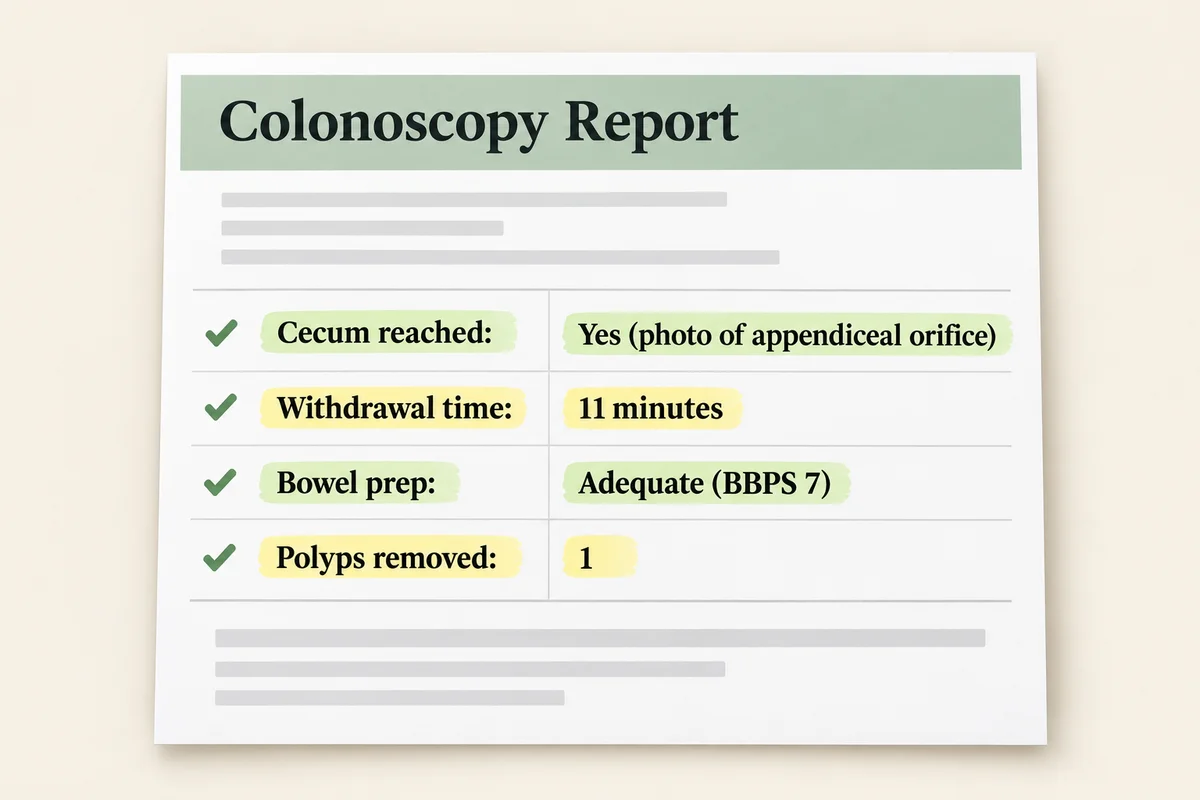
Here’s how I explain it in class. It’s not just going backwards for eight minutes. The clock that matters starts after you’ve properly cleaned everything and you can see everything. So it’s actually a quality eight-minute withdrawal, so the withdrawal time on the report should often say 10 or 11 minutes, because two or three went to cleaning. (If you’re comparing, the guideline times the whole withdrawal, cleaning included [1].)
So what if your report says 6 minutes? That’s below today’s average target, and it’s a fair thing to ask about. It isn’t proof something was missed, though. The guideline says outright that 8 minutes is an average, and that not every exam has to reach it [1]. Still, if I saw 6 minutes on my own report, I’d ask why.
Adenoma detection rate: the number that matters most
If you circle one number in this article, make it this one. Your doctor’s adenoma detection rate (ADR) is the share of their patients, 45 and older, in whom they find at least one adenoma [1]. Think of it as a batting average for polyp hunting. The guideline calls it the most clinically relevant quality measure in colonoscopy, and the most thoroughly validated [1].
You’re looking for at least 35% overall, the 2024 minimum (40% for men, 30% for women) [1]. By 2018, the average in US gastroenterology practices had already reached 38% [1].
Does it matter for you? Researchers at Kaiser Permanente in California followed 314,872 colonoscopies by 136 gastroenterologists [7]. Their ADRs ran from 7.4% to 52.5%. Say your doctor was in the lowest fifth. Their patients later got 9.8 cancers for every 10,000 people followed for a year. Top fifth? 4.8 [7]. That’s roughly half. And every 1% rise in ADR came with about 3% less cancer risk [7].
Can you find out your doctor’s ADR? Just ask. The guidelines expect every colonoscopist to measure it [1].
The prep is your half of the job
The prep will never make anybody’s list of favorite evenings. Still, it’s the one piece of quality that’s in your hands.
Try finding a dime on a muddy floor. Leftover stool can hide a polyp, so the cleaner you get, the fewer your doctor misses [1]. The guidelines expect adequate prep in at least 90% of outpatients, people who go home the same day [1]. Did your report call yours poor or inadequate? Then you’d usually repeat the colonoscopy within a year rather than wait 10 [1]. Ask about a split prep, too: half the evening before, half that morning. In randomized trials, it found more adenomas [1].
Then there’s your doctor’s half: did the scope make it all the way? A road crew that quits two miles short hasn’t paved the road. Your report should mention the cecum, the pouch where your colon begins, ideally with photos of its landmarks, like the opening of the appendix [1]. Doctors are expected to reach it in at least 95% of exams [1].
Endocuff Vision and AI: do the new tools help?
Where I do my colonoscopies, we use a really cool device called Endocuff Vision. It’s a soft cap on the tip of the scope, and it rakes open the colon folds with these little rubber fingers so you can see everything. You can also use AI to help find polyps.
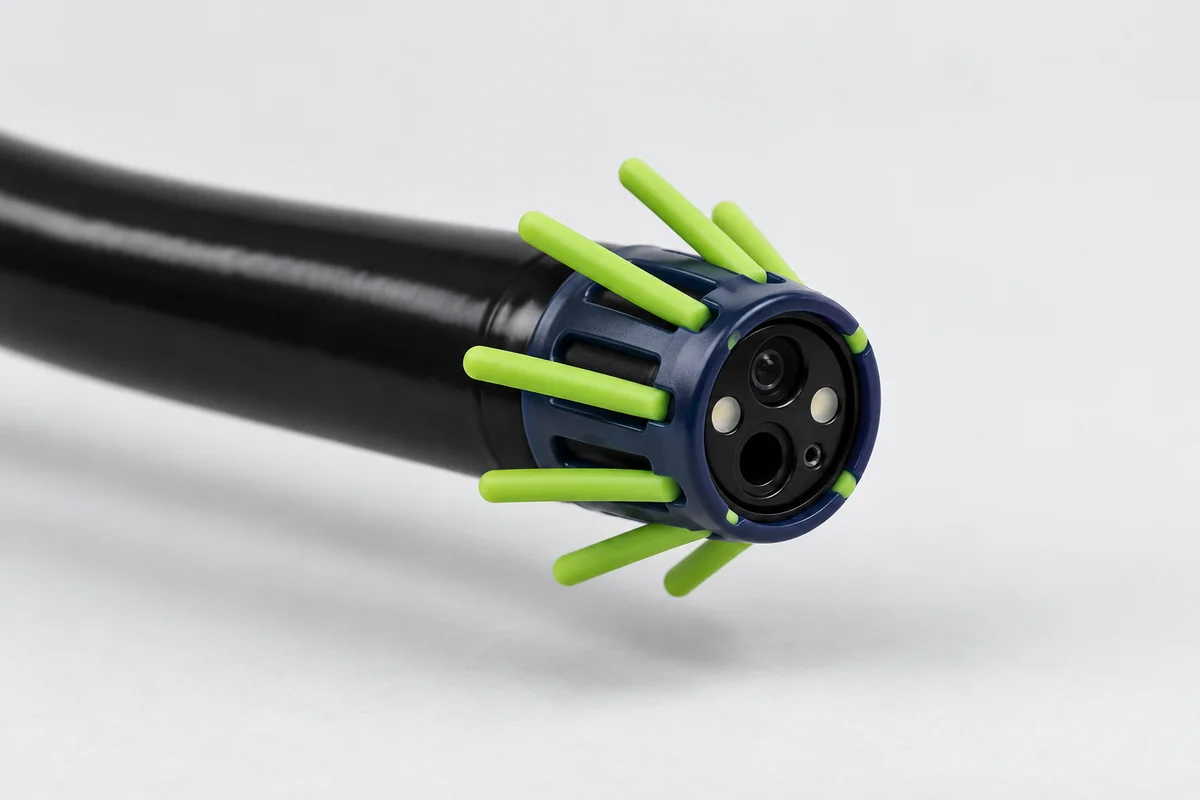
Across 8 randomized trials with 5,695 patients, Endocuff Vision raised the ADR from 45.6% to 49.8% [8]. The gain was larger for doctors whose ADR started under 30% [8]. In a second, smaller trial, two expert doctors got through the inspection about 2 minutes faster with it, and found no fewer polyps [9]. The 2024 guidelines list caps like this among the tools that improve ADR [1].
Now, AI. On paperwork you may see it called computer-aided detection. In April 2021, the US Food and Drug Administration (FDA) authorized GI Genius as the first AI device to help spot colon lesions in real time [10]. Lesions just means abnormal spots on the lining. Think of a backup camera beeping at the curb. It draws a green box on the screen around anything that might be a polyp, and then your doctor decides what it is and whether it comes out [10].
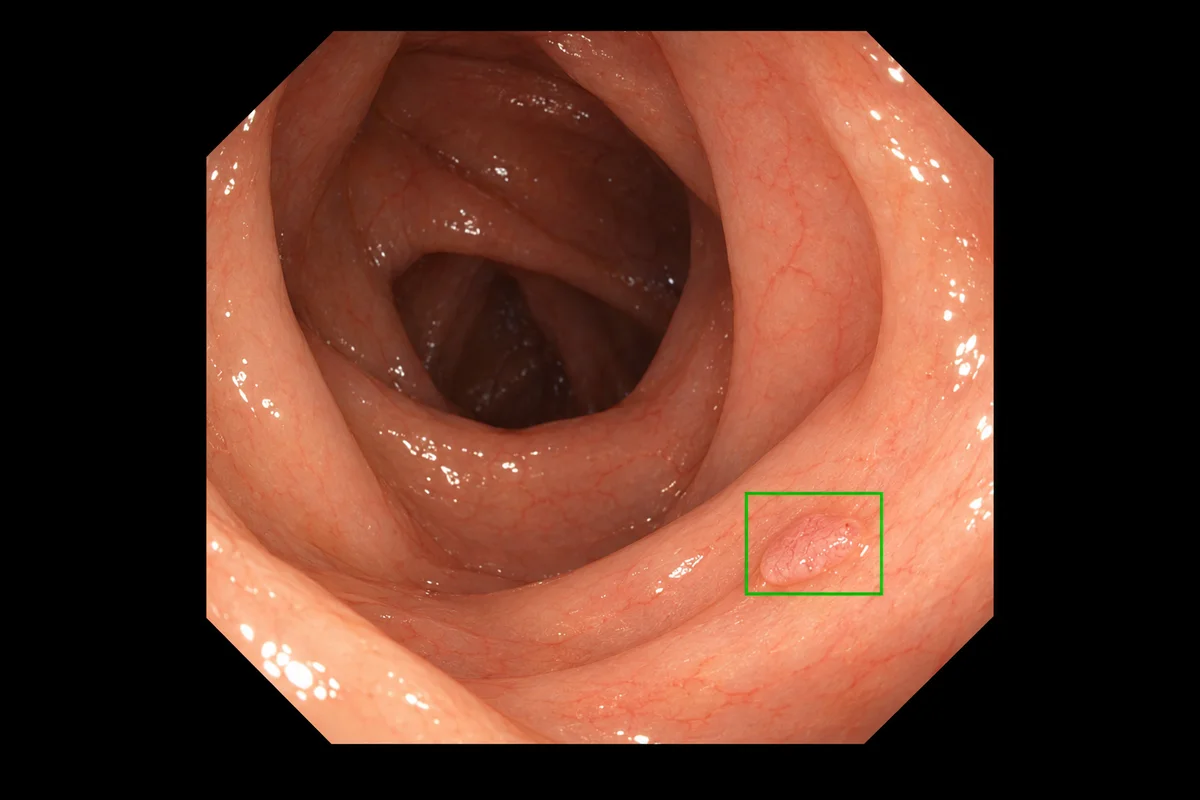
Pool 44 trials and more than 36,000 people, and AI lifted the ADR from 36.7% to 44.7% [11]. The fine print? Advanced growths, the more dangerous ones, barely budged: 0.16 per colonoscopy with AI and 0.15 without [11]. It also meant almost 2 extra harmless polyps removed for every 10 exams [11].
Two honest catches:
- Nobody’s shown yet that it prevents cancer deaths. In 2025, the American Gastroenterological Association made no recommendation for or against it, citing very low certainty about cancer outcomes [12].
- Can doctors come to lean on it, the way GPS can make you stop learning the roads? The FDA itself lists overreliance on the device as a risk, one that can lead to missed polyps or false alarms [10].
Do you need these tools for a good colonoscopy? They help. Just know that the trials counted polyps found, not cancers prevented [8][11]. A good flashlight doesn’t make a good searcher. A doctor with a high ADR and a careful withdrawal can do an excellent exam without them [1].
Gutsavi and Dr. Ted have no financial ties to Olympus, which makes Endocuff Vision, or to Cosmo or Medtronic, which make and sell GI Genius.
Questions to ask before your colonoscopy
You’re not grilling anyone. You’d ask a contractor how they’ll do the job before they open up your walls. Same idea. Ask at the visit before the day itself.
- “What’s your adenoma detection rate?” Look for 35% or higher [1].
- “What’s your average withdrawal time?” At least 8 minutes, on average, in normal exams [1].
- Ask whether they use Endocuff Vision or AI to help find polyps. It’s a plus, not a requirement.
- “What can I do to get a really good prep?” A split dose is worth asking about [1].
- Afterwards, check the report. Did they reach the cecum, and how was your prep rated? If it was poor, ask when to repeat it [1].
Not sure how to open? Try something like:
“I’ve read that adenoma detection rate and withdrawal time matter. Do you track yours?”
When to call your doctor
A clear colonoscopy is good news, but it’s not a lifetime warranty. Call your doctor about any of these, even if your last scope was recent:
- blood in your stool, or black, tarry stools
- Losing weight without trying? Don’t wait.
- a change in your bowel habits that sticks around for more than a few weeks
- tiredness, or anemia (a low red blood cell count) on a blood test
- belly pain that doesn’t go away
Right after a colonoscopy, get same-day care for severe belly pain, a fever, or heavy bleeding. Bring your last report to any visit, too, so your doctor sees the date, the withdrawal time, the prep rating and what was found.
Frequently asked questions
Can you have colon cancer 1 year after a colonoscopy?
Yes, though it’s uncommon. Doctors call these post-colonoscopy or interval cancers, meaning they show up between scheduled checks. Across 12 studies, 3.7% of colon cancers were found 6 to 36 months after a colonoscopy [2], most often because something was missed or not fully removed [3]. So new symptoms within a year of a clear exam still deserve a call to your doctor.
What is a good adenoma detection rate?
At least 35%, if you go by the 2024 ACG and ASGE guidelines (40% for men, 30% for women) [1]. Higher is better. In a large California study, patients of doctors in the top fifth for ADR got about half as many later cancers as patients of the bottom fifth [7]. The US average had reached 38% by 2018 [1].
How long should a colonoscopy take?
The scope part is shorter than you’d think. In one trial, reaching the cecum took about 4 minutes [9]. Then came 6 to 8 minutes of careful looking on the way out, not counting cleaning or polyp removal [9]. Guidelines want the withdrawal to average at least 8 minutes [1]. Your whole visit runs longer, with check-in, sedation and recovery.
Does bowel cancer show up on a colonoscopy?
Yes. With a colonoscopy, your doctor can see a cancer, take a sample, and remove polyps before they can turn into one. It isn’t perfect, though. About 1 in 27 colon cancers is found within 3 years after a colonoscopy that didn’t catch it [2]. Your prep and your doctor’s careful withdrawal both lower that risk [1][6].
Get the next one in your inbox
Join the Gutsavi newsletter for plain answers on gut health from a gastroenterologist, minus the jargon. Seeing blood? Read Do I need a colonoscopy for rectal bleeding? and my article on GI cancers in younger adults. There’s more in our Learn hub.
Sources
- Rex DK, Anderson JC, Butterly LF, et al. Quality indicators for colonoscopy. Am J Gastroenterol. 2024;119(9):1754-80. doi:10.14309/ajg.0000000000002972
- Singh S, Singh PP, Murad MH, Singh H, Samadder NJ. Prevalence, risk factors, and outcomes of interval colorectal cancers: a systematic review and meta-analysis. Am J Gastroenterol. 2014;109(9):1375-89. doi:10.1038/ajg.2014.171
- Robertson DJ, Lieberman DA, Winawer SJ, et al. Colorectal cancers soon after colonoscopy: a pooled multicohort analysis. Gut. 2014;63(6):949-56. PMC4383397
- Zhao S, Wang S, Pan P, et al. Magnitude, risk factors, and factors associated with adenoma miss rate of tandem colonoscopy: a systematic review and meta-analysis. Gastroenterology. 2019;156(6):1661-74. doi:10.1053/j.gastro.2019.01.260
- Barclay RL, Vicari JJ, Doughty AS, Johanson JF, Greenlaw RL. Colonoscopic withdrawal times and adenoma detection during screening colonoscopy. N Engl J Med. 2006;355(24):2533-41. doi:10.1056/NEJMoa055498
- Shaukat A, Rector TS, Church TR, et al. Longer withdrawal time is associated with a reduced incidence of interval cancer after screening colonoscopy. Gastroenterology. 2015;149(4):952-7. doi:10.1053/j.gastro.2015.06.044
- Corley DA, Jensen CD, Marks AR, et al. Adenoma detection rate and risk of colorectal cancer and death. N Engl J Med. 2014;370(14):1298-306. doi:10.1056/NEJMoa1309086
- Patel HK, Chandrasekar VT, Srinivasan S, et al. Second-generation distal attachment cuff improves adenoma detection rate: meta-analysis of randomized controlled trials. Gastrointest Endosc. 2021;93(3):544-53. doi:10.1016/j.gie.2020.09.045
- Rex DK, Slaven JE, Garcia J, et al. Endocuff Vision reduces inspection time without decreasing lesion detection: a clinical randomized trial. Clin Gastroenterol Hepatol. 2020;18(1):158-62. doi:10.1016/j.cgh.2019.01.015
- US Food and Drug Administration. De Novo classification request for GI Genius (DEN200055): decision summary. Granted April 9, 2021. accessdata.fda.gov (PDF)
- Soleymanjahi S, Huebner J, Elmansy L, et al. Artificial intelligence-assisted colonoscopy for polyp detection: a systematic review and meta-analysis. Ann Intern Med. 2024;177(12):1652-63. doi:10.7326/ANNALS-24-00981
- Sultan S, Shung DL, Kolb JM, et al. AGA living clinical practice guideline on computer-aided detection-assisted colonoscopy. Gastroenterology. 2025;168(4):691-700. doi:10.1053/j.gastro.2025.01.002
- US Preventive Services Task Force. Screening for colorectal cancer: US Preventive Services Task Force recommendation statement. JAMA. 2021;325(19):1965-77. doi:10.1001/jama.2021.6238
This article is for education only and isn’t medical advice. Talk with your own doctor about your care.
This article is for education only and isn't a substitute for advice from your own doctor. If something feels off, talk to your care team.