
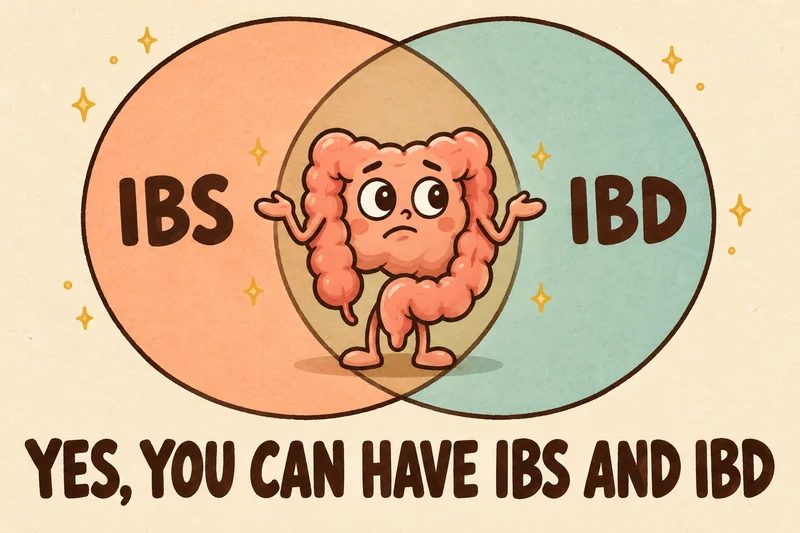
Can you have IBS and IBD at the same time? Yes. Irritable bowel syndrome (IBS) and inflammatory bowel disease (IBD) are one letter apart on paper, but they’re separate conditions. Having one doesn’t buy you a pass on the other. Take someone whose Crohn’s or colitis (the two main kinds of IBD) has finally gone quiet. About 1 in 3 people in that spot still get symptoms that fit IBS [1].
If you read nothing else
- They overlap a lot, more so if you have Crohn’s disease [1][2].
- Worried your IBS will turn into IBD? It isn’t known to. Early IBD can pass for IBS, though, so sometimes the IBS label shows up first [6][8].
- Ask your doctor about a stool test for gut inflammation. It does a lot of the sorting [8].
Same street, totally different problems
I put that heading on a post back in January, and I’d still sign it. IBS can be living in the same neighborhood as IBD. Yes, they can coexist. They just don’t answer to the same fixes.
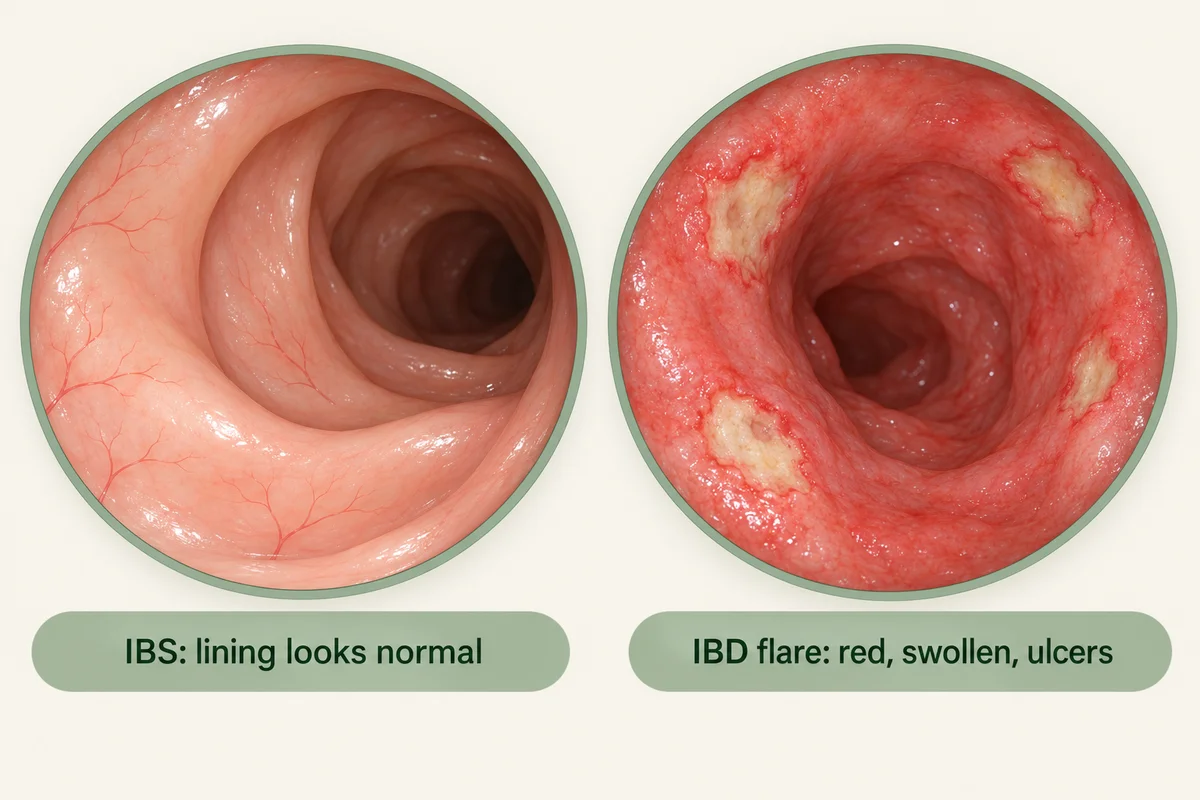
Here’s the plumbing version. With IBD, the pipe itself gets damaged. That’s Crohn’s disease or ulcerative colitis, where your own immune system goes after the gut lining. During a flare, when the disease is active, a scope (a tiny camera on a thin tube) shows a red, swollen lining, often dotted with open sores called ulcers [5].
With IBS, the pipe looks fine and the trouble is in the wiring. IBS is sensitivity and miscommunication between the gut and the brain. Picture the gut’s volume knob cranked too high, so ordinary stretching and gas come through as pain. Your pain, bloating and bathroom changes are real, even though the lining looks normal on a scope [4]. And no, it’s not “just in your head.”
IBS isn’t spotless, though. Look hard enough and researchers find subtle signs of inflammation in some IBS cases [6]. Could that be part of why the two overlap? Plenty of experts think so [3][6].
How often do IBS and IBD overlap?
More often than most people would guess. Pool 13 studies and 39% of people with IBD have symptoms that meet IBS criteria. That’s close to five times the odds seen without IBD [2].
Calm the IBD down and the overlap doesn’t leave with it. The 2026 panel’s review of 33 studies found IBS-type symptoms in about 30% of people in remission, when their IBD is quiet [1].
Wondering about IBS and ulcerative colitis specifically? It shows up there too. Across the older studies, flaring or quiet, it was about 36% with ulcerative colitis against 46% with Crohn’s [2].
Until recently, doctors didn’t even have a standard name or definition for it [1]. So in 2026 a panel from the Rome Foundation (the group behind the official IBS criteria) and the IOIBD (International Organization for the Study of Inflammatory Bowel Disease) gave it a name: “IBD with IBS-like symptoms” [1]. Not exactly catchy. I call it IBS in the setting of IBD.
Still cramping even though your IBD is quiet? I answer that one in its own guide: IBD in remission but still have symptoms.
Can IBS turn into IBD?
There’s no good evidence that it does. IBS doesn’t leave visible damage in your gut [4]. So why does it sometimes look like it happened?
Partly it’s the timeline. A large US study followed 9,341 people newly diagnosed with IBS [6]. They went on to get an IBD diagnosis 8.6 times as often as similar people without IBS, typically about 2 years later [6]. Among those whose IBS diagnosis was clearest, the gap was about 15 times [6].
Numbers like 8.6 times are born to be scary headlines. Let’s look at the real numbers. In that study, about 1 in 420 people with IBS got an IBD diagnosis each year, compared with about 1 in 3,600 without IBS [6]. If you have IBS, odds are good you’ll never get IBD.
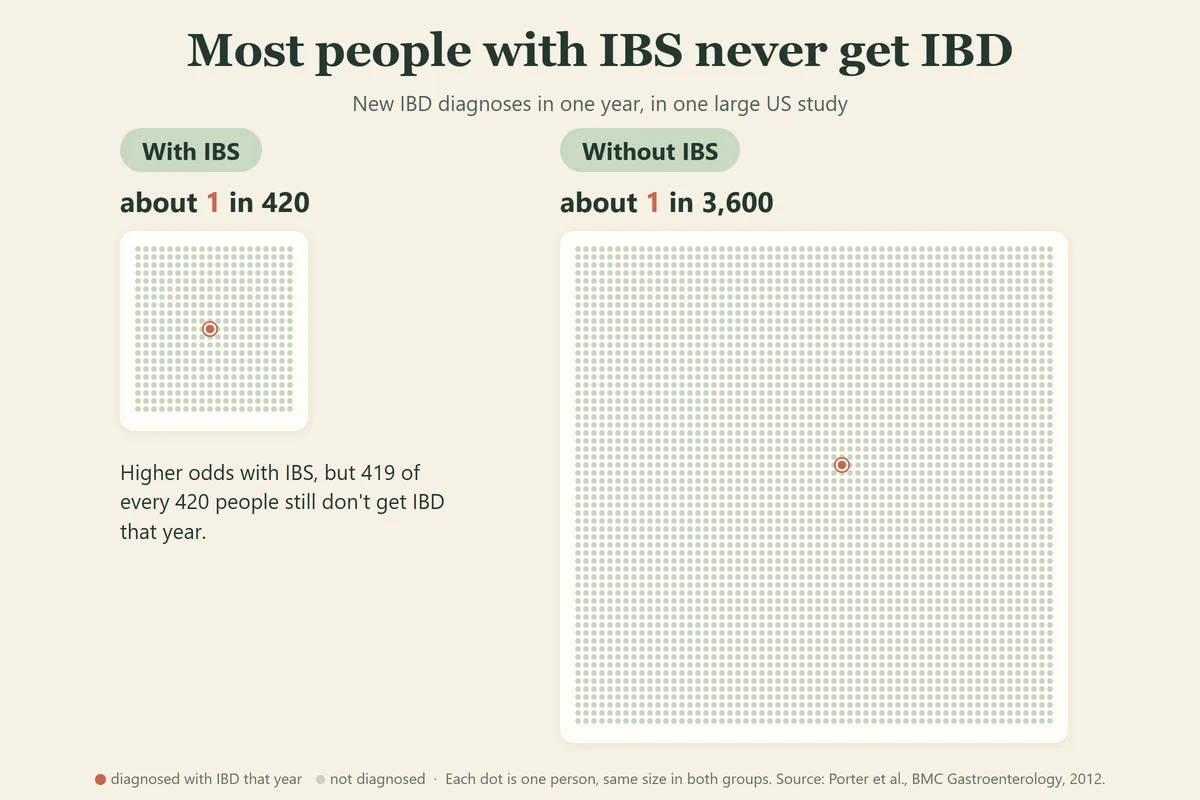
So why the link at all? Researchers still argue about that one. Some of those “IBS” cases may have been early IBD that hadn’t shown its hand yet. Ever had a car run rough for months before the check-engine light finally came on? Same idea. The symptoms overlap, which is why gut doctors check for inflammation when IBS comes with diarrhea [6][8]. A gut infection (a stomach bug, the food-poisoning kind) also roughly doubled the risk in that study [6]. And some experts think the two conditions share roots, so they may sit closer together than we once thought [3][6].
Told “IBS” first, then diagnosed with IBD?
Getting to the right diagnosis can take a while. In a US study of 177 people with IBD, the typical (median) wait from first symptoms to diagnosis was about 9.5 months for Crohn’s and about 3 months for ulcerative colitis [7]. In Crohn’s, the longest waits were linked to more complications, including narrowing of the bowel [7].
I still meet patients who were told it was IBS for years before a scope showed Crohn’s.
Once the IBD is under control, can the IBS part stick around? It can. In a 6-year study, IBS-type symptoms weren’t linked to more flares, steroids, hospital stays or surgery [9]. They did mean more clinic visits and more scopes [9].
How do doctors tell which one is acting up?
Symptoms alone can fool any doctor, me included, because cramps, urgency and loose stools show up in both.
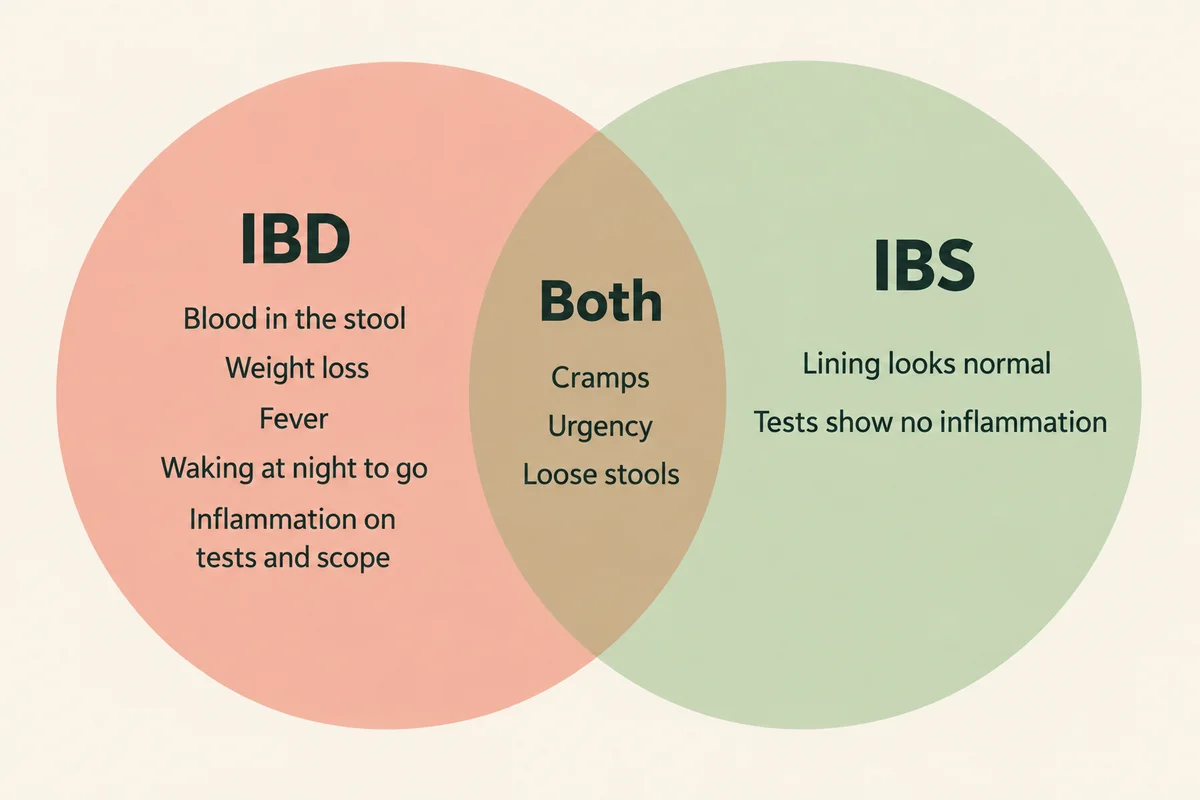
Is diarrhea a big part of your IBS? Then the American College of Gastroenterology (ACG) suggests a stool test called fecal calprotectin [8]. What’s the lab hunting for? A protein white blood cells let loose when your gut is inflamed. If it comes back normal, IBD becomes less likely. Your doctor may also order a blood test for celiac disease, where an immune reaction to gluten damages the small intestine [8].
Already have IBD? Then the 2026 panel wants proof there’s no active inflammation before anyone calls your symptoms IBS-like [1]. You and your GI team sort that out with tests, not hunches. I walk through each one in Flare or IBS? How we find out.
Can you treat both at once?
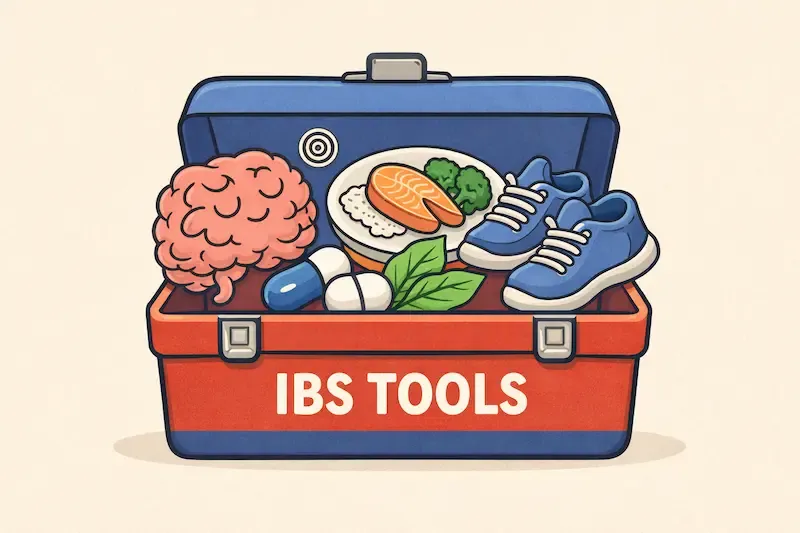
Yes, and each one gets its own toolbox. Your IBD medicine keeps working on the inflammation. For the IBS side, though, piling on more IBD drugs isn’t the answer [1]. That would be calling the plumber for a wiring problem. I usually start with a short low FODMAP trial (a few weeks off certain hard-to-digest carbs), then add other tools if it isn’t enough.
Here’s how I put it to patients. It feels like inflammatory bowel disease, but in fact it’s probably just IBS. And you can do certain treatments for the IBS, which will make the symptoms better.
What the 2026 panel rated appropriate [1]:
- A short low FODMAP diet. FODMAP stands for fermentable oligosaccharides, disaccharides, monosaccharides and polyols, which is why nobody says the long version. They’re carbs your gut may handle poorly. In a trial of 52 people with quiet IBD, 52% felt adequate relief on low FODMAP, against 16% on a comparison diet [10].
- Psyllium, a fiber made from plant seed husks, and the one I use most often in clinic. Got a narrowed bowel (a stricture)? Then skip it.
- Gut-directed hypnotherapy (deep relaxation with guided suggestions aimed at your gut) or CBT, cognitive behavioral therapy, where you work with a therapist on how you think and react. Hypnosis for your bowels? Nobody swings a pocket watch, and it still made the list.
- Medicines matched to your main symptom, picked with your GI team (GI is short for gastrointestinal, meaning your gut).
For IBS, the ACG recommends a limited low FODMAP trial, not a forever diet [8]. After a few weeks, you bring foods back to find your triggers. Our Chef Savi recipe generator can help you cook through that stretch, and so can our low FODMAP recipes.
When to call your doctor
Don’t wait on these, whether you have IBS, IBD or both:
- Any blood in your stool. IBS-like symptoms don’t include bleeding [1].
- Diarrhea that wakes you up at night
- Weight loss you can’t explain
- A fever along with gut symptoms
- Pain that keeps getting worse, or a pattern that’s suddenly different from your usual
Frequently asked questions
Which is more serious, IBD or IBS?
How do I tell if I have IBS or IBD?
You can’t tell from symptoms alone. Your doctor can, with tests. With diarrhea in the mix, the usual starting point is fecal calprotectin, a stool test for inflammation [8]. Add blood tests, and sometimes a colonoscopy (a scope of the whole colon) as the final judge. Bleeding, weight loss, waking up at night to poop? Those push me toward IBD.
Does having IBS mean I’ll get IBD?
No. If you have IBS, you’ll most likely never develop IBD. People with an IBS diagnosis are diagnosed with IBD more often than others, but it’s still uncommon: about 1 in 420 a year in one large study [6]. If new warning signs show up, get checked.
Cook your way through a low FODMAP trial
Trying low FODMAP for IBS-like symptoms? Chef Savi turns what’s in your fridge into gut-friendly recipes in seconds. Browse our abdominal pain and bloating guide, read The Remission Playbook and how stress talks to your gut, or join the Gutsavi newsletter.
Sources
- Ma C, Ford AC, Hashash JG, et al. Recommendations for the evaluation and management of inflammatory bowel disease with irritable bowel syndrome-like symptoms: a joint Rome Foundation and IOIBD consensus. Gastroenterology. 2026;171(3):504-20. doi:10.1053/j.gastro.2026.04.008
- Halpin SJ, Ford AC. Prevalence of symptoms meeting criteria for irritable bowel syndrome in inflammatory bowel disease: systematic review and meta-analysis. Am J Gastroenterol. 2012;107(10):1474-82. doi:10.1038/ajg.2012.260
- Colombel JF, Shin A, Gibson PR. AGA Clinical Practice Update on functional gastrointestinal symptoms in patients with inflammatory bowel disease: expert review. Clin Gastroenterol Hepatol. 2019;17(3):380-90. doi:10.1016/j.cgh.2018.08.001
- National Institute of Diabetes and Digestive and Kidney Diseases. Definition & facts for irritable bowel syndrome. Reviewed November 2017. niddk.nih.gov
- National Institute of Diabetes and Digestive and Kidney Diseases. Definition & facts of ulcerative colitis. Reviewed September 2020. niddk.nih.gov
- Porter CK, Cash BD, Pimentel M, Akinseye A, Riddle MS. Risk of inflammatory bowel disease following a diagnosis of irritable bowel syndrome. BMC Gastroenterol. 2012;12:55. doi:10.1186/1471-230X-12-55
- Nguyen VQ, Jiang D, Hoffman SN, et al. Impact of diagnostic delay and associated factors on clinical outcomes in a U.S. inflammatory bowel disease cohort. Inflamm Bowel Dis. 2017;23(10):1825-31. doi:10.1097/MIB.0000000000001257
- Lacy BE, Pimentel M, Brenner DM, et al. ACG clinical guideline: management of irritable bowel syndrome. Am J Gastroenterol. 2021;116(1):17-44. doi:10.14309/ajg.0000000000001036
- Fairbrass KM, Hamlin PJ, Gracie DJ, Ford AC. Natural history and impact of irritable bowel syndrome-type symptoms in inflammatory bowel disease during 6 years of longitudinal follow-up. Aliment Pharmacol Ther. 2022;56(8):1264-73. doi:10.1111/apt.17193
- Cox SR, Lindsay JO, Fromentin S, et al. Effects of low FODMAP diet on symptoms, fecal microbiome, and markers of inflammation in patients with quiescent inflammatory bowel disease in a randomized trial. Gastroenterology. 2020;158(1):176-88. doi:10.1053/j.gastro.2019.09.024
This article is for education only and isn’t medical advice. Talk with your own doctor about your care.
This article is for education only and isn't a substitute for advice from your own doctor. If something feels off, talk to your care team.