
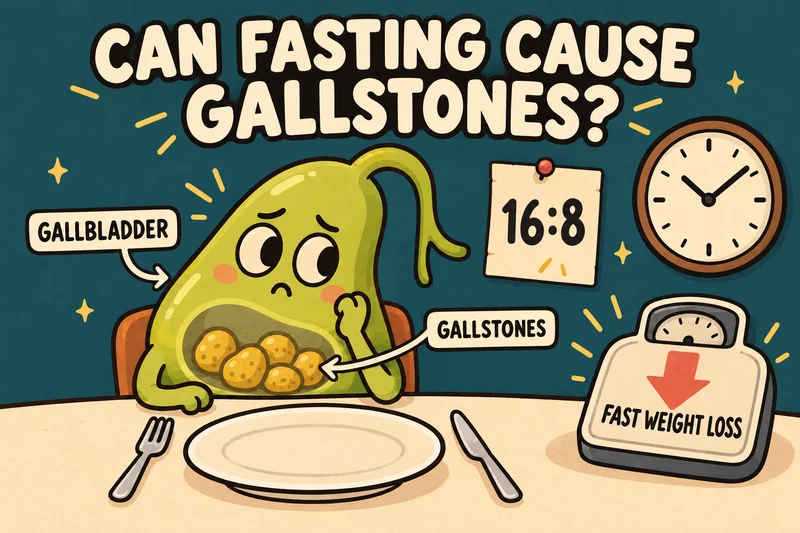
Does fasting cause gallstones? It can, but mostly through how fast the weight comes off, not the eating window itself. When you go a long time without food, your liver sends extra cholesterol into your bile and your gallbladder sits there full, waiting for a meal [1][3]. Lose weight quickly on top of that and stones can form within weeks [11][13]. Ordinary intermittent fasting, though, has never been tested head-on, so the honest answer for a 16:8 schedule is “possibly, and less than you’d fear.”
If you read nothing else
- Worried about your gallbladder? Watch how fast you’re losing, more than when you eat. Rapid weight loss is the trigger with real proof behind it: in one study, about a quarter of people on a strict diet grew new stones in 8 weeks [11].
- Big surveys tie long overnight fasts and skipped breakfasts to gallstones. That’s a link, not proof [8][9].
- Lose it slowly, keep a little healthy fat in your meals, and know the signs of a gallbladder attack [3][4][14].
Why I wanted to write this one
A while back I sent my team two screenshots of an AI answer on my phone. It claimed intermittent fasting can lead to an inflamed gallbladder, and I wanted an article “about how intermittent [fasting] can potentially lead to gallstones.” Notice the word potentially? The AI answer leaned on a pharmacy website and a supplement seller’s site. So we went to the actual research instead.
I’m not anti-fasting. But I see a lot of people who think skipping meals is the whole plan, and I’ll say it plainly: “not eating at all is not the answer.” It’s not enough to just not eat. How you eat when you do eat, and how fast the weight comes off, matter to your gallbladder too. (More on that in eating less but not losing weight.)
A woman in her forties came to see me after her gallbladder had already been taken out. She’d gone all in on a fasting plan she found online: one meal a day, usually grilled chicken on lettuce with fat-free dressing, plus two days a week of nothing but water and black coffee. Results? About 28 pounds gone in 8 weeks. She felt great about it.
Then came her sister’s birthday dinner. Steak, potatoes, cake, the works. That night she woke up with a hard, gripping pain under her right ribs that went through to her back. It eased after a few hours, so she figured it was the steak. A week later it came back and didn’t let up, this time with a fever. The ER ultrasound showed a swollen gallbladder packed with small stones. And get this. Two years earlier, an ultrasound done for something else had shown a perfectly clean gallbladder.
Surgeons removed it the next day, and she went home soon after. She’s doing fine. She still eats in a window, by the way. She just eats real meals in it now, with some olive oil on the salad, and she’s losing weight at a pace that doesn’t break any records. The fasting window wasn’t the villain. The speed and the near-zero-fat meals were.
How your gallbladder works with meals
Put a hand on your right side, just below the ribs. That’s roughly where your gallbladder lives, a small, pear-shaped pouch tucked under the liver [1]. Your liver makes bile, a digestive juice made mostly of cholesterol, bile salts and bilirubin (a yellow waste pigment) [1]. Between meals your gallbladder holds on to that bile. When you eat, your body tells it to squeeze the bile into your small intestine to help digest the food [1].
Who gives the order? A hormone called cholecystokinin, or CCK, which your gut releases when food arrives. Fat and protein get it going strongly; sugar, not so much [7]. In one classic study, people’s gallbladders shrank by about half within 30 minutes of a meal [7].
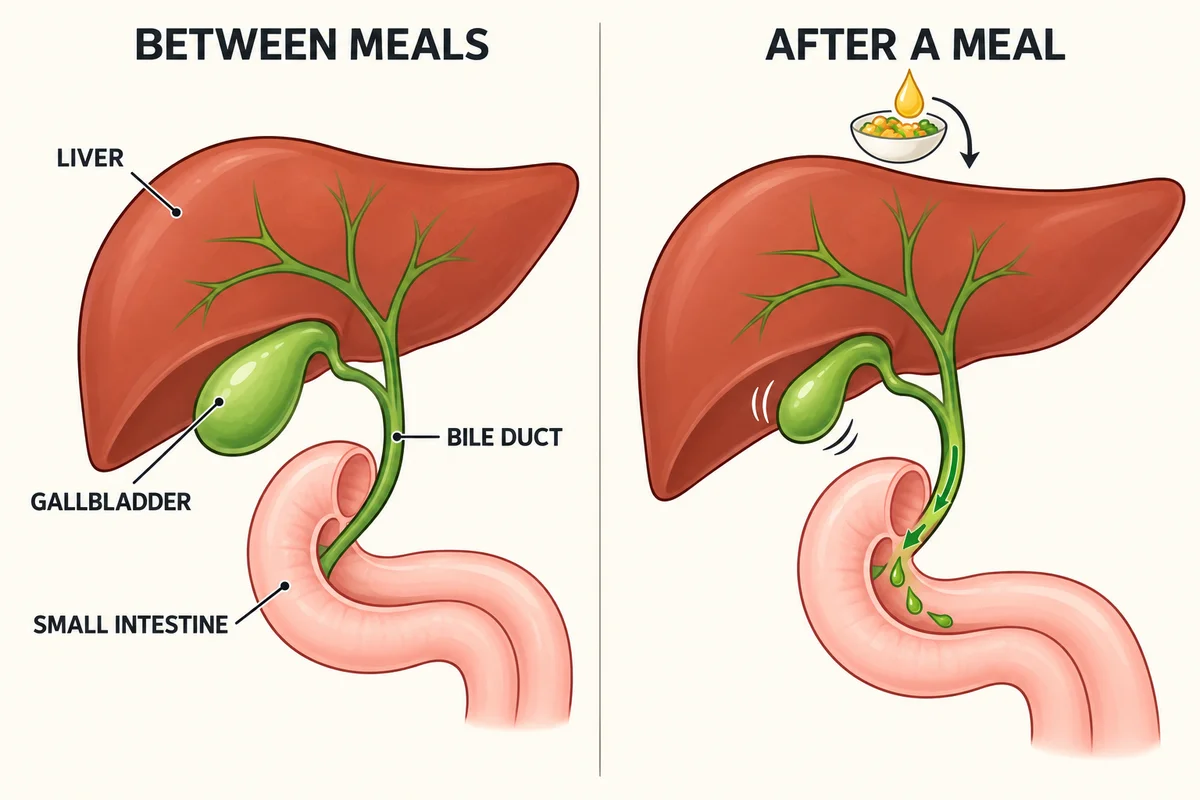
Your gallbladder works like a ketchup squeeze bottle that gets used every time you eat. Skip meals for long stretches and nobody squeezes the bottle.
Fasting and gallstones: what happens to the bile
Gallstones are hard, pebble-like lumps that form in your gallbladder, usually out of cholesterol, anywhere from the size of a grain of sand to a golf ball [1]. Two things help them grow, and fasting can nudge both:
- Bile with too much cholesterol in it. When you don’t eat for a long time or you lose weight quickly, your liver releases extra cholesterol into the bile [3].
- A gallbladder that sits still. Stones may form when it doesn’t empty completely or often enough [2]. Fast weight loss can also keep it from emptying properly [3].
Stack a long fast on top of fast weight loss and you’ve got both problems at once. Richer bile, and a gallbladder that isn’t flushing it out.
Does intermittent fasting cause gallstones? What the research actually shows
Here’s where I have to be straight with you. We couldn’t find a single trial that put people on intermittent fasting and then checked their gallbladders for new stones. What we have is indirect:
- Long overnight fasts. A US government study followed 4,730 women for about 10 years. The longer their usual overnight fast, the more likely they were to land in the hospital with gallstone disease, and dieting and low fiber raised the risk too [8].
- Next, the late first meal. In national survey data on 6,547 American adults, the later people ate their first meal of the day, the more likely they were to report gallstones [9]. Skip breakfast, higher odds. But it was a snapshot survey, and the authors say it can’t prove cause [9].
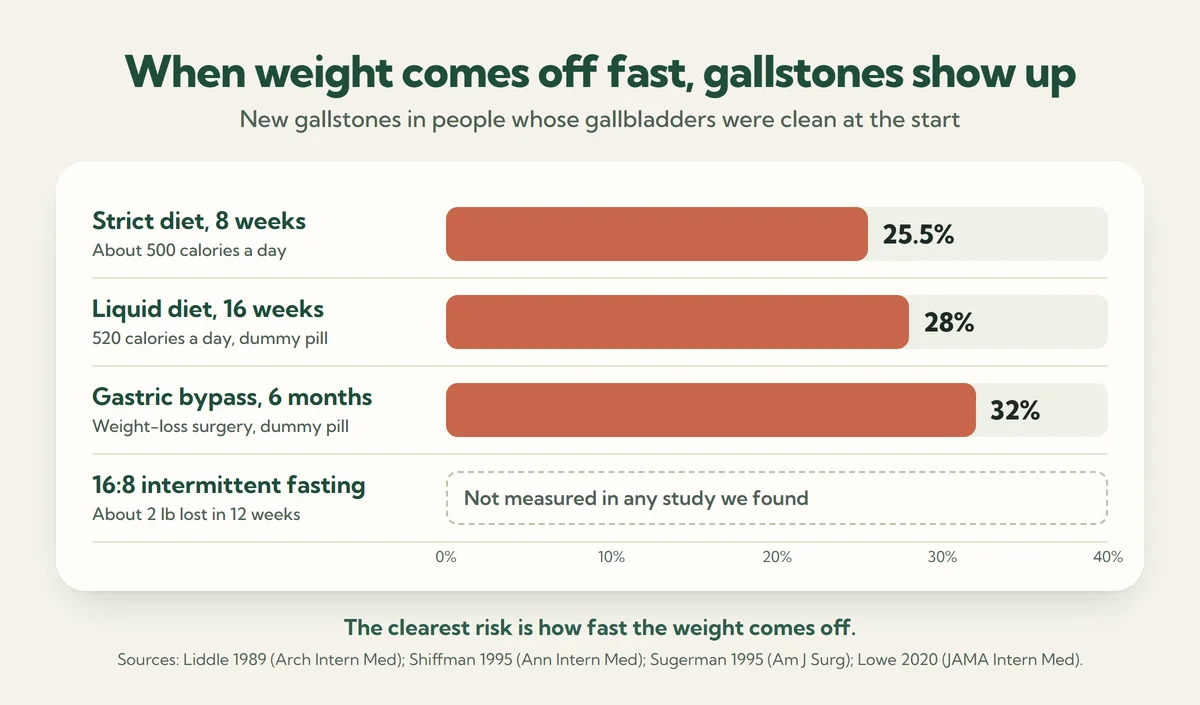
- And what about the pace of a real 16:8 plan? In a US trial (food only from noon to 8 p.m.), people lost about 2 pounds over 12 weeks, no faster than people eating three meals a day [10]. That’s nowhere near the speed that worries me.
So if you’re doing a typical 16:8 schedule, that’s probably not your main problem. An aggressive plan is a different animal. One tiny meal a day, multi-day water fasts, anything that strips off 3 or more pounds a week. That’s where the evidence gets solid.
Rapid weight loss gallstones: the risk with real proof
This part isn’t a maybe. When weight comes off fast, gallstones show up:
- Very-low-calorie diets. In a San Francisco study, 51 people started a diet of about 500 calories a day. Everyone’s gallbladder was clean on ultrasound at the start. After 8 weeks, 13 of them (25.5%) had gallstones, and 3 eventually needed their gallbladder out. None of the 26 people who weren’t dieting developed anything [11].
- The speed limit. Researchers who pooled the weight-loss studies found the gallstone risk climbs steeply once weight loss passes about 1.5 kilograms (roughly 3.3 pounds) a week [12].
- Weight-loss surgery. After gastric bypass, 32% of patients on a dummy pill had gallstones within 6 months [17].
- Will those stones hurt? Between 10% and 25% of people with obesity may form gallstones within a few months of starting a very-low-calorie diet, and perhaps a third of them will have symptoms [13].
- GLP-1 weight-loss drugs. In a pooled look at 76 trials, these drugs were linked to more gallstones and gallbladder inflammation, especially at higher doses, with longer use, and when used for weight loss [18]. More on these in are GLP-1 drugs safe.
One small upside: in that San Francisco study, stones disappeared in 4 of the 11 people followed after they went back to normal eating [11]. Don’t count on it, though. Three of them needed surgery [11].
Who’s more likely to get gallstones
Gallstones are common. About 10 to 15 percent of Americans have them, and most never know [1][2]. So who gets them? Your odds go up if you [1][6]:
- Are a woman, especially with extra estrogen from pregnancy, birth control pills or hormone therapy
- Are older, or have family members with gallstones
- Are American Indian or Mexican American
- Have obesity, diabetes or insulin resistance, high triglycerides, or metabolic syndrome
- Have lost weight fast, including after weight-loss surgery, or keep losing and regaining it [3]
- Eat a diet high in calories and refined carbs and low in fiber
Here’s the rub. The people most drawn to aggressive fasting plans, often women with extra weight to lose, are already at higher risk. Check several of those boxes? Ease in.
Gallbladder attack or cholecystitis? When to go to the ER
Most gallstones are silent. They just sit there, cause no symptoms, and usually need no treatment [2][5]. Trouble starts when a stone blocks the way out.
A gallbladder attack (doctors call it biliary colic) is pain in your upper right belly that can last several hours. It often follows a heavy meal and tends to show up in the evening or at night, then usually stops once the stone shifts [2]. Had one? More are likely [2]. And yes, the big meal that breaks a long fast is exactly that kind of meal.
Acute cholecystitis is the more serious one. The gallbladder itself gets inflamed, often because a stone stays stuck in its outlet [6]. The pain tends to hang on, and it can spread to your back or under your right shoulder blade [6].
Get care right away if you have:
These can mean infection or inflammation of your gallbladder, liver or pancreas, and blocked ducts left untreated can be life-threatening [2]. Pain that came and went after a meal still deserves a visit, even once it’s gone, because it may come back [5].
If it does come to surgery, you can live normally without a gallbladder. Taking it out is one of the most common operations in US adults, and many people go home the same day [5].
How to fast without feeding your gallbladder stones
If fasting works for you, here’s how I’d protect your gallbladder:
- Watch the scale’s speed, not just the number. Experts suggest starting with 5 to 10 percent of your body weight over 6 months [3]. At 200 pounds, you’d be aiming for 10 to 20 pounds in half a year, while stones get much more common past about 3 pounds a week [12].
- Put a little healthy fat in the meal that breaks your fast. Olive oil on the salad, some fish, a handful of nuts. Healthy fats help your gallbladder contract and empty [4]. In one trial of rapid weight loss, 4 of 6 people on an almost fat-free diet formed stones, versus none of 7 who got a small fatty meal each day [14]. A pooled look at the weight-loss trials found the same pattern, though its strictest statistical test didn’t confirm it [15].
- Don’t break a long fast with a feast. Heavy meals are when attacks tend to hit [2]. Go easy on the fried food and dessert [4].
- Eat real fiber. Fruit, vegetables, beans and whole grains, with fewer refined carbs and less sugar [4].
- Skip crash diets and yo-yo cycles. Losing and regaining weight over and over may raise your odds too [3].
- Planning a very-low-calorie diet or weight-loss surgery? Ask your doctor about ursodiol. It’s a prescription bile acid pill. In a trial of 1,004 people on a 520-calorie diet, gallstones formed in 28% on a dummy pill versus 3% on ursodiol [16]. The FDA approves it for exactly this: people with obesity who are losing weight fast [19]. Whether you need it is your doctor’s call, not a do-it-yourself fix.
A meal plan that keeps some fat and fiber in the window is easier with ideas on hand. Chef Savi can turn what’s in your fridge into a recipe in seconds.
When to see your doctor
- Any of the “get care right away” signs above
- Pain under your right ribs after meals, even if it passes
- Planning a very-low-calorie diet, multi-day fasts or weight-loss surgery? Book a visit first, all the more so with known gallstones [3]
- If the scale keeps dropping more than about 3 pounds a week, even when you weren’t aiming for that, mention it [12]
Frequently asked questions
Can intermittent fasting cause a gallbladder attack?
Should I stop intermittent fasting if I have gallstones?
Does one meal a day cause gallstones?
No study has tested one meal a day (OMAD) for gallstones directly. It does mean long stretches without food. Long overnight fasts are linked to more gallstone hospital stays in women [8], and if OMAD cuts calories hard, the weight can come off fast. More in is eating one meal a day healthy.
Can gallstones from fasting go away?
Slow down the scale, not the clock
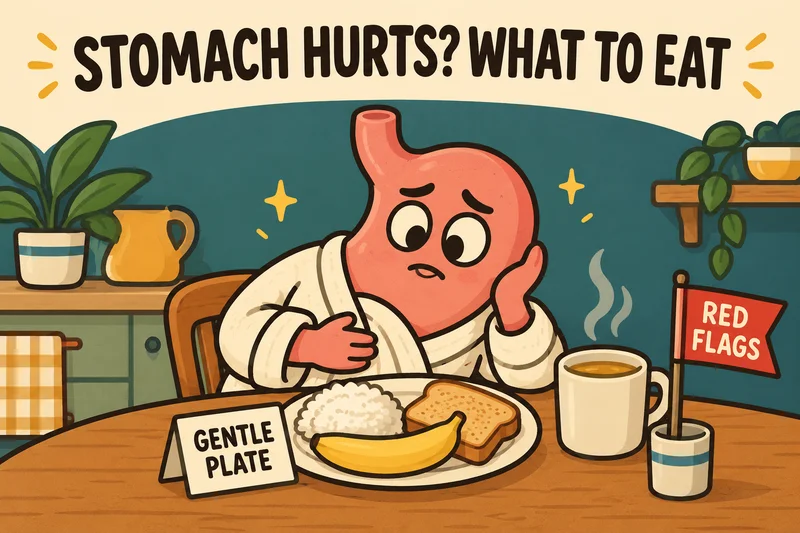
Fasting isn’t automatically bad for your gallbladder. Fast, hard weight loss is. Keep the pace slow and keep some healthy fat in your meals, and know the signs of an attack. If your plan is aggressive, bring your doctor in before you start. For more on belly pain, our abdominal pain and bloating hub has you covered, and what to eat when your stomach hurts covers gallbladder-friendly meals. The Gutsavi newsletter brings new articles to your inbox.
Sources
- National Institute of Diabetes and Digestive and Kidney Diseases (NIDDK). Definition & facts for gallstones. Reviewed November 2017. niddk.nih.gov
- NIDDK. Symptoms & causes of gallstones. Reviewed November 2017. niddk.nih.gov
- NIDDK. Dieting & gallstones. Reviewed November 2017. niddk.nih.gov
- NIDDK. Eating, diet, & nutrition for gallstones. Reviewed November 2017. niddk.nih.gov
- NIDDK. Treatment for gallstones. Reviewed November 2017. niddk.nih.gov
- MedlinePlus, US National Library of Medicine. Acute cholecystitis. medlineplus.gov
- Liddle RA, Goldfine ID, Rosen MS, Taplitz RA, Williams JA. Cholecystokinin bioactivity in human plasma: molecular forms, responses to feeding, and relationship to gallbladder contraction. J Clin Invest. 1985;75(4):1144-52. doi:10.1172/JCI111809
- Sichieri R, Everhart JE, Roth H. A prospective study of hospitalization with gallstone disease among women: role of dietary factors, fasting period, and dieting. Am J Public Health. 1991;81(7):880-4. doi:10.2105/ajph.81.7.880
- Sun T, Zhang L, Lu Y, et al. Non-linear relationship between the first meal time of the day and gallstone incidence in American adults: a population-based cross-sectional study. Front Nutr. 2024;11:1521707. doi:10.3389/fnut.2024.1521707
- Lowe DA, Wu N, Rohdin-Bibby L, et al. Effects of time-restricted eating on weight loss and other metabolic parameters in women and men with overweight and obesity: the TREAT randomized clinical trial. JAMA Intern Med. 2020;180(11):1491-9. doi:10.1001/jamainternmed.2020.4153
- Liddle RA, Goldstein RB, Saxton J. Gallstone formation during weight-reduction dieting. Arch Intern Med. 1989;149(8):1750-3. PubMed 2669662
- Weinsier RL, Wilson LJ, Lee J. Medically safe rate of weight loss for the treatment of obesity: a guideline based on risk of gallstone formation. Am J Med. 1995;98(2):115-7. doi:10.1016/S0002-9343(99)80394-5
- Everhart JE. Contributions of obesity and weight loss to gallstone disease. Ann Intern Med. 1993;119(10):1029-35. doi:10.7326/0003-4819-119-10-199311150-00010
- Gebhard RL, Prigge WF, Ansel HJ, et al. The role of gallbladder emptying in gallstone formation during diet-induced rapid weight loss. Hepatology. 1996;24(3):544-8. doi:10.1002/hep.510240313
- Stokes CS, Gluud LL, Casper M, Lammert F. Ursodeoxycholic acid and diets higher in fat prevent gallbladder stones during weight loss: a meta-analysis of randomized controlled trials. Clin Gastroenterol Hepatol. 2014;12(7):1090-1100. doi:10.1016/j.cgh.2013.11.031
- Shiffman ML, Kaplan GD, Brinkman-Kaplan V, Vickers FF. Prophylaxis against gallstone formation with ursodeoxycholic acid in patients participating in a very-low-calorie diet program. Ann Intern Med. 1995;122(12):899-905. doi:10.7326/0003-4819-122-12-199506150-00002
- Sugerman HJ, Brewer WH, Shiffman ML, et al. A multicenter, placebo-controlled, randomized, double-blind, prospective trial of prophylactic ursodiol for the prevention of gallstone formation following gastric-bypass-induced rapid weight loss. Am J Surg. 1995;169(1):91-6. doi:10.1016/s0002-9610(99)80115-9
- He L, Wang J, Ping F, et al. Association of glucagon-like peptide-1 receptor agonist use with risk of gallbladder and biliary diseases: a systematic review and meta-analysis of randomized clinical trials. JAMA Intern Med. 2022;182(5):513-9. doi:10.1001/jamainternmed.2022.0338
- Ursodiol capsules USP, 300 mg. Prescribing information. DailyMed, US National Library of Medicine. dailymed.nlm.nih.gov
This article is for education only and isn’t medical advice. Talk with your own doctor about your care.
This article is for education only and isn't a substitute for advice from your own doctor. If something feels off, talk to your care team.