
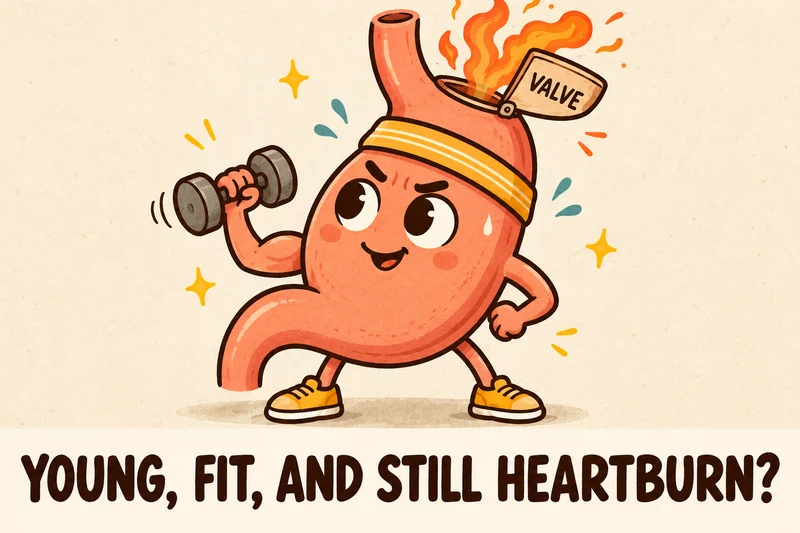
Heartburn in young adults is common, and it isn’t always about what you eat or what you weigh. In a survey of 71,812 Americans, 1 in 4 people aged 18 to 29 had heartburn or regurgitation (acid or food coming back up) in the past week [1]. For some of them, the reason is mechanical: the valve and muscle that keep stomach contents down don’t seal the way they should.
Before we get into the plumbing
- Weight and late, heavy meals matter. They just aren’t the only reasons a 22-year-old gets heartburn.
- Your reflux barrier has moving parts: the food pipe’s valve, the diaphragm (your main breathing muscle) wrapped around it, and a flap where the two meet [6].
- Ever heard of a hiatal hernia? It’s one mechanical problem doctors look for, where the top of the stomach slides up into the chest. Small ones can hide from a scope (a camera test down the throat) or an X-ray [8].
- Still burning after a proper 8-week trial of acid medicine? That’s when testing makes sense [3][4].
Is it normal to have heartburn in your 20s?
Common, yes. Normal enough to ignore? Not if it keeps showing up week after week.
In that big US survey, 25% of people aged 18 to 29 had reflux symptoms in the past week. In their 30s? 34% [1]. Most of us file reflux under middle-age problems, somewhere next to reading glasses, and for a long time medicine saw it that way too [2]. Health-record data from 11 years show the share of younger patients going up, most of all in people aged 30 to 39 [2].
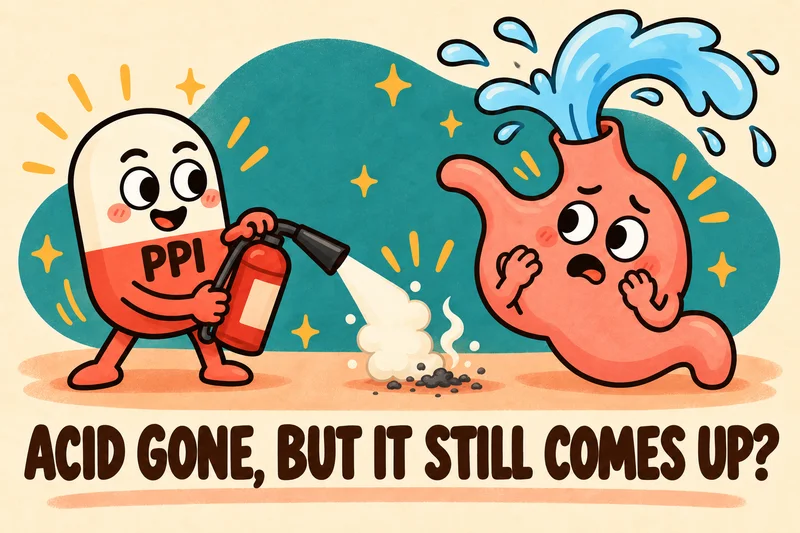
The same survey has a number that should get your attention. Among young adults who took a PPI (an acid-reducing medicine like omeprazole) every day, 65% still had symptoms [1]. In people over 60, it was 46%. So the younger you were, the more likely the daily pill wasn’t doing the whole job [1].
Here’s how I’d put it: one of the most common reasons for heartburn in a young individual is not just lifestyle, meaning being overweight and poor eating.
In clinic, I see plenty of young, lean people with heartburn who already eat well. Diet and weight can’t be the whole story for them. You can’t eat enough salad to fix a valve that won’t seal.
The mechanical cause that gets missed
In my experience, the one that gets missed is a hiatal hernia, often a small one. That’s when the top of your stomach slips up past the diaphragm.
Why does it fly under the radar? It doesn’t always come up when you’re young and otherwise healthy, because the usual suspects are weight and food.
What makes me think mechanical? A young patient whose burning is worst lying down, and who’s still burning after 8 weeks of a PPI.
Sound familiar? Then let’s look at how the barrier works, and where it breaks.
Three parts that keep acid where it belongs
Ever bent over to tie your shoes after lunch and wondered why lunch stays put? Three structures work together at the bottom of your food pipe (esophagus) [6]:
- The lower esophageal sphincter (LES). A ring of muscle that’s squeezed shut between swallows.
- The crural diaphragm. Part of your breathing muscle wraps around that ring like a second hand on a hose.
- The flap valve. A fold of tissue where the food pipe joins the stomach, meant to work like a one-way flap.
When does reflux happen? When that barrier is weak, or relaxes at the wrong time [5]. Some reflux happens in healthy people too [7]. So where the acid sits matters.
After a meal, a pocket of acid floats on top of your food, a bit like the grease that rises on a pot of soup. Everybody has one, and it’s where reflux comes from [7]. A hiatal hernia lifts that pocket up above the diaphragm, and that makes reflux more likely every way it can happen [7]. Same door swinging open, very different splash.
A weak valve also tends to come with more severe reflux disease [3], so the mechanics aren’t a side issue. Want the basics first? Our hub page has a plain overview of what acid reflux and GERD are. GERD is short for gastroesophageal reflux disease.
Hiatal hernia in young adults
A hiatal hernia means the top of your stomach has slid up through the opening in your diaphragm (the hiatus) into your chest [8]. That pulls the valve away from the diaphragm muscle that’s supposed to hug it. The second hand on the hose just let go. The hernia itself rarely causes pain. What you feel is the acid it lets up, often worse when you bend over or lie down [9].
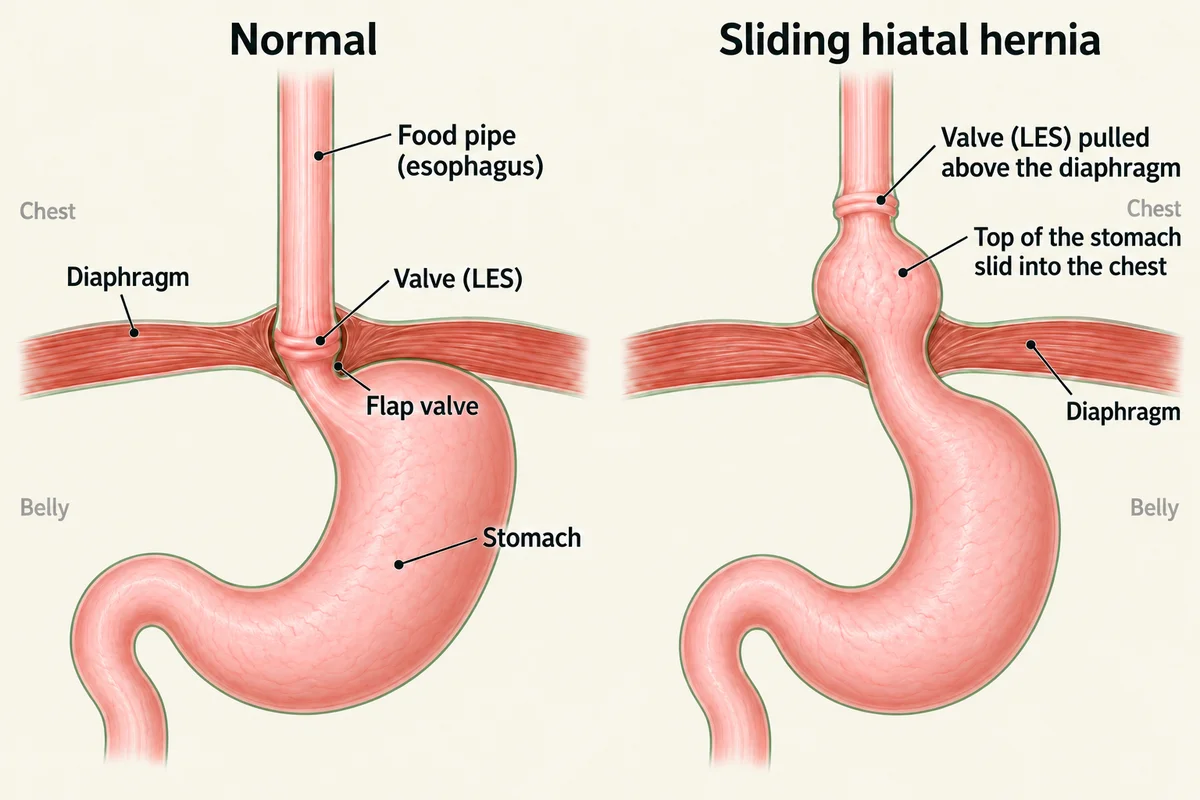
They’re common. Estimates range from 10% to 80% of adults in North America, depending on how they’re measured [8]. That’s a range you could drive a truck through. They do get more common with age, because the tissue anchoring the stomach gets looser over time [8]. Extra weight and smoking raise the odds too [9].
So are young, lean people off the hook? Not entirely. Children who have one are usually born with it [9], and the exact cause in adults often isn’t known [9].
Why can it be missed? The junction where your food pipe meets your stomach doesn’t hold still; it slides up and down. Experts who study it write that endoscopy (the scope test) and X-rays are “relatively insensitive” for small sliding hernias [8]. Bigger than about 2 cm? Then a scope or an X-ray usually finds it [8]. Smaller gaps between the valve and the diaphragm show up reliably only on high-resolution manometry, a pressure test of the food pipe [8].
Gym days, heavy lifting and other pressure on the valve
Is the gym part of your story? In one small study, 30 trained athletes with heartburn from exercise did standard workouts while a probe measured acid in the food pipe. Weightlifters had acid there 36% of the time in workouts after a meal. Cyclists? 6.5%. Runners landed in between [11]. Nobody’s asking you to sell your barbell. But if the burn shows up with the heavy sets, that’s a clue worth telling your doctor.
Other things that load the barrier:
- Pregnancy is on the National Institutes of Health (NIH) list of reflux risk factors [5], along with smoking or secondhand smoke.
- Taking an NSAID (anti-inflammatory) pain reliever like ibuprofen, some asthma medicines or some sedatives? They can play a part [5]. Don’t stop a prescription medicine without asking your doctor, though.
- Weight still counts, even if you’re not “overweight.” A study of 10,545 women looked at those who started at a normal BMI (body mass index, a weight-for-height score). Gaining more than 3.5 BMI points nearly tripled their odds of frequent reflux [10]. For a woman who’s 5 foot 6, that’s about 22 pounds.
How doctors look for a mechanical cause
Classic heartburn, no warning signs? The usual first move is an 8-week trial of a once-daily PPI, taken 30 to 60 minutes before a meal [3].
Still burning after that? Then it’s testing time [4]:
- Upper endoscopy. A thin camera looks at your food pipe and stomach. According to the American Gastroenterological Association (AGA), a complete exam notes the diaphragm opening, the flap valve and the length of any hiatal hernia [4]. Worth asking: does your report describe these?
- pH monitoring off medicine. A small wireless capsule tracks your acid levels (that’s the pH) for up to 96 hours, which shows whether you truly have reflux disease [4].
- High-resolution manometry. A thin tube with pressure sensors checks how your valve and food pipe squeeze. It isn’t a test for reflux by itself [3]. What it can show is whether the valve and diaphragm line up or sit apart [8], and it’s done before any reflux surgery [3].
- Barium swallow. You drink a chalky liquid while X-rays follow it down, which can show a larger hernia [8][9].
What helps when the problem is mechanical
Acid medicine turns down the acid. It can’t move your stomach back where it belongs. That’s why the plan often has more than one piece.
Habits that work with gravity. Gravity works for free, and it never calls in sick. Eat earlier, so dinner is 2 to 3 hours before bed, and raise the head of your bed if nights are bad [3]. Don’t lie down or bend over right after a big meal [9]. Planning lighter, earlier dinners? Chef Savi, your personal low FODMAP culinary companion, builds a gut-friendly recipe from what’s in your fridge, low in FODMAPs, the carbs that ferment in the gut.
Training the diaphragm. If that breathing muscle is part of your reflux barrier, can you train it like any other muscle? Researchers at the Mayo Clinic tested belly breathing (diaphragmatic breathing) after meals in 23 people whose reflux hits while they’re upright [12]. Breathing that way made the valve squeeze harder and cut the number of reflux episodes after a meal [12]. In the 2 hours after a test meal, time with acid in the food pipe fell from about 12% to 5% [12]. Over a whole day, though, total acid didn’t beat a sham technique. It’s one small trial, so treat it as something to ask your doctor about, not a proven fix [12].
Weight, if it applies. If you’re overweight, losing weight is strongly recommended [3]. If you’re already lean, this one isn’t your fix.
Repair, for proven reflux. Have a large hiatal hernia and proven reflux? Then you’re among those most likely to benefit from surgery [3]. Surgery can repair the hernia and add a wrap or device that helps stop reflux [4][9]. Before any procedure, testing has to prove the reflux and rule out achalasia, a swallowing disorder [4]. And some through-the-mouth repairs aren’t advised if the hernia is over 2 cm [3].
When to call your doctor
Occasional heartburn? That’s common. Don’t wait it out if any of these sound like you [3][14]:
- trouble or pain swallowing, or food that sticks on the way down
- Vomiting blood, or stools that are bloody or black?
- weight loss you didn’t plan
- heartburn with lightheadedness, sweating or dizziness
- heartburn for more than 3 months, or still burning after 8 weeks of a PPI
Call 911 for chest pain with shortness of breath, sweating, or pain spreading to your arms, neck or shoulders. The omeprazole label warns these may be signs of a serious condition [14].
Frequently asked questions
What causes acid reflux in young adults?
Usually it’s a mix of weight gain, large late meals, smoking and certain medicines [3][5]. Mechanics can play a part too: a valve that’s weak or relaxes at the wrong time, or a hiatal hernia that lets acid sit higher [5][7]. And in trained athletes, hard workouts can trigger it, weightlifting most of all [11].
What causes hiatal hernia in young adults?
Often nobody knows [9]. In children, it’s usually there from birth [9]. In adults, the tissue anchoring the stomach loosens over time, and extra belly pressure from weight seems to pull the valve and diaphragm apart [8][13]. That may be why hiatal hernias get more common with age and extra weight [9].
Can losing weight help a hiatal hernia?
It can help your reflux, and weight loss is strongly recommended for people with GERD (gastroesophageal reflux disease) who are overweight [3]. Does it shrink the hernia itself? That’s less clear. Even researchers who linked weight to a separated valve say it’s unknown whether weight loss reverses it [13]. If you’re already lean, ask about other options.
Why won’t my heartburn go away?
Start with how you take the pill. Is your PPI taken daily, 30 to 60 minutes before a meal? That’s how the American College of Gastroenterology (ACG) says to take it [3]. Still there after 8 weeks? Then it’s time to test rather than guess [4]. A scope, pH monitoring and sometimes manometry can show a hernia, a weak valve, or that it isn’t reflux at all.
Ask Dr. Ted
Young, fit and still stuck with heartburn? Send your question through Ask Dr. Ted. For more on reflux, browse the acid reflux and GERD guide or read what reflux has to do with colon polyps, and join the Gutsavi newsletter so you don’t miss the next one.
Sources
- Delshad SD, Almario CV, Chey WD, Spiegel BMR. Prevalence of gastroesophageal reflux disease and proton pump inhibitor-refractory symptoms. Gastroenterology. 2020;158(5):1250-61. doi:10.1053/j.gastro.2019.12.014
- Yamasaki T, Hemond C, Eisa M, Ganocy S, Fass R. The changing epidemiology of gastroesophageal reflux disease: are patients getting younger? J Neurogastroenterol Motil. 2018;24(4):559-69. doi:10.5056/jnm18140
- Katz PO, Dunbar KB, Schnoll-Sussman FH, Greer KB, Yadlapati R, Spechler SJ. ACG clinical guideline for the diagnosis and management of gastroesophageal reflux disease. Am J Gastroenterol. 2022;117(1):27-56. doi:10.14309/ajg.0000000000001538
- Yadlapati R, Gyawali CP, Pandolfino JE. AGA clinical practice update on the personalized approach to the evaluation and management of GERD: expert review. Clin Gastroenterol Hepatol. 2022;20(5):984-94. doi:10.1016/j.cgh.2022.01.025
- National Institute of Diabetes and Digestive and Kidney Diseases. Symptoms & causes of GER & GERD in adults. 2020. niddk.nih.gov
- Kahrilas PJ, Nguyen NT. The esophagogastric junction reconsidered. Gastrointest Endosc Clin N Am. 2025;35(3):541-53. doi:10.1016/j.giec.2025.01.003
- Kahrilas PJ, McColl K, Fox M, et al. The acid pocket: a target for treatment in reflux disease? Am J Gastroenterol. 2013;108(7):1058-64. doi:10.1038/ajg.2013.132
- Kahrilas PJ, Kim HC, Pandolfino JE. Approaches to the diagnosis and grading of hiatal hernia. Best Pract Res Clin Gastroenterol. 2008;22(4):601-16. doi:10.1016/j.bpg.2007.12.007
- MedlinePlus, US National Library of Medicine. Hiatal hernia. Reviewed 2025. medlineplus.gov
- Jacobson BC, Somers SC, Fuchs CS, Kelly CP, Camargo CA Jr. Body-mass index and symptoms of gastroesophageal reflux in women. N Engl J Med. 2006;354(22):2340-8. doi:10.1056/NEJMoa054391
- Collings KL, Pierce Pratt F, Rodriguez-Stanley S, Bemben M, Miner PB. Esophageal reflux in conditioned runners, cyclists, and weightlifters. Med Sci Sports Exerc. 2003;35(5):730-5. doi:10.1249/01.MSS.0000064937.99001.56
- Halland M, Bharucha AE, Crowell MD, Ravi K, Katzka DA. Effects of diaphragmatic breathing on the pathophysiology and treatment of upright gastroesophageal reflux: a randomized controlled trial. Am J Gastroenterol. 2021;116(1):86-94. doi:10.14309/ajg.0000000000000913
- Pandolfino JE, El-Serag HB, Zhang Q, Shah N, Ghosh SK, Kahrilas PJ. Obesity: a challenge to esophagogastric junction integrity. Gastroenterology. 2006;130(3):639-49. doi:10.1053/j.gastro.2005.12.016
- US Food and Drug Administration. Drug Facts label: omeprazole delayed-release tablets 20 mg, acid reducer (over the counter). DailyMed. dailymed.nlm.nih.gov
This article is for education only and isn’t medical advice. Talk with your own doctor about your care.
This article is for education only and isn't a substitute for advice from your own doctor. If something feels off, talk to your care team.