
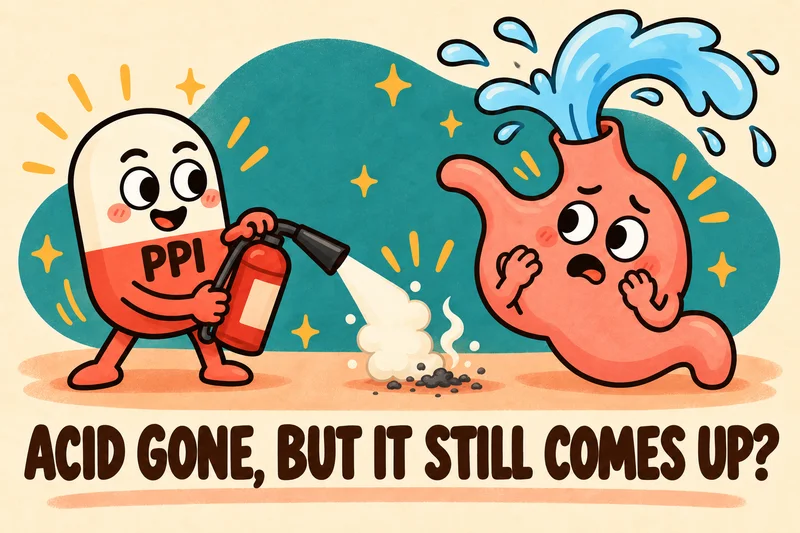
Omeprazole not working for reflux? Quite often it is working, just on the acid. Omeprazole is a PPI (proton pump inhibitor), and its whole job is to turn down how much acid your stomach makes. Keeping stomach contents where they belong? Not in the job description. When they come back up into your throat or mouth, that’s called regurgitation. Across seven placebo-controlled trials (tested against a dummy pill), PPIs helped it far less than they helped heartburn [5].
The short version
- Timing first. Take it 30 to 60 minutes before breakfast, every day [1].
- Burning gone but stuff still coming up? That’s a job for a tool aimed at the backflow, not more acid medicine.
- There’s an over-the-counter medicine for exactly this, and plenty of people have never heard of it.
- Still stuck after all that? Testing shows whether it’s acid, non-acid reflux, or something else entirely.
Why am I still getting acid reflux on omeprazole?
Here’s the question the way I first sent it to my team: “Heartburn and acidity is controlled, but still experiencing reflux?” If that’s you, let’s figure out why.
Reflux and acid aren’t the same problem. Picture the valve at the bottom of your food pipe as a screen door that’s supposed to swing shut after every meal. With reflux, it still opens when it shouldn’t, and stomach contents still wash up through it. Omeprazole makes that liquid less acidic, so it doesn’t burn as much. It doesn’t fix the latch.
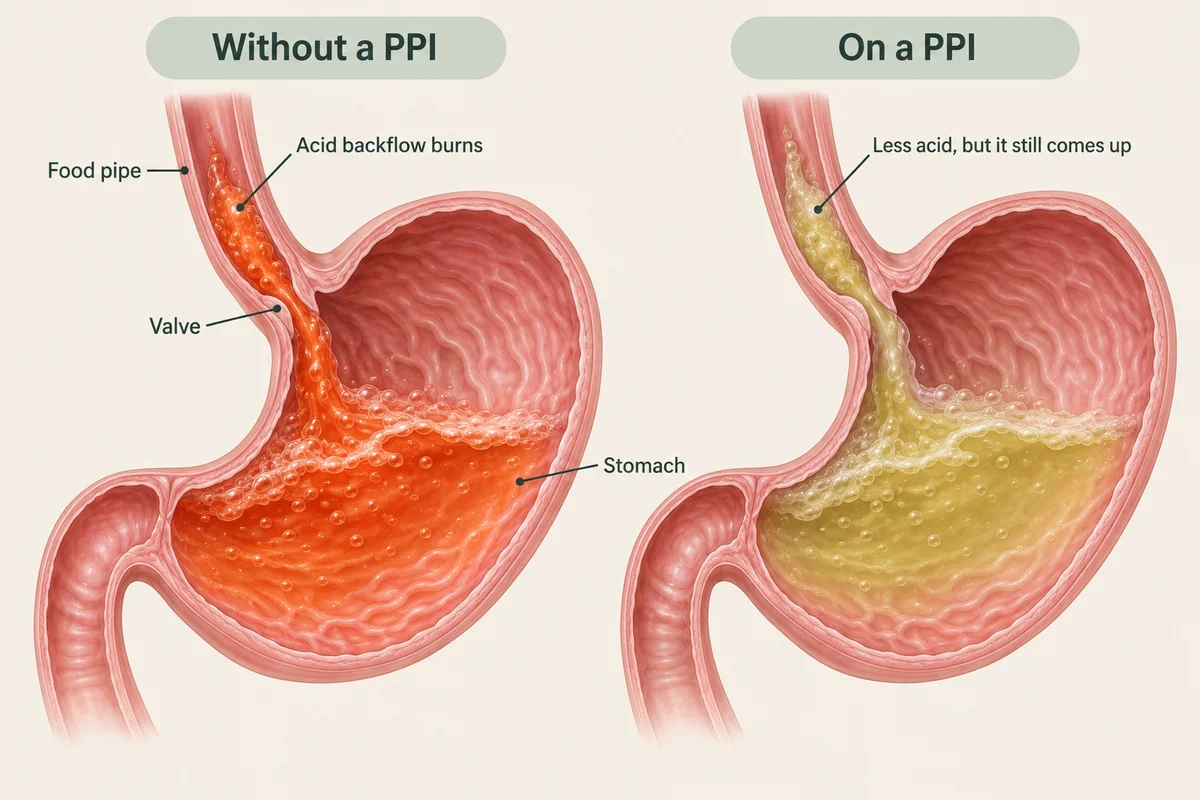
That’s why regurgitation is the stubborn one. A sour taste, food or liquid creeping into your throat, a wet burp after dinner. Sound familiar? In trials, the PPI’s edge over placebo for regurgitation averaged 17%, more than 20 points smaller than its edge for heartburn [5].
And you’ve got plenty of company. In a US survey, 54% of daily PPI users still had reflux symptoms on 2 or more days in the past week [3]. Troublesome regurgitation? In the trials pooled in a review of 19 studies, it hung on in about 28% of people taking a PPI [4].
When patients tell me their omeprazole stopped working, the first thing I ask is when and how they take it.
Before anything else: how are you taking it?
Before you add a single thing, get the basics right. The guidelines start here too [1].
A PPI can only shut down acid pumps that are switched on, and food is what switches them on. So the timing is the whole trick. You take it 30 to 60 minutes before breakfast. If your doctor has you on it twice a day, the second dose goes before dinner. A bedtime dose doesn’t work as well [1].
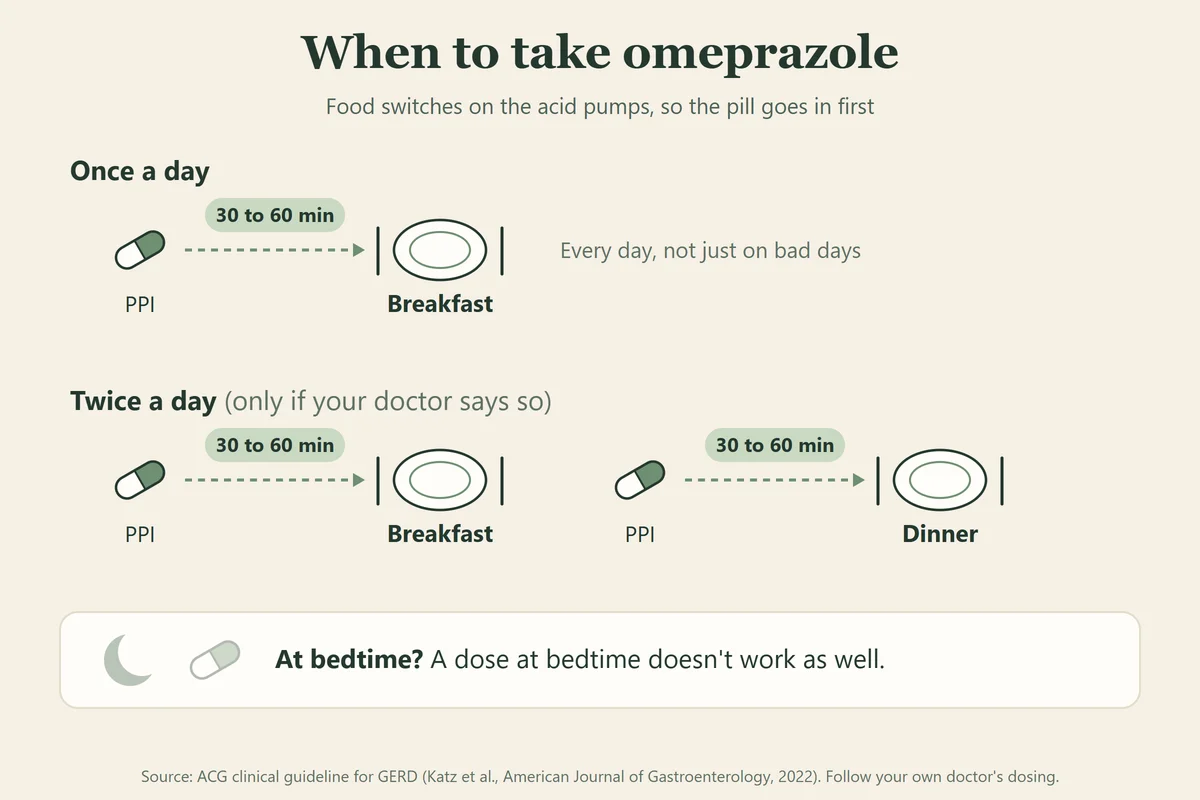
Is that how you take yours? Plenty of people don’t, and it’s an easy fix. In one study of 100 people still having symptoms on a PPI, only 46% took it with a meal or up to an hour before. 16 took it after meals, and 15 at bedtime [9].
Skipped days count too. People with good control took their PPI on 84% of days, against 55% in people with poor control [1]. A pill sitting in the cabinet lowers exactly zero acid.
Buying it over the counter? Flip the box over and read the Drug Facts label. It’s a 14-day course, and you shouldn’t repeat it more often than every 4 months unless your doctor says so [10]. Had heartburn for more than 3 months? Then the label says to ask a doctor before you start [10]. That’s your cue to get checked, not to keep buying another box.
Your doctor may also try a twice-daily dose or a different acid blocker [2]. More than one switch between PPIs isn’t supported, though [1]. And cranking the acid knob higher won’t fix a problem that isn’t acid.
The over-the-counter medicine I want you to know about
It’s an alginate, a medicine made from seaweed. Yes, seaweed. The name you’ll recognize at the store is Gaviscon (I have no ties to the company that makes it, or to any other). Instead of turning down acid, it puts a barrier in the way of the backflow [7][8]. How that barrier works, and how mixed the trials are, comes in the next section.
A lot of people with reflux have never heard of it, and it doesn’t always come up in a short visit.
I like it because it goes after the part omeprazole can’t touch. I have patients take it after meals and at bedtime, as needed. The American Gastroenterological Association (AGA) says alginates may help most with symptoms after meals or at night [2].
It’s sold over the counter, but tell your doctor or pharmacist before you start it. That goes double if you take other prescriptions.
Other ways to go after the backflow
Which of these fit you depends on your pattern. You know when it hits and what sets it off; your GI (gastrointestinal) team knows the options, so work it out together. Guidelines warn against piling on medicines routinely when a PPI hasn’t helped; the add-on should match your symptoms [1][2].
Alginates. Taken after a meal, these form a gel “raft” that floats on top of what’s in your stomach [8]. Where does acid collect after you eat? In a pocket right on top of the meal, which is exactly where the raft sits. In a small imaging study, it neutralized that “acid pocket” in 6 of 8 people who had one [8].
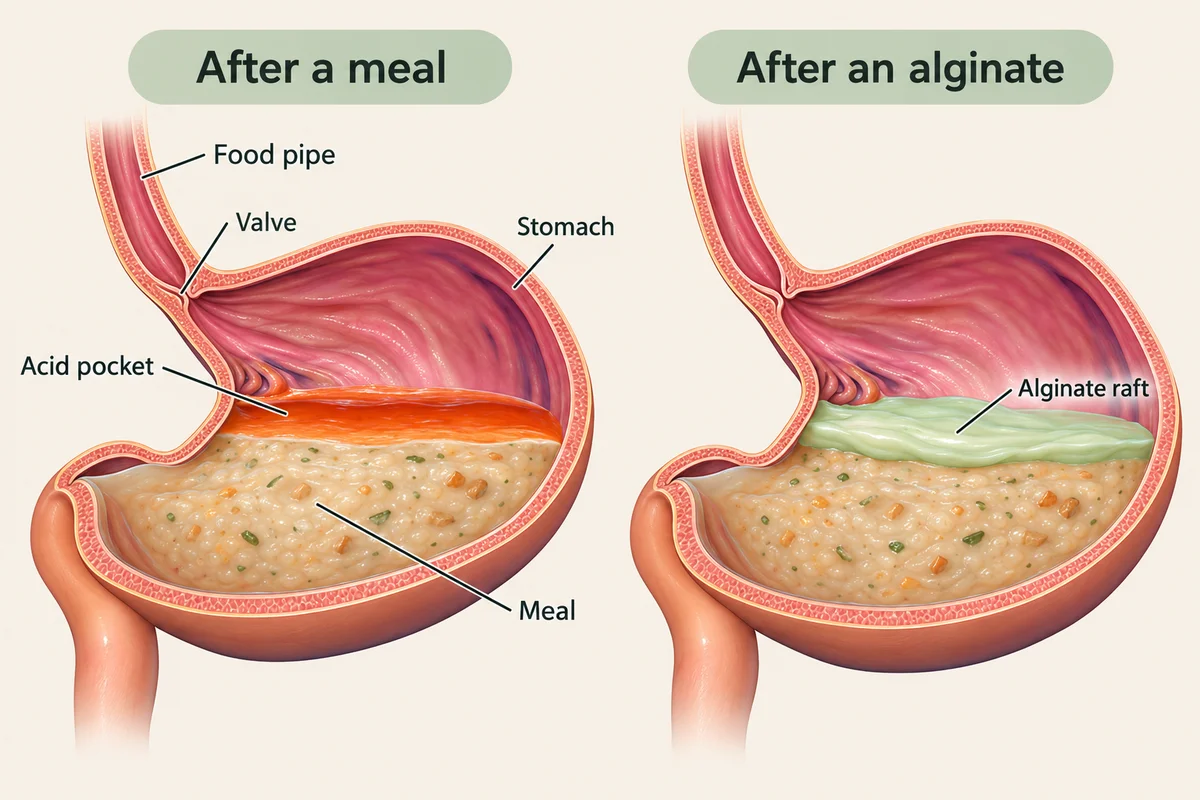
So how well do they work? Pooling 14 trials and about 2,100 people, alginates helped symptoms more than a placebo or a plain antacid [7]. On top of a PPI, the AGA lists them as an add-on for breakthrough symptoms [2]. One catch: alginate content varies between products and countries, so the box you buy may not match what was tested [1]. US Gaviscon, for example, lists two antacids as its active ingredients and the alginate among the inactive ones [14].
Night-time habits. Reflux that shows up at night has the simplest fixes.
- Finish eating 2 to 3 hours before bed [1].
- Symptoms hit at night? Raise the head of the bed, with blocks under the legs or a wedge [1].
- Sleep on your left side. In a small US study of people with night-time reflux, lying on the right side meant more time with acid in the food pipe and slower clearing than the left [11].
- If nights are the problem, ask about a bedtime acid blocker of a different type (an H2 blocker, such as famotidine) [2].
Weight. If you carry extra weight, this one has the strongest backing of any lifestyle change [1]. In one study, women who lowered their BMI (body mass index, a weight-for-height score) by 3.5 points or more cut frequent reflux symptoms by 40% [1].
Food triggers? The evidence is weaker than you’d think [1][12]. If coffee or a big fatty dinner sets you off every single time, skip it. But don’t swear off half the grocery store on a hunch.
Prescription and procedure options. These are for reflux that’s been proven on testing:
- Baclofen, a muscle-relaxant pill, calms the valve relaxations that let reflux through, and it can cut down on burping. Side effects like dizziness, sleepiness and constipation limit it, and it’s only for reflux confirmed on testing [1][2].
- Is regurgitation your main problem, and has testing proved the reflux? Then surgery is a real option, and so are newer valve procedures [1][2]. One is a magnetic ring placed around the valve (magnetic sphincter augmentation). Another is a repair done through the mouth, called TIF (transoral incisionless fundoplication) [1][2].
When it isn’t acid reflux at all
This part surprises people. Some “refractory reflux,” doctor-speak for reflux that won’t respond to treatment, isn’t reflux, and no reflux medicine will touch it [1].
Rumination syndrome. Food comes back up soon after eating, easily and without retching. If you have it, you may have been told you have reflux that won’t respond to treatment [13]. The first-line treatment isn’t a pill. It’s diaphragmatic (belly) breathing after meals, which can be taught by a GI doctor, a speech therapist or a psychologist [13].
A sensitive food pipe. Sometimes testing shows normal amounts of reflux, but your esophagus (food pipe) is extra sensitive to it. Or it burns with no reflux at all. Think of a volume knob on the nerves that got turned way up, so ordinary traffic feels like a pileup. You may hear these called reflux hypersensitivity and functional heartburn [2]. Nerves that stay on high alert can turn the symptoms up, so here doctors often taper the acid pill rather than raise it [2]. Gut-brain treatments can help here: a low-dose nerve-calming medicine, hypnotherapy, CBT (cognitive behavioral therapy, a kind of talk therapy) or breathing work [2]. Stress plays into this; we wrote about how worry affects the gut.
Belching disorders. Burping all day? That can be its own problem, separate from reflux. An impedance test, a thin tube through your nose that tracks air and liquid moving up your food pipe, can pick up a belching disorder [2].
A swallowing or structural problem. Achalasia (a food pipe that doesn’t empty properly) can pass for reflux [1]. So can eosinophilic esophagitis, an allergy-type inflammation of the food pipe, and some hernias [1]. Your doctor also looks for a hiatal hernia during the scope, the camera test described below. That’s when part of the stomach slides up through the diaphragm, the breathing muscle under your lungs [2].
How we test when reflux won’t quit
If your symptoms haven’t settled after a proper PPI trial, it’s time to test rather than guess [2]. Here’s the usual lineup:
- An upper endoscopy. A thin camera looks at your food pipe, the valve and any hiatal hernia. Trouble swallowing, bleeding or weight loss? This comes first [1][2].
- pH monitoring off the PPI. Never had reflux proven on a test? You pause the PPI, and a small wireless capsule measures acid (pH) for up to 96 hours [2].
- pH-impedance monitoring on the PPI. If reflux is already proven, this test tells acid, weakly acidic and non-acid reflux apart while you stay on your medicine [1][2][6]. It answers the exact question in this article: is something still coming up, and is it acid?
- Esophageal manometry. This pressure test checks how your food pipe squeezes. Your doctor may add it when the other tests don’t explain things, and it’s needed before any reflux surgery [1].
When to call your doctor
The omeprazole label lists warning signs worth knowing [10]. Don’t wait it out. Get seen soon if any of these sound like you:
- Trouble or pain swallowing, or food that sticks on the way down
- Vomiting blood, or stools that are black or bloody
- Losing weight without trying
- Repeated vomiting
- Heartburn most days for more than 3 months, or needing the over-the-counter course more often than every 4 months
Chest pain is different. Get emergency care (call 911) for chest pain with shortness of breath, sweating, or pain spreading to your arms, neck or shoulders [10]. Heart pain can feel exactly like heartburn, and you can’t tell them apart at home [1].
Frequently asked questions
What can I take for acid reflux if omeprazole isn’t working?
Fix the timing first: 30 to 60 minutes before breakfast, every day [1]. If the burning’s gone but stuff still comes up, ask about an add-on aimed at the backflow, like the over-the-counter alginate above (Gaviscon is the name you’ll see at the store). Night-time habits help too. Still stuck? Your doctor can test before adding more.
Is there anything stronger than omeprazole for acid reflux?
How long does it take for a PPI to stop reflux?
Can you have reflux without heartburn?
Ask Dr. Ted
Got a reflux question this article didn’t answer? Send it through Ask Dr. Ted, browse the acid reflux and GERD guide, or read what reflux has to do with colon polyps. Trying to move dinner earlier and make it lighter? Chef Savi, your personal low FODMAP culinary companion, builds a gut-friendly recipe from what’s in your fridge. And join the Gutsavi newsletter so you don’t miss the next one.
Sources
- Katz PO, Dunbar KB, Schnoll-Sussman FH, Greer KB, Yadlapati R, Spechler SJ. ACG clinical guideline for the diagnosis and management of gastroesophageal reflux disease. Am J Gastroenterol. 2022;117(1):27-56. doi:10.14309/ajg.0000000000001538
- Yadlapati R, Gyawali CP, Pandolfino JE. AGA clinical practice update on the personalized approach to the evaluation and management of GERD: expert review. Clin Gastroenterol Hepatol. 2022;20(5):984-94. doi:10.1016/j.cgh.2022.01.025
- Delshad SD, Almario CV, Chey WD, Spiegel BMR. Prevalence of gastroesophageal reflux disease and proton pump inhibitor-refractory symptoms. Gastroenterology. 2020;158(5):1250-61. doi:10.1053/j.gastro.2019.12.014
- El-Serag H, Becher A, Jones R. Systematic review: persistent reflux symptoms on proton pump inhibitor therapy in primary care and community studies. Aliment Pharmacol Ther. 2010;32(6):720-37. doi:10.1111/j.1365-2036.2010.04406.x
- Kahrilas PJ, Howden CW, Hughes N. Response of regurgitation to proton pump inhibitor therapy in clinical trials of gastroesophageal reflux disease. Am J Gastroenterol. 2011;106(8):1419-25. doi:10.1038/ajg.2011.146
- Gyawali CP, Yadlapati R, Fass R, et al. Updates to the modern diagnosis of GERD: Lyon consensus 2.0. Gut. 2024;73(2):361-71. doi:10.1136/gutjnl-2023-330616
- Leiman DA, Riff BP, Morgan S, et al. Alginate therapy is effective treatment for GERD symptoms: a systematic review and meta-analysis. Dis Esophagus. 2017;30(5):1-9. doi:10.1093/dote/dow020
- Kwiatek MA, Roman S, Fareeduddin A, Pandolfino JE, Kahrilas PJ. An alginate-antacid formulation (Gaviscon Double Action Liquid) can eliminate or displace the postprandial ‘acid pocket’ in symptomatic GERD patients. Aliment Pharmacol Ther. 2011;34(1):59-66. doi:10.1111/j.1365-2036.2011.04678.x
- Gunaratnam NT, Jessup TP, Inadomi J, Lascewski DP. Sub-optimal proton pump inhibitor dosing is prevalent in patients with poorly controlled gastro-oesophageal reflux disease. Aliment Pharmacol Ther. 2006;23(10):1473-7. doi:10.1111/j.1365-2036.2006.02911.x
- US Food and Drug Administration. Drug Facts label: omeprazole delayed-release tablets 20 mg, acid reducer (over the counter). DailyMed, 2025. dailymed.nlm.nih.gov
- Khoury RM, Camacho-Lobato L, Katz PO, Mohiuddin MA, Castell DO. Influence of spontaneous sleep positions on nighttime recumbent reflux in patients with gastroesophageal reflux disease. Am J Gastroenterol. 1999;94(8):2069-73. doi:10.1111/j.1572-0241.1999.01279.x
- Kaltenbach T, Crockett S, Gerson LB. Are lifestyle measures effective in patients with gastroesophageal reflux disease? An evidence-based approach. Arch Intern Med. 2006;166(9):965-71. doi:10.1001/archinte.166.9.965
- Halland M, Pandolfino J, Barba E. Diagnosis and treatment of rumination syndrome. Clin Gastroenterol Hepatol. 2018;16(10):1549-55. doi:10.1016/j.cgh.2018.05.049
- US Food and Drug Administration. Drug Facts label: Gaviscon (aluminum hydroxide and magnesium carbonate) liquid. DailyMed. dailymed.nlm.nih.gov
This article is for education only and isn’t medical advice. Talk with your own doctor about your care.
This article is for education only and isn't a substitute for advice from your own doctor. If something feels off, talk to your care team.