
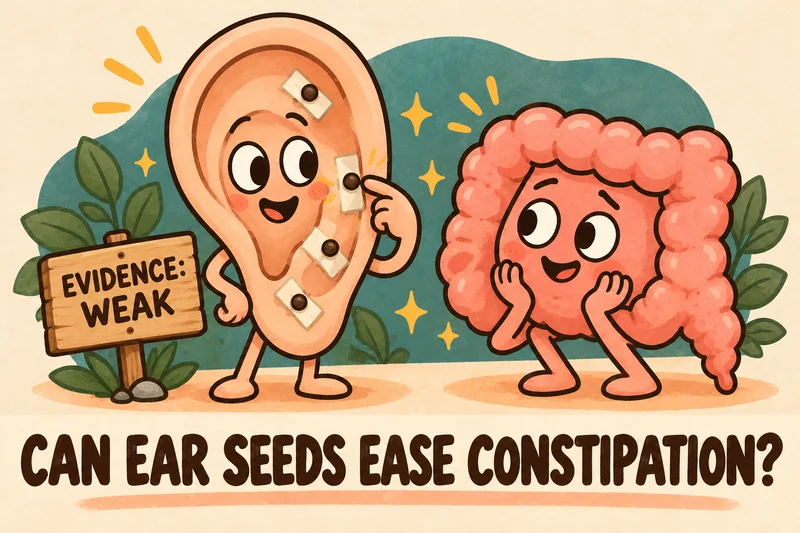
Acupressure for constipation, mostly the ear kind with tiny seeds taped on, may help you a little, and it rarely causes harm. The catch? The research. Most trials are small, most come from China, and only a few compared it with a fake version, so the evidence is weak, and that’s what the reviewers concluded too [1][2]. Use it on top of proven treatments, not instead of them [11].
The short version
- The clearest number in a 2023 review of 34 trials was about one extra complete bowel movement a week (one that leaves you feeling fully emptied), and that’s from just two of the studies [1].
- Side effects? Usually minor. Your skin may itch or feel sore where the tape sits [1][8].
- Need relief? Fiber and laxatives have far stronger evidence, and so, for some people, does pelvic floor therapy, where you retrain the muscles you push with [11][12].
Does ear acupressure help constipation?
It might. “Did you know auricular acupuncture (and its needleless alternative, auricular acupressure) can help with constipation.” That’s the message I sent my team when I pitched this topic. So let’s see how well my own line holds up.
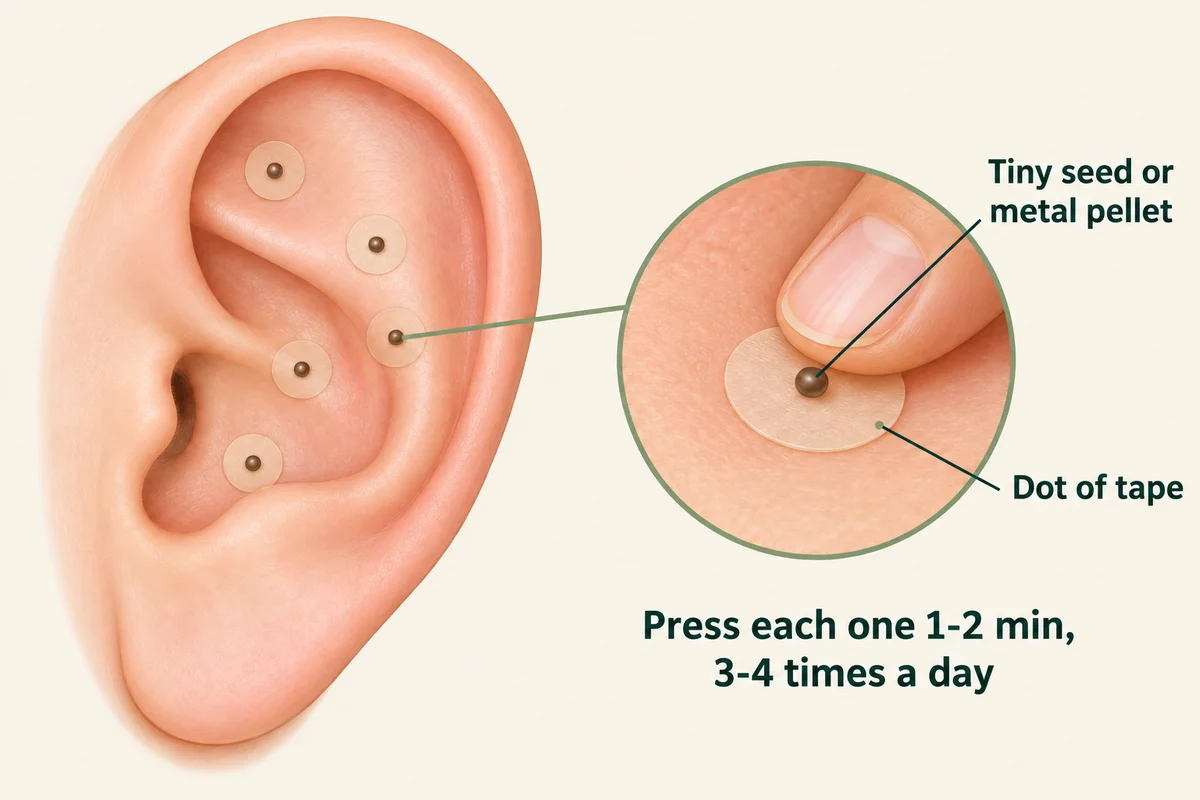
Auricular? It just means “of the ear.” Medicine never uses a plain word when a Latin one is lying around. With auricular acupuncture, someone trained puts tiny needles into set points on your outer ear. Not a fan of needles? Then you’d want the acupressure version, where nothing breaks the skin. Each point gets a small seed or metal pellet stuck over it with a dot of tape, and you press them during the day.
So what did the studies find? A 2023 review pooled 34 trials and 2,465 adults [1]. Only two of those trials counted complete bowel movements, and people on ear acupressure had about 1.2 more a week than the comparison group. What about the 26 trials that simply rated people “improved” or not? There, acupressure raised that chance by roughly a quarter. An earlier review of 17 trials and 1,637 adults called ear therapy “probably beneficial” [2].
How strong is the evidence?
Weak, honestly. The 2023 review’s own authors graded nearly every result low or very low certainty, and none high [1]. Low certainty is their way of saying the real effect could turn out quite different. Why so shaky?
- Small trials. You’ll often see just a few dozen people in each one [1].
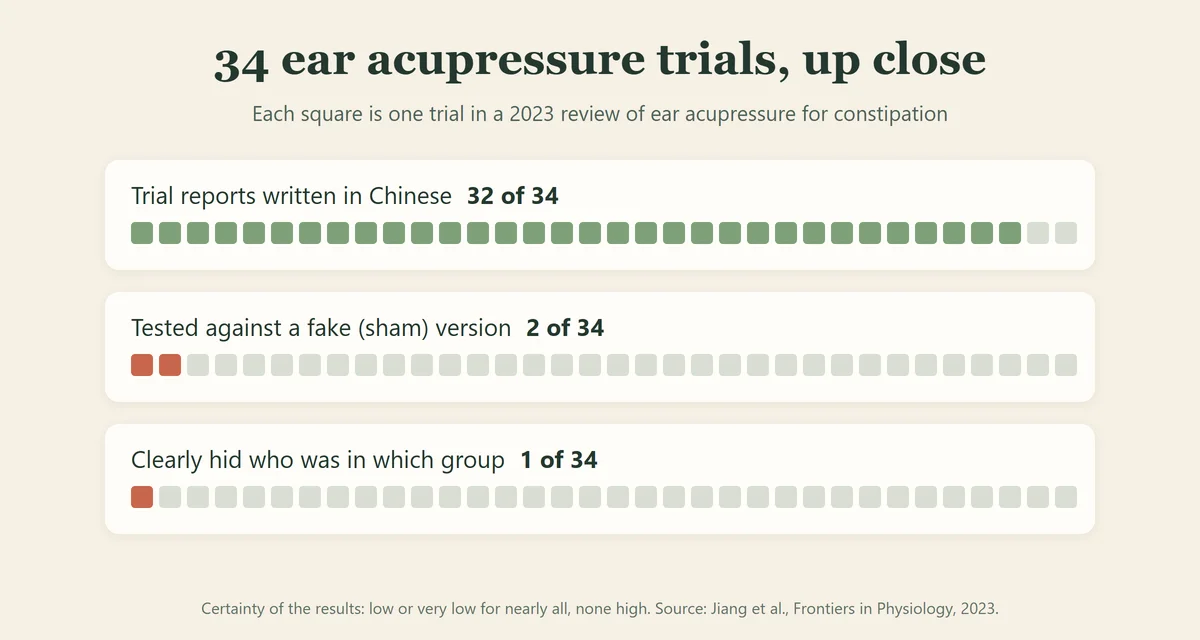
- It’s nearly all from one region. 32 of the 34 trial reports were in Chinese, and every trial in the 2014 review was from mainland China or Hong Kong [1][2]. That isn’t a knock on those research teams. It means we can’t be sure the results carry over elsewhere, as the authors say themselves [2].
- Only 2 of the 34 used sham acupressure, a fake version you can compare against [1]. Without one, how do you know it wasn’t expectation and extra attention?
- Was the group assignment hidden from staff? In just one trial, clearly [1].
- Missing studies. The statistics hinted that some small trials with bad results never got published [1].
I wouldn’t climb a ladder made of ten wobbly kitchen chairs lashed together, and pooling a pile of small, shaky trials has the same problem. You get height, not stability.
Then there’s the seed puzzle. A Hong Kong trial gave its “placebo” group tape with Vaccaria seeds, a small plant seed [3]. Trials in Iran and South Korea? Those same seeds were the real treatment [4][5]. One team’s decoy was another team’s medicine. How do you score a game when nobody agrees which side is wearing the fake jerseys?
Want to see what a real effect looked like? Take the Iranian trial. 53 older adults in a care home wore seeds or seedless tape on the same seven ear points for 10 days [4]. The seed group’s symptom score ended 0.41 lower, on a scale where you rate each symptom 0 to 4. Then they stopped, and ten days later the gap had shrunk to 0.09. So it acted a bit like a space heater: warm while it’s running, and the room cools off soon after you unplug it.
A review of drug-free treatments in care homes went further. Its authors couldn’t recommend any of them, ear acupressure included, until better trials exist [13].
Can it help after surgery, chemo or opioids?
Some trials picked people at high risk of getting blocked up: after surgery, on chemo, or on opioid pain medicine. Facing one of those yourself? The results lean positive, but they’ve got the same weak spots.
- Palliative care patients (people getting comfort-focused care for a serious illness) in Turkey didn’t go any more often for the first 11 days [6]. After that, the acupressure group pulled ahead, and they used fewer laxatives.
- If you’re on chemo: a Korean trial of 52 women with breast cancer found lower constipation scores after six weeks [5]. There wasn’t a fake treatment, though, only usual care.
- Taking opioids for cancer pain? A 2026 review of 36 trials found ear acupressure plus a laxative may beat the laxative alone on one bowel score, with low certainty [7].
And adults after surgery? A few post-fracture and post-brain-surgery trials are part of the 2023 review [1], but we didn’t find any review that pools adult surgery trials alone.
How is ear acupressure done?
Usually someone trained finds your points and places the tape. In the Iranian trial, a care provider trained under a specialist did it [4]. My advice: have a licensed acupuncturist place them the first time, then do the pressing yourself at home. That beats squinting into the bathroom mirror with tweezers and a chart off the internet.
Here’s how the trial protocols worked:
- Small seeds (often Vaccaria, a plant seed) or tiny metal pellets get taped onto 7 points on your ear [3][4][5].
- Each seed gets pressed three or four times a day, until it feels slightly sore. In the Iranian trial, the researcher did the pressing [4].
- After 5 days, you switch to the other ear [4].
- Plan on 10 days to 6 weeks; that’s how long the courses ran [4][5].
Yes, slightly sore is the target. Nobody promised a spa day.
Patience helps, too. In the palliative care trial, it took 12 days to see a difference [6].
Is ear acupressure safe? Who should skip it?
For most people it’s low risk. What can go wrong? A review of 43 reports found skin irritation, mild soreness and dizziness, mostly short-lived, and no serious harm [8]. In the Iranian trial, 9 of 53 people got an itchy ear, and one quit because of it [4].
Skip it, or ask your doctor first, if:
- the skin on your ear is broken or infected (the Iranian trial left these people out) [4]
- Has tape adhesive ever given you a rash? Then pass.
- your constipation is new or severe, or comes with a warning sign from the list below
Low risk isn’t the same as proven, though. Keep your usual treatment going. That’s what the Iranian trial did: people kept their usual laxatives and added the seeds on top [4].
Which acupressure points for constipation have been tested?
Which ear points? The Iranian trial taped seven, among them large intestine, rectum, spleen and lung [4]. Those names come from traditional Chinese medicine.
You’ve probably seen charts with points on the belly, hands and legs, too. Our post All Natural Remedies: Cultivating a Healthy Digestive System touches on those. Two studies away from the ear are worth knowing about:
- Pressing the perineum. That’s the patch of skin between your anus and genitals. At UCLA, 100 adults learned to press it repeatedly before a bowel movement [9]. Four weeks in, their bowel function and quality of life had improved more than with advice alone. And 72% said pressing helped them pass stools. Everyone knew which group they were in, though; the trial wasn’t blinded.
- Prefer needles? Electroacupuncture, needles with a mild current, did well in a large trial. 1,075 people at 15 Chinese hospitals got it on body points, or a sham [10]. Over the 8 weeks of treatment, 31% of the real-needle group got to three complete bowel movements a week. The sham group? 12%. But that was needles hooked up to a current in a clinic, which is a long way from a seed you press on the couch.
What should you try first?
Start with what has strong trials behind it. In 2023, the two big U.S. gut-doctor groups wrote a constipation guideline together [11]. Their initials are AGA and ACG: the American Gastroenterological Association and the American College of Gastroenterology. Polyethylene glycol (PEG) gets their strong yes; it’s an over-the-counter laxative powder you mix into a drink. Several prescription medicines get one too. Fiber got a softer “conditional” nod. So did senna, a plant-based laxative. Magnesium oxide got one too; it’s a mineral that pulls water into your stool. Conditional means reasonable to try, with less certain evidence.
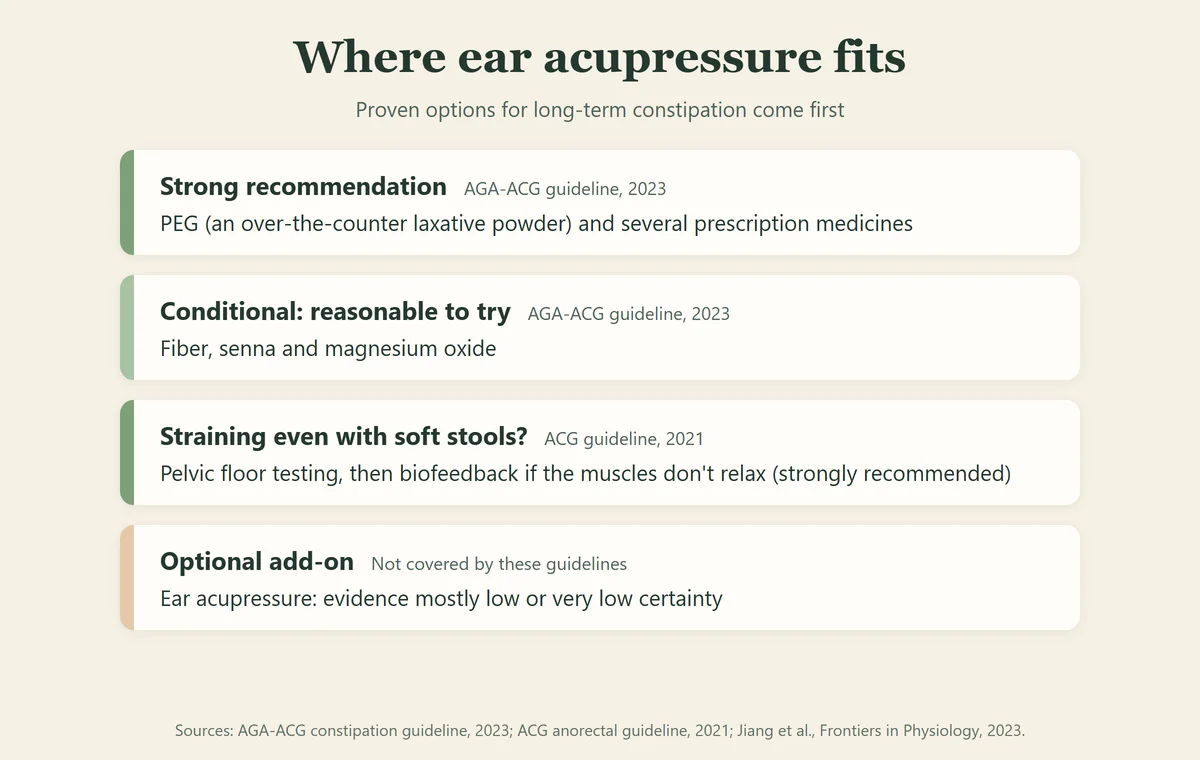
Soft stools, and you’re still straining? Then your pelvic floor muscles may not be relaxing when you push. You shove, they hold, like a door somebody’s leaning on from the other side. A test called anorectal manometry can check that: a thin tube measures the squeeze in your rectum and anus. If it’s the problem, biofeedback therapy retrains those muscles, using sensors that show you what they’re doing, and the ACG strongly recommends it [12]. I do this test myself and refer patients for biofeedback when it’s needed.
So where does acupressure fit? For me, it’s an extra, not the plan. Want to try it? A couple of weeks alongside fiber and a laxative is fine by me, as long as your usual treatment keeps going. Let’s get the proven basics working first, and then the seeds can ride along.
Fiber’s easier to stick with when the food tastes good. Chef Savi turns what’s in your fridge into gut-friendly recipes. For how I add fiber, read my post The Fiber Fix: How I Help Patients Feel Lighter, Calmer, and Fuller Without Counting Calories. If you want more drug-free ideas, see Proven Natural GI Relief and our all-natural remedies page.
When to call your doctor
See a doctor if self-care isn’t working, or if colon or rectal cancer runs in your family [14]. Get care right away if constipation comes with any of these:
- Bleeding from your rectum, or blood in your stool
- belly pain that won’t let up
- Can’t pass gas? Call.
- You’re vomiting or running a fever.
- pain in your lower back
- Losing weight without trying? That counts too.
Frequently asked questions
Are there pressure points in the ear that can help with constipation?
Which finger do you press for constipation?
How long does acupressure take to work for constipation?
Is acupuncture better than acupressure for constipation?
Get Dr. Ted’s take in your inbox
Want honest reads on gut health trends like this one? Join the Gutsavi newsletter. For more on getting things moving, browse our constipation guide and Understanding Constipation.
Sources
- Jiang ZF, Liu G, Sun XX, et al. Auricular acupressure for constipation in adults: a systematic review and meta-analysis. Front Physiol. 2023;14:1257660. doi:10.3389/fphys.2023.1257660
- Yang LH, Duan PB, Du SZ, et al. Efficacy of auriculotherapy for constipation in adults: a systematic review and meta-analysis of randomized controlled trials. J Altern Complement Med. 2014;20(8):590-605. doi:10.1089/acm.2013.0324
- Li MK, Lee TF, Suen KP. Complementary effects of auricular acupressure in relieving constipation symptoms and promoting disease-specific health-related quality of life: a randomized placebo-controlled trial. Complement Ther Med. 2014;22(2):266-77. doi:10.1016/j.ctim.2014.01.010
- Aminizadeh M, Tirgari B, Rashtabadi OR, Jahani Y, Tajadini H. Effectiveness of auricular acupressure on constipation and related quality of life among the older people in the residential care home: a randomized clinical trial. BMC Geriatr. 2023;23:171. doi:10.1186/s12877-023-03881-7
- Shin J, Park H. Effects of auricular acupressure on constipation in patients with breast cancer receiving chemotherapy: a randomized control trial. West J Nurs Res. 2018;40(1):67-83. doi:10.1177/0193945916680362
- Biçak Ayik D, Can G. Effect of auricular acupressure in management of constipation in palliative care patients. J Palliat Care. 2026;41:50-59. doi:10.1177/08258597231181040
- Liu X, Shao H, Yang J, et al. Acupuncture-related therapies for opioid-induced constipation in patients with cancer: a systematic review and network meta-analysis. Front Med (Lausanne). 2026;13:1869529. doi:10.3389/fmed.2026.1869529
- Tan JY, Molassiotis A, Wang T, Suen LK. Adverse events of auricular therapy: a systematic review. Evid Based Complement Alternat Med. 2014;2014:506758. doi:10.1155/2014/506758
- Abbott R, Ayres I, Hui E, Hui KK. Effect of perineal self-acupressure on constipation: a randomized controlled trial. J Gen Intern Med. 2015;30(4):434-9. doi:10.1007/s11606-014-3084-6
- Liu Z, Yan S, Wu J, et al. Acupuncture for chronic severe functional constipation: a randomized trial. Ann Intern Med. 2016;165(11):761-9. doi:10.7326/M15-3118
- Chang L, Chey WD, Imdad A, et al. American Gastroenterological Association-American College of Gastroenterology clinical practice guideline: pharmacological management of chronic idiopathic constipation. Gastroenterology. 2023;164(7):1086-1106. doi:10.1053/j.gastro.2023.03.214
- Wald A, Bharucha AE, Limketkai B, et al. ACG clinical guidelines: management of benign anorectal disorders. Am J Gastroenterol. 2021;116(10):1987-2008. doi:10.14309/ajg.0000000000001507
- Dobarrio-Sanz I, Hernández-Padilla JM, López-Rodríguez MM, et al. Non-pharmacological interventions to improve constipation amongst older adults in long-term care settings: a systematic review of randomised controlled trials. Geriatr Nurs. 2020;41(6):992-9. doi:10.1016/j.gerinurse.2020.07.012
- National Institute of Diabetes and Digestive and Kidney Diseases. Symptoms & causes of constipation. niddk.nih.gov
This article is for education only and isn’t medical advice. Talk with your own doctor about your care.
This article is for education only and isn't a substitute for advice from your own doctor. If something feels off, talk to your care team.