
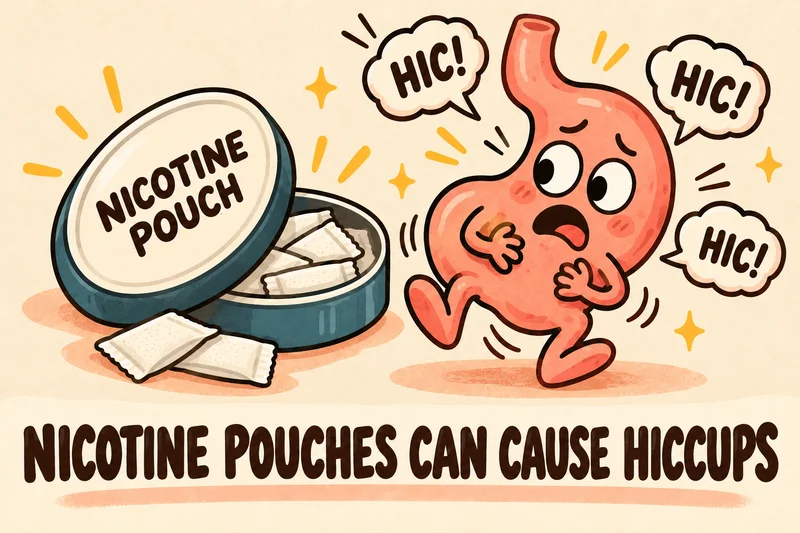
Can nicotine pouches cause hiccups? Very likely, yes, and if it happens to you every time you put one in, you’re not imagining it. Hiccups are one of the most often reported side effects of nicotine taken by mouth, such as gum and lozenges [1][2][3]. They’ve shown up in small pouch studies too [4]. What nobody has done yet is study pouch hiccups head-on. So the “why” is still partly theory, and I’ll tell you which parts are which.
The short version
- Take the pouch out and they usually stop.
- The firmest data come from gum and lozenges, not pouches. Patches, which skip your mouth, show no clear link [2].
- Still hiccuping after 48 hours? See a doctor. Reflux, stomach acid washing back up, is the most common cause of those [5].
Do nicotine pouches cause hiccups? What’s been counted
Let’s start with the FDA (the US Food and Drug Administration) and its safety reports. Doctors and patients file one when they suspect a product caused a side effect. Out of nearly 200,000 nicotine reports from 2004 to 2022, 970 mentioned hiccups [2]. Lozenges and gum carried that link, while inhaled nicotine and patches didn’t. When the same team checked which drugs were most tied to hiccups, nicotine came out on top by far [6]. It wasn’t a close race. Do reports like these prove the nicotine did it? No. They’re a tip line, not a verdict, and they tell researchers exactly where to look next.
Then come the controlled clinical trials, where people are assigned to one product or another by chance. In a 12-week study of 901 smokers, about 1 in 10 people on a 4 mg nicotine lozenge got hiccups [3]. On 4 mg gum it was closer to 1 in 15. For the lozenge, only nausea was more common. Pool 14 trials of nicotine taken by mouth, and hiccups turn up clearly more often than with a placebo [1]. That’s the dummy version with no nicotine in it.
Pouches themselves? Here the data thin out fast, and the companies paid for most of it. A US study followed about 1,000 adults using one pouch brand. Hiccups topped their list of complaints, though that’s only 5 people [4]. And a 2025 Cochrane review, from a group known for careful evidence summaries, called the research on pouches limited [7].
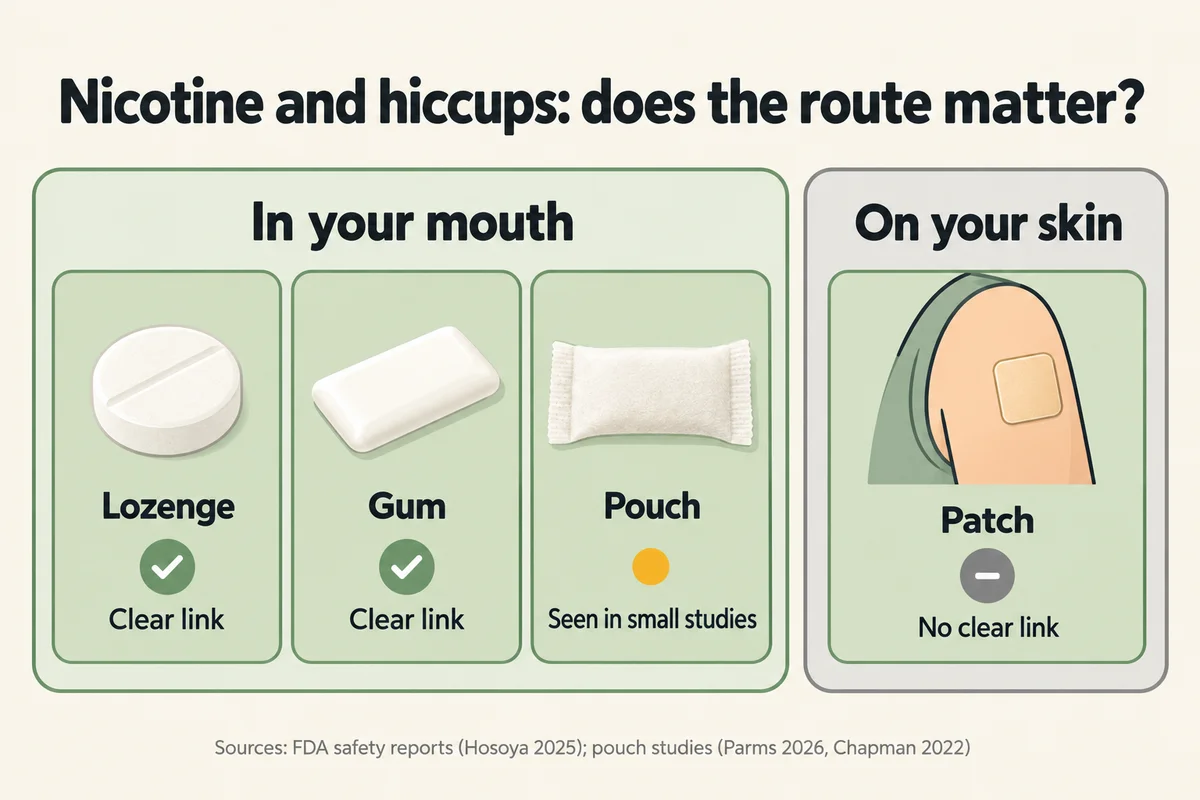
So can a pouch give you hiccups? Almost certainly, given everything above. As of this writing, though, no published case describes pouch hiccups that last for days.
Why does nicotine set off hiccups?
“Did you know your Zyn can cause persistent uncontrollable hiccups and why?” That’s the note I sent my team. Here’s the “why”, as far as the research goes.
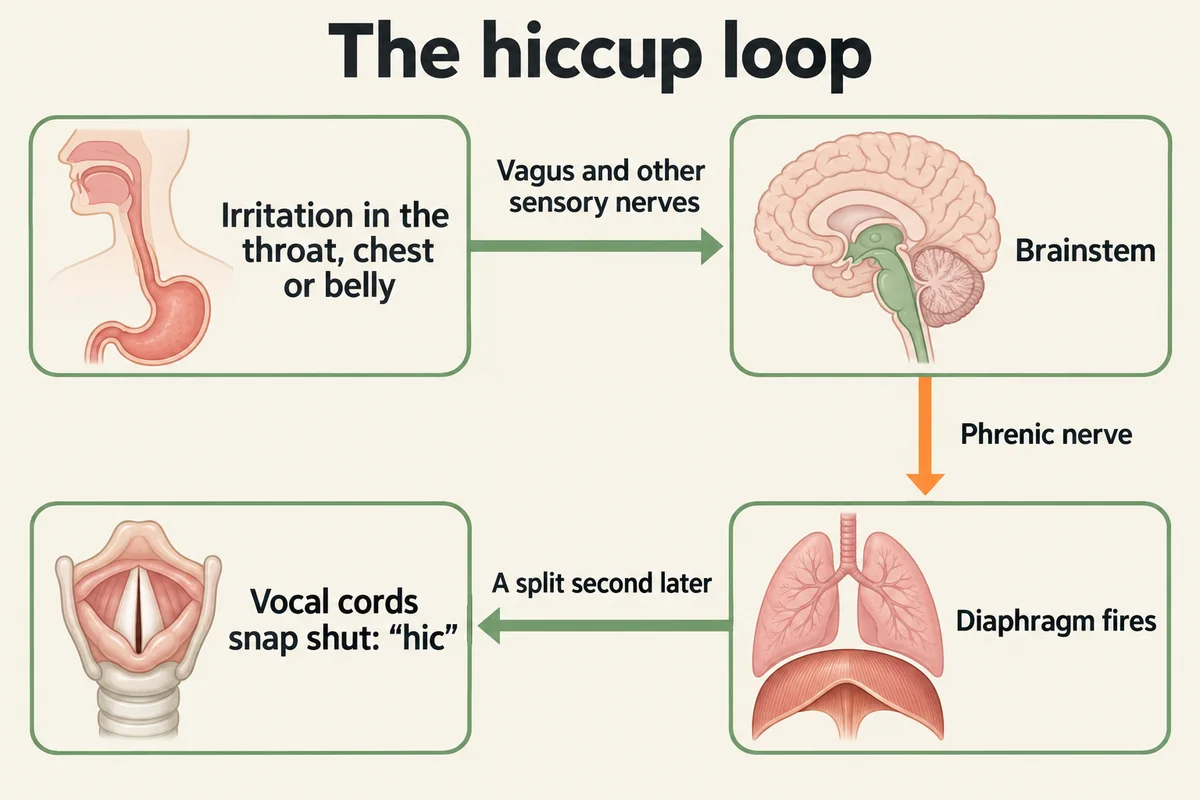
A hiccup runs on wiring. Nerves out in your body carry signals up to the brainstem, the stalk at the base of the brain that runs automatic reflexes, and back out again [5]. One of the main wires is the phrenic nerve. It works your diaphragm, the dome of muscle under your lungs that you breathe with [10]. Irritate that loop and the diaphragm jerks between normal breaths. Your vocal cords snap shut, and that snap is the “hic” [10].
It works like a doorbell. Press any button along the wire and the bell rings, whether or not anybody’s at the door.
Ever get hiccups after wolfing down a big meal or chugging a soda? A bloated, gassy belly is a classic trigger. So are alcohol and smoking [10]. Where does a pouch fit in? Researchers have a few ideas, and none of them is proven for pouches yet:
- Nerves in your mouth and throat. Nicotine sitting against your gums may set off the glossopharyngeal nerve, one of the wires in the hiccup loop. It’s the same nerve behind your gag reflex. That’s one theory from the FDA-report study, whose authors noted that patches don’t seem to do it [2].
- Nicotine you swallow. Some of it probably reaches your stomach. A pouch keeps releasing nicotine into your saliva, and some of that saliva goes down the hatch. The CDC (the US Centers for Disease Control and Prevention) lists hiccups right next to stomach upset and extra saliva among nicotine gum side effects [8]. Nobody’s tested this for pouches yet.
- A looser valve. In a small study, a nicotine patch alone dropped the pressure of the valve between the esophagus (your food pipe) and stomach by about 30% in 10 healthy people [9]. A weak valve is a screen door that won’t latch, and acid can sneak up into your esophagus. Reflux is a known hiccup trigger [5].
- Your brain chemistry. Nicotine latches onto receptors (tiny docking spots on nerve cells) from your brain down to your gut. One team thinks it sets off hiccups by releasing dopamine, a brain chemical tied to the reflex. That’s a hypothesis, not a finding [6].
Which one matters most? Nobody knows yet, because no one has studied pouch users specifically. My own guess, as a GI (digestive) doctor, is the nicotine you swallow, since it lands right on your esophagus and stomach. A guess, mind you, and I’m labeling it as one.
How to get rid of hiccups from nicotine pouches
How long do they hang around? Not long, usually. Most hiccups stop on their own within minutes to hours [10]. In the US study of about 1,000 pouch users, they were mostly mild [4].
Hiccuping right now? Here’s what’s worth a try.
- Pull the pouch. Hiccups gone within a few minutes? Then you’ve probably found your trigger.
- Hold your breath, or sip cold water slowly [10]. No home trick is a sure thing [11], and having a friend jump out and scare you is the least sure of all.
- Spit out the extra saliva instead of swallowing it. Nobody has tested that, but it fits the swallowed-nicotine theory.
- Every single pouch, every time? That’s a pattern, not bad luck, so it’s worth asking your doctor about cutting back.
So what do I tell patients? Take it out and sip some water. If it happens with every pouch, treat that as your sign to cut back.
A bloated, gassy belly can set off hiccups even if you’ve never touched nicotine [10]. Trying to eat smaller, gentler meals? Chef Savi, your personal low FODMAP culinary companion, builds a gut-friendly recipe from what’s already in your fridge. Low FODMAP just means it goes easy on certain carbs that ferment in your gut and make gas.
When hiccups last longer than 48 hours
How long have yours lasted? Doctors call hiccups persistent once they pass 48 hours, and intractable once they pass a month [10]. Past two days, the question changes. We stop asking “is it my pouch?” and start asking “what else is pressing that doorbell?”
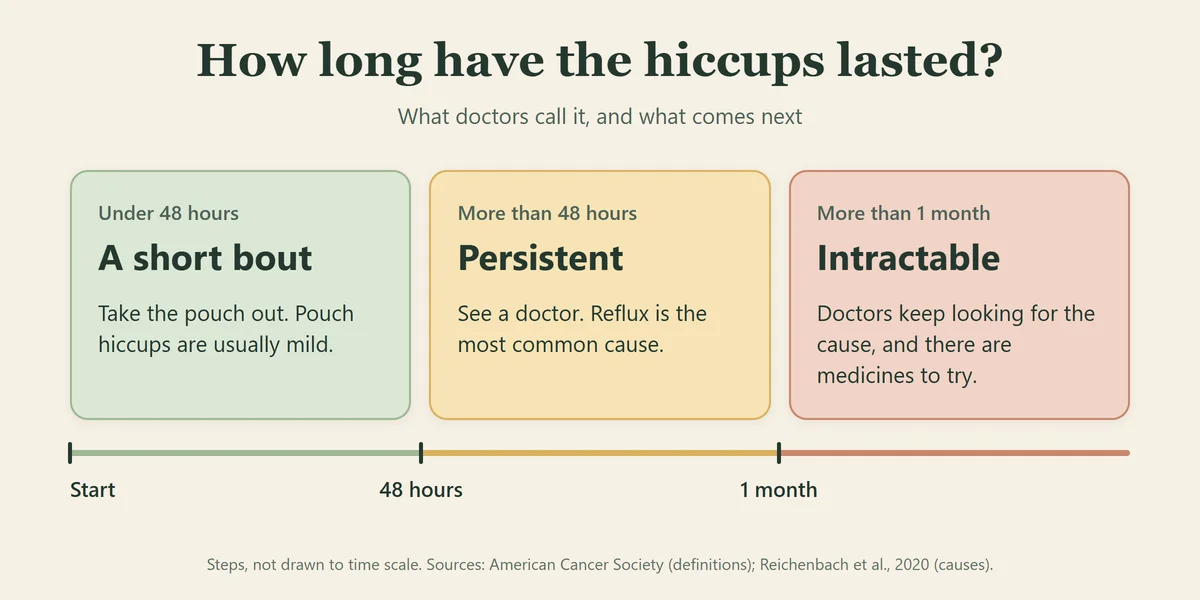
Persistent hiccups can be a sign of a problem underneath that needs testing [5][10]. The most common cause is gastroesophageal reflux disease (GERD), and a US review advises starting with acid-reducing medicine and a GI doctor’s input [5].
Here’s what your doctor may check, working along the wire:
- Reflux. Often you’ll get a trial of a PPI (proton pump inhibitor, a medicine that turns down stomach acid) first [5].
- Your medicines. Steroids, chemotherapy, and some pain and anxiety medicines can all cause hiccups [10].
- Blood tests, for salt (electrolyte) problems like low calcium or potassium [10].
- Your esophagus and belly. Tumors or blockages in the esophagus, liver or pancreas can cause hiccups [10].
- Your brain. A stroke or a tumor can cause hiccups, so new weakness or numbness changes the plan [11].
Treatment goes after the cause whenever doctors can find one [5][12]. Can’t find one? There are still medicines to try. Only one, chlorpromazine, an older antipsychotic medicine, is FDA-approved for hiccups [12]. Others, like baclofen (a muscle relaxant) and gabapentin (a nerve pain medicine), have only small studies behind them [12].
When to call your doctor
A short bout that stops when you take the pouch out is rarely a worry. Call your doctor if:
- Your hiccups have lasted more than 48 hours, nicotine or not [10].
- They keep you from eating, drinking or sleeping. Hiccups that drag on can leave you worn out and low [10].
- Food sticks on the way down.
- You’re losing weight without trying, or have heartburn or sour liquid coming up most weeks.
Call 911 if hiccups come with chest pain or trouble breathing, or with weakness, numbness, slurred speech or a drooping face. A stroke can cause hiccups [11], and chest pain or trouble breathing is never something to wait out.
Thinking about cutting back?
In January 2025, the FDA authorized the sale of 20 nicotine pouch products. In the same notice, it said that authorization “does not mean these tobacco products are safe” [13]. Allowed on the shelf and safe aren’t the same thing.
If the hiccups have you rethinking nicotine altogether, free help is available. You can call 1-800-QUIT-NOW to reach your state’s quitline, which helps with smokeless products and other tobacco, not just cigarettes [14]. Prefer texting? Smokefree.gov, from the National Cancer Institute, has text programs and quit plans [15]. Your doctor can help you find what’s realistic.
Frequently asked questions
Is it normal for nicotine to give you hiccups?
Yes, it’s common, and gum and lozenges are the usual culprits. Hiccups are on the CDC’s list of nicotine gum side effects [8]. In one large trial, about 1 in 10 people using nicotine lozenges got them [3]. Most bouts are short and harmless. Getting them every time, or for more than 48 hours? Mention it to your doctor.
Why do I start hiccuping when I put a Zyn in?
Most likely it’s the nicotine, not the brand. Nicotine you take by mouth is strongly linked to hiccups, and patches aren’t [2]. The suspects are irritated throat nerves, swallowed nicotine, or a looser valve above your stomach. Which one it is for pouches? Nobody’s tested that.
Does nicotine gum cause hiccups?
Do nicotine hiccups go away?
Got a question about your gut?
Send it to me through Ask Dr. Ted. If heartburn is part of your picture, browse our acid reflux and GERD guide, read Understanding Acid Reflux/GERD, or see Reflux in the Throat, Polyps in the Colon? Let’s Talk About That. You’ll find more topics in our Learn hub. And join the Gutsavi newsletter to get the next article in your inbox.
Sources
- Mills EJ, Wu P, Lockhart I, Wilson K, Ebbert JO. Adverse events associated with nicotine replacement therapy (NRT) for smoking cessation: a systematic review and meta-analysis of one hundred and twenty studies involving 177,390 individuals. Tob Induc Dis. 2010;8:8. doi:10.1186/1617-9625-8-8
- Hosoya R, Ishii-Nozawa R, Terajima T, Kagaya H, Uesawa Y. Investigation of nicotine-induced hiccups: effects of administration route using the FDA adverse events reporting system. Chem-Bio Informatics J. 2025;25:19-27. doi:10.1273/cbij.25.19
- Marsh HS, Dresler CM, Choi JH, et al. Safety profile of a nicotine lozenge compared with that of nicotine gum in adult smokers with underlying medical conditions: a 12-week, randomized, open-label study. Clin Ther. 2005;27(10):1571-87. doi:10.1016/j.clinthera.2005.10.008
- Parms TA, Makena P, Shetty M, et al. Product acceptance and cigarette reduction: results from a Velo pouch actual use study among United States adults who smoke. Prev Med Rep. 2026;70:103608. doi:10.1016/j.pmedr.2026.103608
- Reichenbach ZW, Piech GM, Malik Z. Chronic hiccups. Curr Treat Options Gastroenterol. 2020;18(1):43-59. doi:10.1007/s11938-020-00273-3
- Hosoya R, Ishii-Nozawa R, Kurosaki K, Uesawa Y. Analysis of factors associated with hiccups using the FAERS database. Pharmaceuticals (Basel). 2021;15(1):27. doi:10.3390/ph15010027
- Hartmann-Boyce J, Tattan-Birch H, Brown J, et al. Oral nicotine pouches for cessation or reduction of use of other tobacco or nicotine products. Cochrane Database Syst Rev. 2025;10:CD016220. doi:10.1002/14651858.CD016220.pub2
- Centers for Disease Control and Prevention. How to use nicotine gum. Tips From Former Smokers.
- Kadakia SC, De La Baume HR, Shaffer RT. Effects of transdermal nicotine on lower esophageal sphincter and esophageal motility. Dig Dis Sci. 1996;41(11):2130-4. doi:10.1007/BF02071391
- American Cancer Society. Hiccups and heartburn. Last revised April 30, 2025. cancer.org
- MedlinePlus Medical Encyclopedia. Hiccups. US National Library of Medicine. Reviewed January 1, 2025. medlineplus.gov
- Polito NB, Fellows SE. Pharmacologic interventions for intractable and persistent hiccups: a systematic review. J Emerg Med. 2017;53(4):540-9. doi:10.1016/j.jemermed.2017.05.033
- US Food and Drug Administration. FDA authorizes marketing of 20 ZYN nicotine pouch products after extensive scientific review. January 16, 2025.
- Centers for Disease Control and Prevention. Quitlines and other cessation support resources.
- National Cancer Institute. Smokefree.gov.
- Einarson TR, Einarson A. Hiccups following nicotine gum use. Ann Pharmacother. 1997;31(10):1263-4. doi:10.1177/106002809703101025
This article is for education only and isn’t medical advice. Gutsavi has no ties to any nicotine pouch maker or quit-smoking company. Talk with your own doctor about your care.
This article is for education only and isn't a substitute for advice from your own doctor. If something feels off, talk to your care team.