
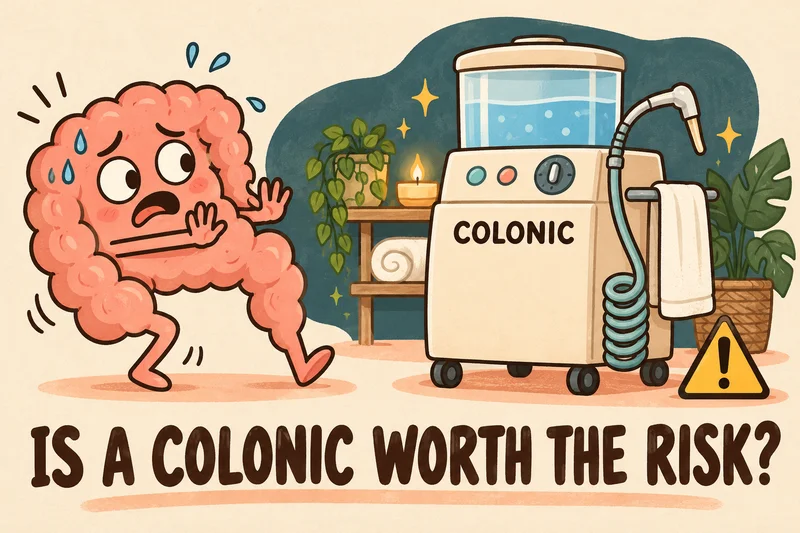
Is colon hydrotherapy safe? Not completely. Serious harm is rare, but it’s real, and you deserve to hear about it before you book. Doctors have published cases of torn bowels, dangerously low blood sodium and severe infections after colonics, and some of those people died [1]. And what’s on the other side of the scale? No good trial shows a colonic improves your health [2].
The short version
- The worst risk is a perforation, a hole in your bowel wall. In one review, 13 of 33 published perforations from colon cleansing ended in death [1].
- You won’t find a colonic machine the FDA (US Food and Drug Administration) has approved for routine “cleansing” [3][4].
- Constipated or bloated? Tested treatments exist, and none of them need a hose.
What actually happens during a colonic?
Here’s the setup. A colonic (also called colon hydrotherapy or colonic irrigation) runs water into your colon through a tube, then lets it drain back out [5]. The machine controls the water’s pressure, temperature or flow [3].
In one session you can take in up to 60 liters of water over 60 to 90 minutes [1]. That’s almost 16 gallons. Compare that with a regular enema, the small squeeze of fluid you can buy at the drugstore: a colonic is far, far more water.
So why do people sign up? Usually to flush out “toxins” they’ve been told pile up in the gut [1]. That idea has a name, autointoxication, and back in the 1800s plenty of doctors believed it. By the 1920s the science had failed to back it up, and medicine dropped it [6]. The marketing, apparently, never got the memo. The idea just stuck around in the public mind [6]. Has anyone shown that a rinsed colon is a healthier one? No [2].
Can colon hydrotherapy perforate your colon?
Yes, it can. Your colon wall is muscle, not steel pipe. Once there’s a hole, stool and bacteria leak into your belly and set off a serious infection called peritonitis [7].
Surgeons in Australia described three women, aged 51 to 59, whose rectums tore during colonics given by alternative practitioners [8]. For one, the pain started the moment the tube went in. The other two felt it start during the rinse. All three needed drainage or surgery, and two ended up with a stoma, an opening on the belly where stool empties into a bag. Nobody had warned them this could happen.
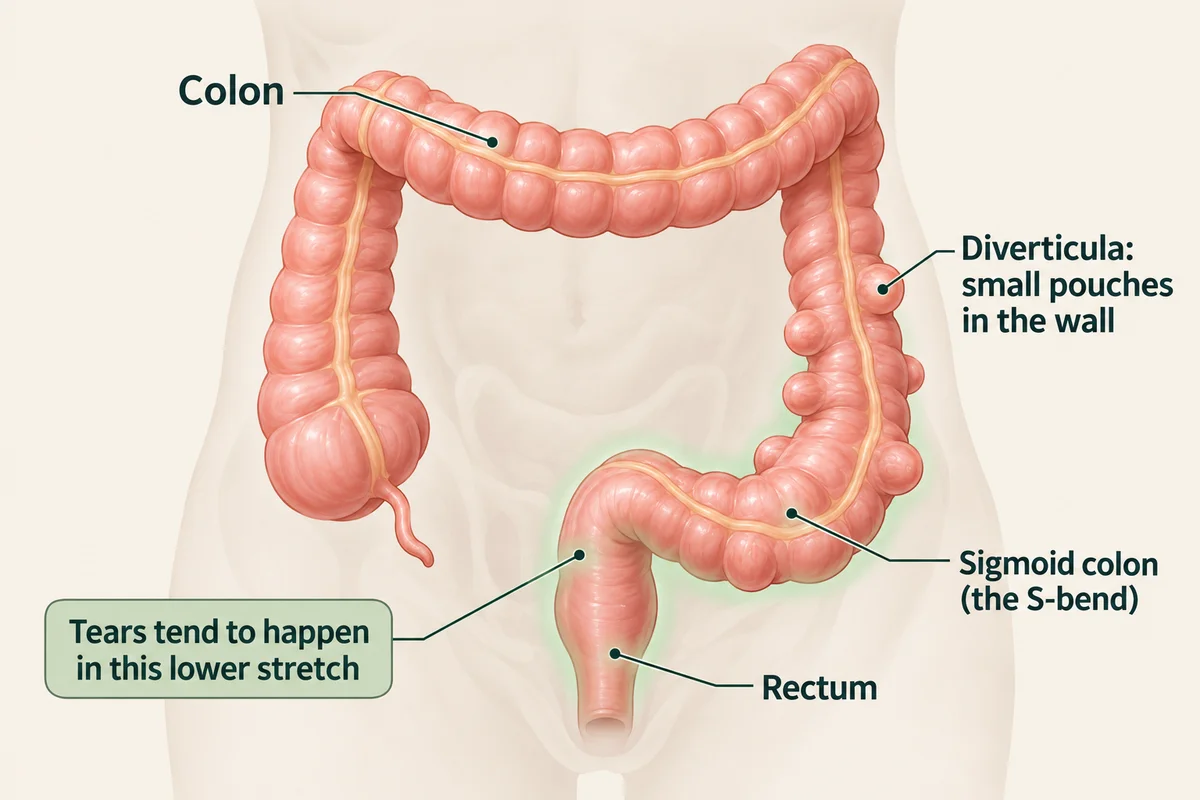
When I sent this topic to my team, my working title was “Did you know your colon hydrotherapy could kill you?” The case behind it is real, though it wasn’t a clinic colonic. A 95-year-old man with years of constipation used to push a rubber hose from a water tap into his rectum to get things moving [9]. The water pressure tore a 2-centimeter hole in his sigmoid colon, the S-shaped last stretch before the rectum. He had emergency surgery and died of organ failure two days later.
That S-bend is where these tears tend to happen [9]. And if you’ve got diverticula, small pouches that bulge out of the colon wall, your risk goes up [9]. Think of an old garden hose with a few bulges in it. It doesn’t take pressure the way a new one does.
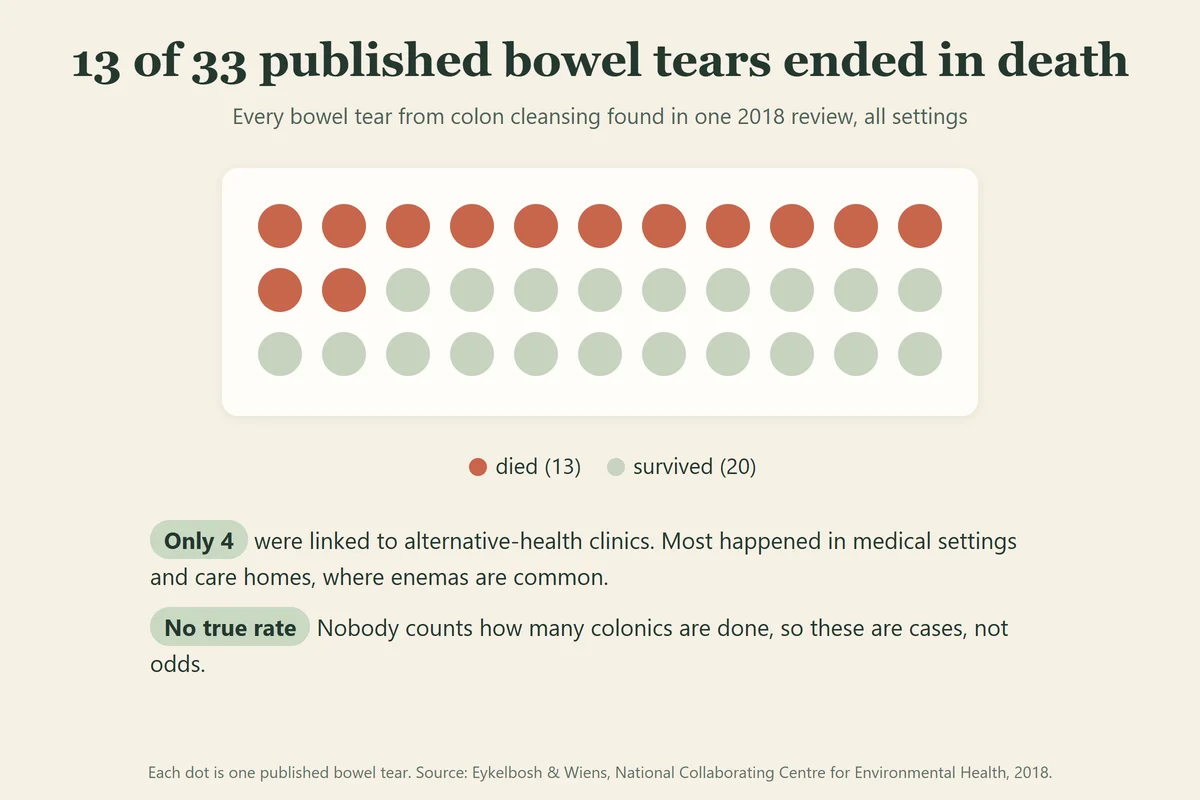
How often does it happen? Nobody knows. A 2018 review by a Canadian public-health centre found 33 published perforations from colon cleansing of every kind, and 13 of those people died [1]. Only 4 were linked to alternative-health clinics; most happened in medical settings and care homes, where enemas are common. No one counts how many colonics are done, so there’s no true rate.
Rare, then. But what do you get in exchange for that risk? That’s the question I’d ask.
Other colonic risks: sodium, infection and air
A torn bowel gets the attention, but it isn’t the only harm on record.
- Low blood sodium. Your colon absorbs water, and too much plain water can dilute the salt in your blood, like topping off a pot of soup from the tap. Doctors in Malaysia described a 42-year-old woman who became confused and lost her memory for a time after colonics she used as a health treatment [10]. The review counted five cases of salt imbalance serious enough for emergency care [1].
- Ever wonder why clinics use throwaway tubes? Between 1978 and 1980, at least 36 people who had colonics at one clinic in Colorado caught amebiasis, a parasite infection of the gut [11]. The Centers for Disease Control and Prevention (CDC) counted seven deaths [12]. Even after routine cleaning, the machine was still heavily contaminated with stool bacteria [11]. Single-use kits became the norm after that, and the 2018 review found no outbreak reported since [1].
- Your own gut bacteria can get into your bloodstream, too. There’s a published case of septic shock (an infection in the blood that makes blood pressure crash) after a colonic [13]. The culprit was E. coli, a common gut bacterium. The review found three infections from a client’s own gut bacteria in all: two in the blood, one an abscess [1].
- Air is the rarest one. Doctors in Taiwan reported a fatal air embolism (air bubbles in the blood vessels) after colon hydrotherapy [14].
Why don’t doctors recommend colonics?
Because nobody has shown they help. In 2009, two gastroenterologists went through everything published on colon cleansing, in medical and alternative-medicine journals alike [2]. Well-designed trials showing a benefit? They didn’t find any. What they did find were case reports of harm. Their verdict: colon cleansing “cannot be recommended.”
The National Institutes of Health (NIH) runs a center for complementary and integrative health. It calls the evidence for what colonics are sold for “insufficient” [5].
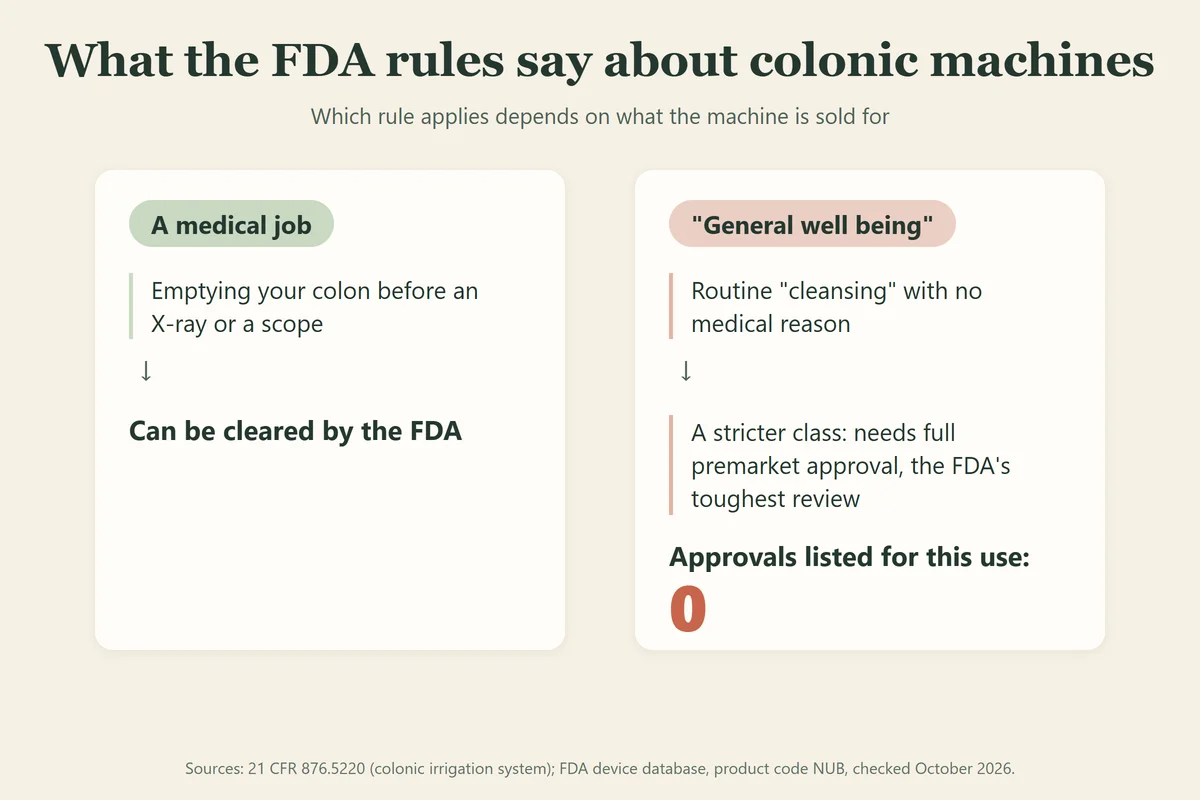
The FDA’s rules point the same way, and they work a bit like building permits. A colonic machine can be cleared for a medical job, like emptying your colon before an X-ray or a scope. Selling one for “general well being” puts it in a stricter class that needs the FDA’s full premarket approval, its toughest review before sale [3]. As of October 2026, the FDA’s public device database doesn’t list a single approval for that use [4]. So nobody’s holding that permit. The FDA and the Federal Trade Commission (FTC) have also gone after companies selling colon-cleansing devices for unapproved uses [5].
Curious about “cleanses” more broadly? Read our post on why your liver isn’t a filter fairy.
Who should never get a colonic?
For some people, the odds get a lot worse. The NIH says harm is more likely if you’ve had gut disease or colon surgery, or if you have severe hemorrhoids, kidney disease or heart disease [5].
Case reports add Crohn’s disease, a type of inflammatory bowel disease (IBD), and spinal cord injury [1]. Diverticular disease makes tears more likely [9].
If you have IBD or diverticulosis, or you’ve had bowel surgery, please don’t book one.
Backed up or bloated? What works instead
Is constipation what’s really pushing you toward a colonic? Then let’s go after the constipation, because it has real, tested treatments. In 2023, the American Gastroenterological Association and the American College of Gastroenterology, two of the main US gastroenterology societies, published a joint guideline on long-term constipation [15]. Their strongest recommendations went to polyethylene glycol (PEG), an over-the-counter laxative that pulls water into stool, plus a few prescription medicines. Fiber, senna (a plant-based laxative) and magnesium oxide? A weaker, conditional thumbs-up. Your doctor can help you choose.
When a constipated patient asks me about a colonic, I usually start them on PEG every day instead.
Food matters too. If high-fiber meals leave you gassy and bloated, Chef Savi can build gut-friendly recipes from what’s already in your fridge. Our constipation guide walks through the causes and the tests your doctor may order.
When to call your doctor
Had a colonic in the past week? Go to the emergency room if you notice any of these:
- belly pain that’s severe, or that keeps building after the session [7]
- a fever or chills
- nausea or vomiting
- feeling faint, confused or very weak
- bleeding from your rectum
Tell the ER team you had a colonic, and when. In the Australian cases, the pain started during the procedure, yet the women reached hospital anywhere from the same day to a week later [8]. One was sent home and came back seven days on. Deaths were far more likely when the diagnosis came late [1].
Frequently asked questions
Are colonics safe?
Most go without incident, but they aren’t risk-free. Published cases include bowel tears, dangerously low sodium and serious infections, and some were fatal [1]. Nobody tracks how many colonics are done, so the true risk isn’t known. With no proven benefit to weigh against it [2], I don’t think the trade is worth making.
Do doctors recommend colonics?
No, not for general health. A systematic review found no rigorous trials showing benefit and said colon cleansing “cannot be recommended” [2]. We do empty the colon when there’s a reason, like before your colonoscopy, the camera exam of the colon. That’s a cleanout with a clear purpose, chosen with a doctor.
How do I know if my colon is perforated?
Can a colon perforation heal on its own?
Get Dr. Ted’s take on the next gut trend
Before you try the next cleanse that shows up in your feed, join the Gutsavi newsletter for Dr. Ted’s evidence-checked take. Looking for meals that are easy on your gut? Try Chef Savi. You can also browse our all natural remedies hub or read Proven Natural GI Relief.
Sources
- Eykelbosh A, Wiens M. Adverse effects after medical, commercial, or self-administered colon cleansing procedures. National Collaborating Centre for Environmental Health (BC Centre for Disease Control); 2018. ncceh.ca
- Acosta RD, Cash BD. Clinical effects of colonic cleansing for general health promotion: a systematic review. Am J Gastroenterol. 2009;104(11):2830-6. doi:10.1038/ajg.2009.494
- Code of Federal Regulations. 21 CFR 876.5220, Colonic irrigation system. law.cornell.edu
- US Food and Drug Administration. Device classification, product code NUB (colonic irrigation system, general well being), and premarket approval database. Checked October 18, 2026. api.fda.gov
- National Center for Complementary and Integrative Health (NIH). “Detoxes” and “cleanses”: what you need to know. Updated March 2025. nccih.nih.gov
- Chen TS, Chen PS. Intestinal autointoxication: a medical leitmotif. J Clin Gastroenterol. 1989;11(4):434-41. doi:10.1097/00004836-198908000-00017
- MedlinePlus. Gastrointestinal perforation. US National Library of Medicine; reviewed April 2026. medlineplus.gov
- Handley DV, Rieger NA, Rodda DJ. Rectal perforation from colonic irrigation administered by alternative practitioners. Med J Aust. 2004;181(10):575-6. doi:10.5694/j.1326-5377.2004.tb06454.x
- Alzahrani HA. A case of self-induced hydrostatic colonic perforation. Qatar Med J. 2021;2021(1):14. doi:10.5339/qmj.2021.14
- Norlela S, Izham C, Khalid BA. Colonic irrigation-induced hyponatremia. Malays J Pathol. 2004;26(2):117-8. PubMed 16329564
- Istre GR, Kreiss K, Hopkins RS, et al. An outbreak of amebiasis spread by colonic irrigation at a chiropractic clinic. N Engl J Med. 1982;307(6):339-42. doi:10.1056/NEJM198208053070603
- Centers for Disease Control. Amebiasis associated with colonic irrigation, Colorado. MMWR. 1981;30(9):101-2. stacks.cdc.gov
- Dore M, Gleeson T. Escherichia coli septic shock following colonic hydrotherapy. Am J Med. 2015;128(10):e31. doi:10.1016/j.amjmed.2015.05.032
- Chen WL, Tsao YT. Fatal aeroportia with systemic air embolism after colon hydrotherapy. J Trauma. 2010;68(1):247. doi:10.1097/TA.0b013e3181a5f4ce
- Chang L, Chey WD, Imdad A, et al. American Gastroenterological Association-American College of Gastroenterology clinical practice guideline: pharmacological management of chronic idiopathic constipation. Gastroenterology. 2023;164(7):1086-1106. doi:10.1053/j.gastro.2023.03.214
This article is for education only and isn’t medical advice. Talk with your own doctor about your care.
This article is for education only and isn't a substitute for advice from your own doctor. If something feels off, talk to your care team.