

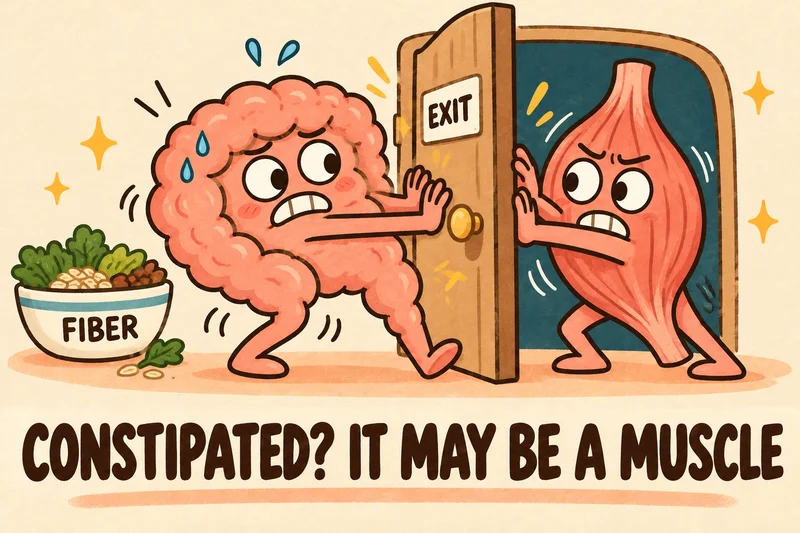
Pelvic floor dyssynergia is what we call it when you push and the muscles at the bottom of your pelvis squeeze tighter, right when they’re supposed to let go. Your stool is ready, and the exit stays shut. It’s a bit like flooring the gas with the parking brake on. That’s why years of fiber and laxatives often don’t fix it, while a kind of muscle training called biofeedback helps most people who try it in trials [2][3][6].
The short version
- It’s common. About 14% of adults live with chronic constipation [1], and when they get tested, this turns up in roughly a quarter to over half of them [2].
- Two office tests can find it: anorectal manometry (a pressure check of the muscles around your anus) and a balloon test [3][4].
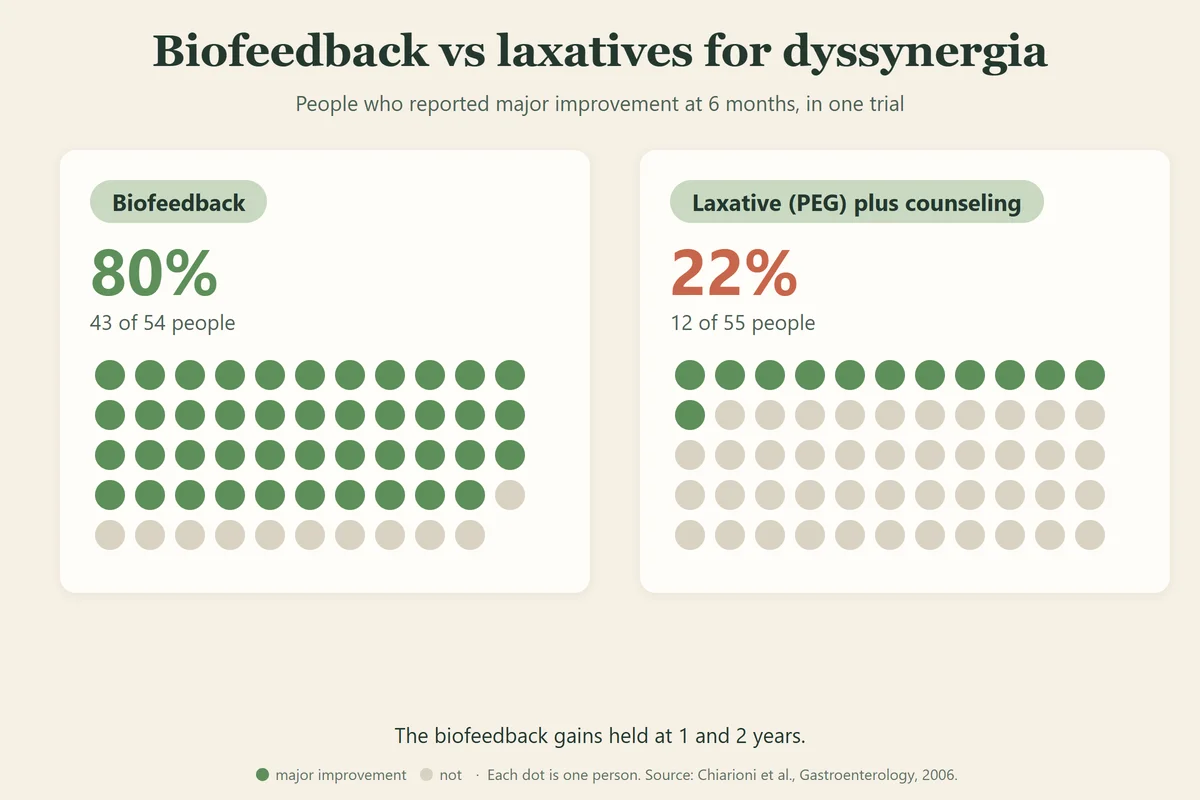
- In a key trial, biofeedback beat laxatives 80% to 22%, and the benefit held for 2 years [6].
- For some people, past trauma is part of the picture. Do you have to tell anyone about it to get tested or treated? Never.
What does pelvic floor dyssynergia feel like?
Mostly, it’s straining that goes nowhere. The urge shows up, you sit down, you push, and very little happens. Sometimes things get partway and stall, and now you’re stuck. Even when you finally stand up, it doesn’t feel finished.
In one study of 118 people with this problem, 84% strained too much and 76% felt they hadn’t emptied fully [5]. Almost half, 48%, used their fingers to help stool out. That can mean pressing around the anus or vagina, or reaching in. Do you do that? I know it’s an awkward thing to say out loud. Tell your doctor anyway, because it’s one of the most useful clues there is.
A few other things tend to tag along:
- bloating, which about 3 in 4 people with dyssynergia report [5]
- Feeling blocked, as if something’s in the way? That’s on the list too [6].
- needing an enema, a liquid flush, just to get anything out. Some people use a suppository instead, a small medicated plug for your bottom [6].
It wears you down. In that same study, it got in the way of work for 69% and social life for 76% [5]. You may also hear your doctor call it dyssynergic defecation (defecation just means passing stool). Or anismus. Same problem, three names; medicine never met a condition it couldn’t name twice.
Why haven’t fiber and laxatives worked?
Short answer: they work on the stool, and your stool was never the real problem. The door is. Fiber bulks stool up. Laxatives soften it or hurry it along. But the muscle clamping shut while you push? Neither one gets anywhere near it.
Ever tried to get toothpaste out with the cap still screwed on? Squeeze all you want. Nothing. And fiber? That just crams more toothpaste into the tube.
Want proof? One trial put this head to head [6]. People with dyssynergia got either 5 weekly biofeedback sessions or a standard laxative (PEG, polyethylene glycol) plus counseling. At 6 months, 80% of the biofeedback group reported major improvement. On the laxative? Just 22%. And the gains didn’t fade at 1 or 2 years. A second trial followed people for a year and called standard therapy “largely ineffective” for this [8].
That doesn’t make laxatives bad. They’re the right first step for most constipation [4]. But if they keep failing you, the sixth brand on the shelf probably won’t do what the first five couldn’t. Ask to be tested. Don’t just take my word for it: the American Gastroenterological Association and the American College of Gastroenterology (ACG) both say so [3][4].
How we test for it: anorectal manometry and the balloon test
I do anorectal manometry myself, so let me walk you through it. I tell nervous patients the same thing every time. It’s a bit awkward, but it shouldn’t hurt.
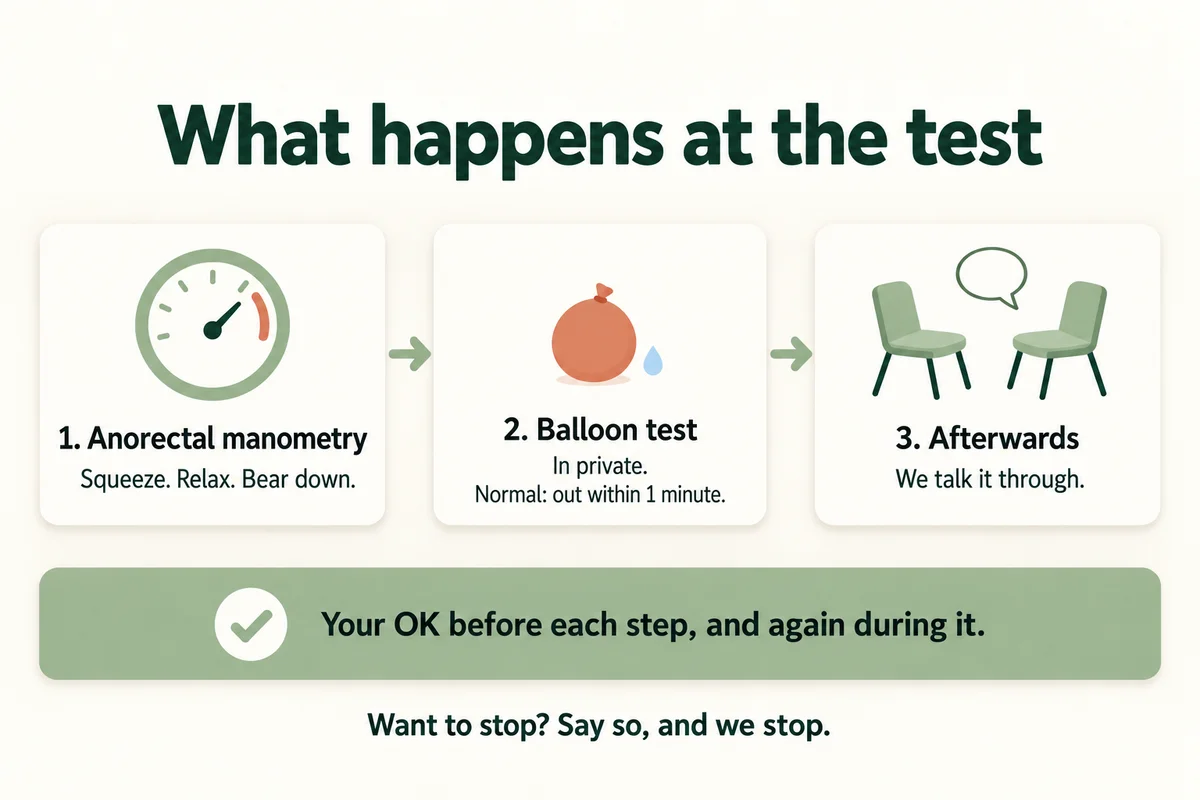
Anorectal manometry starts with a thin, flexible tube, placed just inside the anus. Along it sit pressure sensors, and every squeeze shows up. Think tire gauge, only it’s checking muscle instead of air. Then I coach you. Squeeze. Relax. Now bear down, the way you would at home. The whole test boils down to one question: when you push, does the exit open up, or clamp down?
The balloon expulsion test? Yes, it’s an actual balloon, a small one. It holds about 50 mL of warm water (a little under a quarter cup), and it goes into the rectum. That’s the last stretch of bowel, just above the anus. Then you sit on a toilet, in private, and try to pass it. Most people manage that within 1 minute, which is the normal cutoff [2][3].
Why do both? Because it’s easy to tense up on a test table, and nobody’s at their most relaxed there. One guideline notes that 37% of women without symptoms don’t relax on manometry [3]. So one test on its own can fool us. I read the two tests together, along with what you’ve told me. The American College of Gastroenterology says you need both to make the diagnosis [3].
Sometimes there’s a third test. Why? Up to half of people with dyssynergia also have a slow colon [3]. Picture a highway with a jam halfway down and the exit ramp closed. You’d want to know about both, right? So your doctor may want a colonic transit study, a test that clocks how fast stool gets through.
During the test, you call the shots. If you’ve been through trauma, lying on a table for an anorectal test can feel threatening. Trauma-informed care means we ask your OK before each step, and again during it [13]. You get privacy. Afterwards, we talk it through. Want to stop at any point? Just tell me, and we stop.
A patient I saw recently
A woman in her 30s came to see me after years of constipation. She’d seen numerous physicians. Laxatives, fiber, all the natural remedies: she’d tried them. She was suffering, and about to give up.
So we did the testing. Her anorectal manometry gave us the answer, dyssynergic defecation. Each time she pushed, her pelvic floor tightened instead of letting go, which is exactly backwards. No laxative retrains a muscle, so I referred her for biofeedback therapy.
Her constipation turned out to be tied to trauma in her childhood.
Can trauma cause constipation?
For some people, it’s part of the story. Researchers have seen the link for decades, and it’s mostly been in people who came to GI (gastrointestinal, or digestive) clinics.
- At one U.S. GI referral clinic, 44% of women reported past sexual or physical abuse [11]. Only 17% had ever told a doctor.
- In a study of 344 patients, sexual abuse was reported by 40% of those with functional bowel problems, like irritable bowel syndrome, where the gut misbehaves without visible damage. With other bowel diseases? 10%. Dyssynergia also showed up more often in people who’d been sexually abused [12].
- Among 118 people with dyssynergia, 22% reported sexual abuse and 32% physical abuse [5].
How could the past end up in your pelvic floor? Experts describe dyssynergia as a learned pattern [3]. What’s learned can be retrained. Your muscles get used to guarding, maybe after pain, trauma, or years of holding it in. Then they keep doing it long after the reason is gone. The American College of Gastroenterology lists trauma and physical or sexual abuse among the possible risk factors [3].
So, “my childhood trauma is the cause of my constipation?” For some people, it’s part of the answer.
Keep two things in mind, though. Most people with dyssynergia, nearly 8 in 10, don’t report sexual abuse [5]. It can start in childhood or after pregnancy or an injury, and for 40% there’s no clear trigger at all [2]. Whatever started it, you’re dealing with a real, measurable muscle pattern I can see on a screen. You’re not imagining it. When patients tell me they’ve been told it’s all in their head, I tell them it isn’t. It’s in the pelvic floor, and we can test it [3].
If this brings up something from your own past What you tell your GI doctor is up to you. Want to talk to someone? RAINN’s National Sexual Assault Hotline is free and confidential, and someone’s there 24/7. Call 800-656-4673, or chat at rainn.org. Thinking about hurting yourself? Call or text 988.
How biofeedback retrains the pelvic floor
Ever tried to fix a muscle you can’t see? That’s where biofeedback comes in: you get to watch. A small sensor reads your pelvic floor and belly muscles, and on a screen, each one turns into a line. A trained therapist pulls up a chair next to you and coaches. What you’re after is a gentle push from the belly while the pelvic floor drops. Pull it off, and the screen shows it right away.
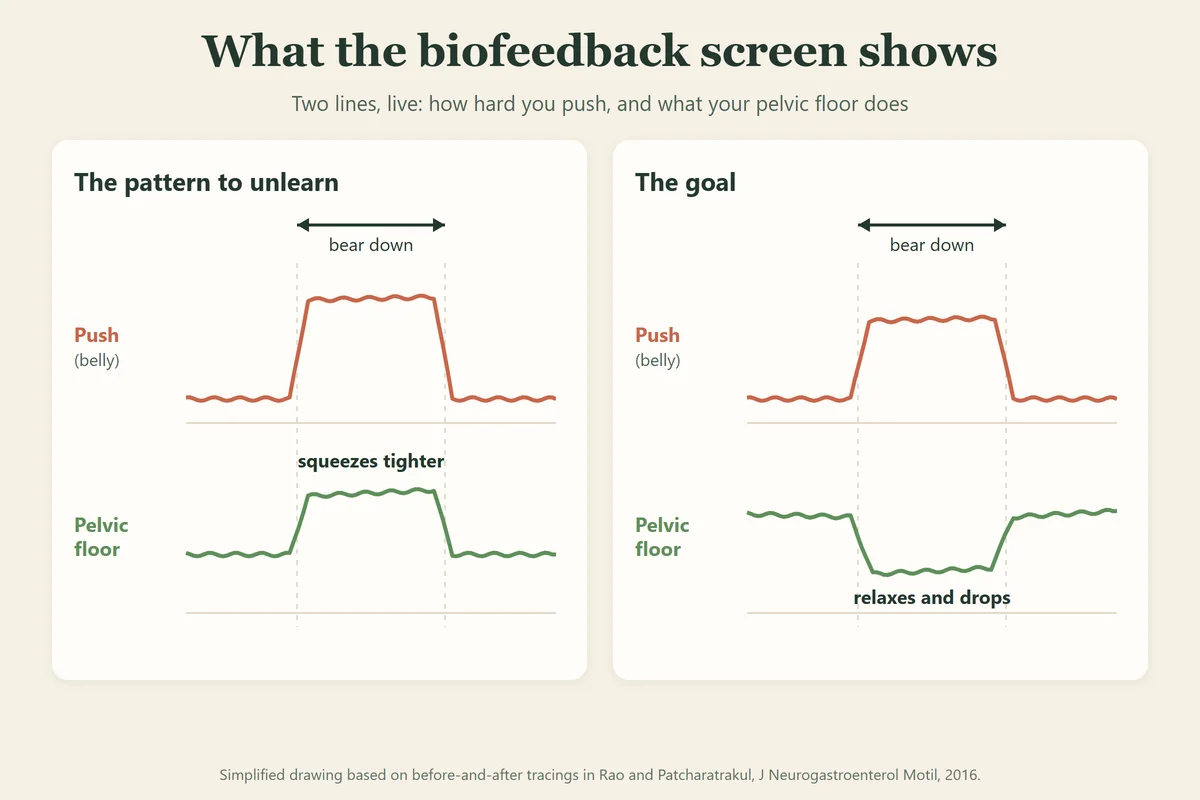
It’s like backing up a trailer. Hard to do blind, a whole lot easier once you’ve got a backup camera. It feels odd at first. You keep at it until it doesn’t, and then you practice at home. Who runs it? For my patients, it’s usually a pelvic floor physical therapist trained in biofeedback.
So what’s the time commitment? Here’s the usual plan:
- 4 to 6 sessions of about an hour, spaced roughly 2 weeks apart [2][3]
- home practice between visits
- no drugs, and no side effects reported in the trials [2][9]
Does it actually work? The ACG’s guideline gives it a strong recommendation [3]. Compared with fake (sham) feedback, real biofeedback did better at fixing the muscle pattern and brought more complete bowel movements. People also needed their fingers to help less often [7]. And it doesn’t wear off fast. The benefit tends to last more than 2 years [2].
Real-world numbers are lower. About 61% of 127 patients had treatment success in one center’s records [10]. Even so, the authors didn’t hedge: they said to offer it to everyone with the diagnosis.
Can’t find a program near you? You wouldn’t be the first; it isn’t widely available [3]. A trial of 100 people tested a home device used for 20 minutes twice a day. It helped 68%, about the same as office therapy at 70%, and cost less [9]. Plain pelvic floor exercises with no sensor feedback didn’t work for this problem [3]. So ask whether the program you’re offered uses real-time feedback.
If you have a trauma history, biofeedback alone may not be the whole answer. For those patients, I often suggest counseling alongside it, if they want it.
When to call your doctor
Some constipation shouldn’t wait. Call your doctor if you notice:
- blood in your stool or on the paper
- Losing weight without trying? That needs a check.
- a change in your bowel habits that sticks around for weeks
- severe belly pain with a swollen belly or vomiting, which can’t wait
- If a parent, brother or sister had colon cancer, mention it, even if your symptoms seem mild.
And if fiber and over-the-counter laxatives haven’t helped after a fair try, ask about anorectal testing [3][4]. For other causes, see our guide to understanding constipation.
Frequently asked questions
Can dyssynergic defecation be cured?
For many people, it can be corrected. It’s a learned muscle habit, so you can unlearn it [2][3]. In one clinic, biofeedback corrected the muscle pattern in 78% [10]. In the 2006 trial, 80% improved a lot with biofeedback and were still better 2 years later [6]. If your colon is also slow, which happens in up to half of people with dyssynergia, that may need its own treatment [3].
How do you fix dyssynergic defecation at home?
Get the diagnosis first, so you know what you’re training. Then ask your GI doctor about a home biofeedback program. In one trial, 68% of people using a home device twice a day improved, close to the 70% who came to the office [9]. Plain pelvic floor exercises without feedback weren’t effective [3].
What will trigger dyssynergic defecation?
What could be causing my poop to get stuck halfway out?
Get Dr. Ted’s take in your inbox
About 1 in 7 adults lives with chronic constipation [1]. If you’re one of them, join the Gutsavi newsletter for plain answers on gut health. And you’ll hear when our Conquer Constipation course opens. You’ll find more on our constipation hub, and on how stress works on the gut in The Stressy Stomach Plot Twist. Have a question for me? Send it through Ask Dr. Ted.
Sources
- Suares NC, Ford AC. Prevalence of, and risk factors for, chronic idiopathic constipation in the community: systematic review and meta-analysis. Am J Gastroenterol. 2011;106(9):1582-91. doi:10.1038/ajg.2011.164
- Rao SS, Patcharatrakul T. Diagnosis and treatment of dyssynergic defecation. J Neurogastroenterol Motil. 2016;22(3):423-35. doi:10.5056/jnm16060
- Wald A, Bharucha AE, Limketkai B, et al. ACG clinical guidelines: management of benign anorectal disorders. Am J Gastroenterol. 2021;116(10):1987-2008. doi:10.14309/ajg.0000000000001507
- Bharucha AE, Pemberton JH, Locke GR 3rd. American Gastroenterological Association technical review on constipation. Gastroenterology. 2013;144(1):218-38. doi:10.1053/j.gastro.2012.10.028
- Rao SS, Tuteja AK, Vellema T, Kempf J, Stessman M. Dyssynergic defecation: demographics, symptoms, stool patterns, and quality of life. J Clin Gastroenterol. 2004;38(8):680-5. doi:10.1097/01.mcg.0000135929.78074.8c
- Chiarioni G, Whitehead WE, Pezza V, Morelli A, Bassotti G. Biofeedback is superior to laxatives for normal transit constipation due to pelvic floor dyssynergia. Gastroenterology. 2006;130(3):657-64. doi:10.1053/j.gastro.2005.11.014
- Rao SS, Seaton K, Miller M, et al. Randomized controlled trial of biofeedback, sham feedback, and standard therapy for dyssynergic defecation. Clin Gastroenterol Hepatol. 2007;5(3):331-8. doi:10.1016/j.cgh.2006.12.023
- Rao SS, Valestin J, Brown CK, Zimmerman B, Schulze K. Long-term efficacy of biofeedback therapy for dyssynergic defecation: randomized controlled trial. Am J Gastroenterol. 2010;105(4):890-6. doi:10.1038/ajg.2010.53
- Rao SSC, Valestin JA, Xiang X, et al. Home-based versus office-based biofeedback therapy for constipation with dyssynergic defecation: a randomised controlled trial. Lancet Gastroenterol Hepatol. 2018;3(11):768-77. doi:10.1016/S2468-1253(18)30266-8
- Patcharatrakul T, Valestin J, Schmeltz A, Schulze K, Rao SSC. Factors associated with response to biofeedback therapy for dyssynergic defecation. Clin Gastroenterol Hepatol. 2018;16(5):715-21. doi:10.1016/j.cgh.2017.10.027
- Drossman DA, Leserman J, Nachman G, et al. Sexual and physical abuse in women with functional or organic gastrointestinal disorders. Ann Intern Med. 1990;113(11):828-33. doi:10.7326/0003-4819-113-11-828
- Leroi AM, Bernier C, Watier A, et al. Prevalence of sexual abuse among patients with functional disorders of the lower gastrointestinal tract. Int J Colorectal Dis. 1995;10(4):200-6. doi:10.1007/BF00346219
- Jagielski CH, Naftaly JP, Riehl ME. Providing trauma informed care during anorectal evaluation. Curr Gastroenterol Rep. 2023;25(9):204-11. doi:10.1007/s11894-023-00879-4
This article is for education only and isn’t medical advice. Talk with your own doctor about your care.
This article is for education only and isn't a substitute for advice from your own doctor. If something feels off, talk to your care team.