
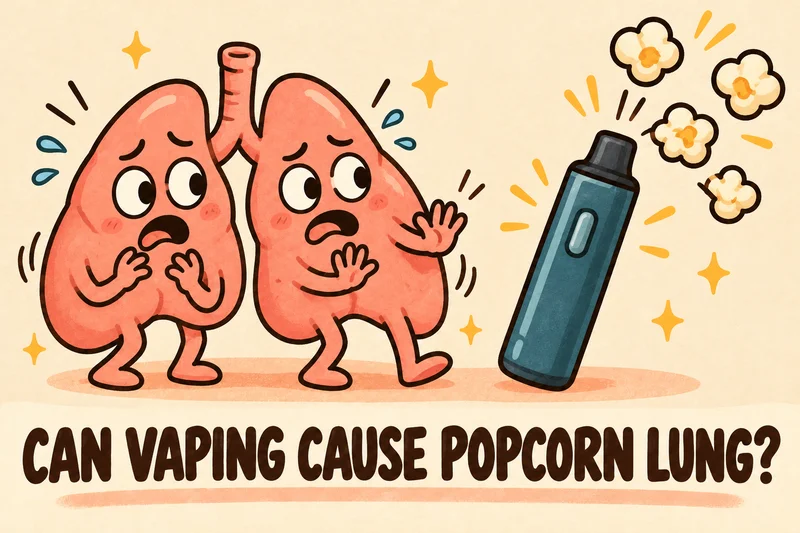
Can vaping cause popcorn lung? It can, but it’s rare. Since 2022, doctors have published lung biopsies (small tissue samples taken from the lung) from a handful of people who vaped and then developed it [1][2]. Nobody’s proven which chemical was to blame. And the 2019 outbreak that put thousands of vapers in hospital? That was a different injury, called EVALI, a sudden vaping lung injury tied mostly to THC vapes [3]. THC is the part of cannabis that gets you high.
The short version
- Popcorn lung from vaping is possible, rare, and still being worked out.
- Black hairy tongue has turned up in people who vape. The evidence is thin, and it’s harmless anyway [4][5].
- Seizures after vaping? They’ve been reported to the FDA (the US Food and Drug Administration), but a link isn’t proven [6]. Swallowed e-liquid (the liquid that goes in a vape) causing seizures is proven [7], and toddlers swallow it most [13].
- You’ll see fewer headlines about the harms with the most data behind them: nicotine addiction, poisoning and battery burns.
“Better think again”: why I sent this one
“Did you know vaping can cause popcorn lung, black hairy tongue, and seizures, better think again the next time you grab your vape device.” That’s the note I sent my team. Then we checked each claim against the research, so you get the real odds and not just a scary list.
Can vaping cause popcorn lung? What’s actually been found
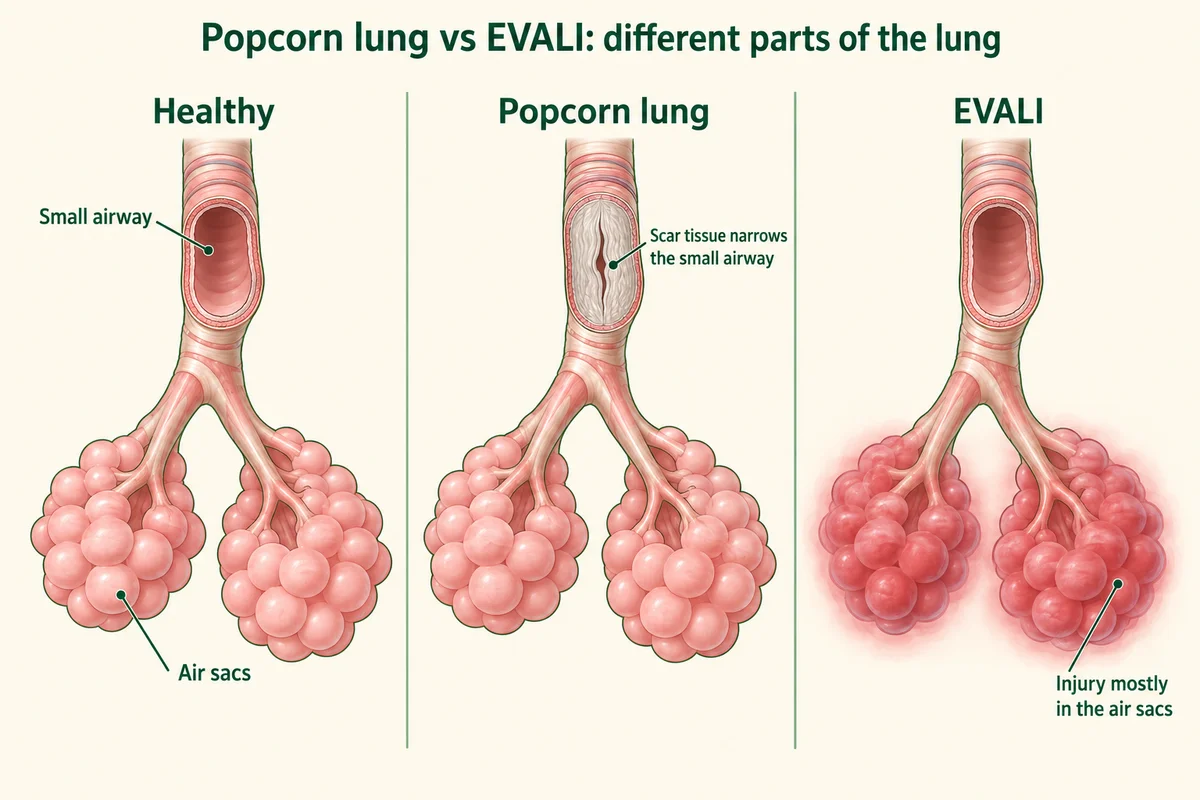
“Popcorn lung” is the nickname for bronchiolitis obliterans. Scar tissue builds up inside your tiniest airways until it squeezes them shut and traps air. I’d call it a plumbing problem: the smallest pipes in the house slowly close up until barely anything gets through.
Why popcorn? Nobody caught it at the movies. Workers at a microwave-popcorn plant had 3.3 times the expected rate of blocked airways [8]. And the more butter-flavoring chemical (diacetyl) they’d breathed, the worse it got [8].
Here’s where vapes come into it. Diacetyl tastes buttery and sweet, and it’s turned up in e-liquids. When a Harvard team tested 51 flavored e-cigarettes, 39 of them had it [9]. Because of what diacetyl did to those workers’ lungs, the team called for urgent action to look into it [9].
For years, that’s where things sat: a worrying chemical, and no patients to show for it. Then a few case reports started to change the picture:
- In 2019, a 17-year-old in Canada who’d vaped flavored liquids and THC heavily spent 47 days in hospital, part of it on a heart-lung machine. Months later his airways were still blocked, and his doctors called it possible popcorn lung [10].
- Four more came out of Boston in 2022. Each person had vaped for 3 to 8 years, and each had a lung biopsy showing constrictive bronchiolitis, the medical name for popcorn lung [1].
- Then in 2024, a Mayo Clinic team added a woman in her 40s. In their words: “This phenomenon has not been well described” [2].
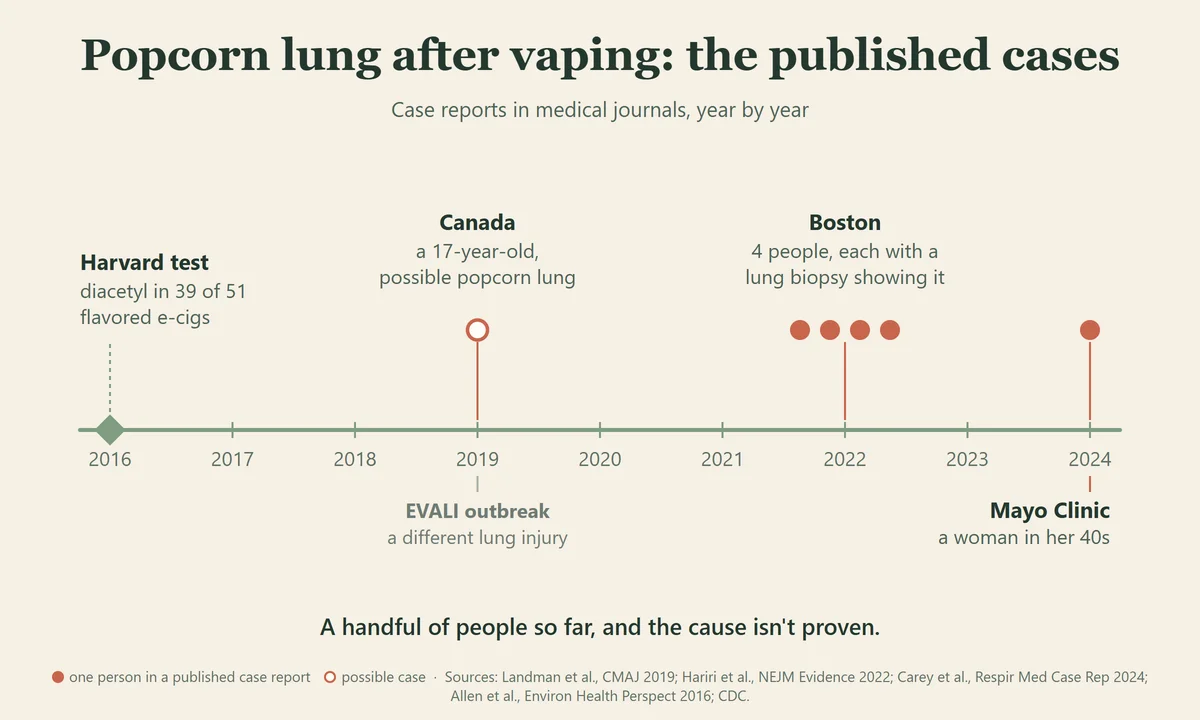
Is that a lot? Not next to the millions of people who vape. And I wouldn’t pin it on diacetyl, either, because none of these reports proves that. My honest read: popcorn lung from vaping is real but rare, and nobody knows yet who’s at risk.
Popcorn lung isn’t EVALI
Remember the 2019 headlines about young people on ventilators, the machines that breathe for you? That was EVALI. The letters stand for e-cigarette or vaping product use-associated lung injury. By February 2020, the CDC (the US Centers for Disease Control and Prevention) had counted 2,807 hospital cases or deaths, and 68 of those were deaths [3].
The two hit different parts of the lung. Popcorn lung scars the small airways, the pipes. EVALI mostly hit the air sacs at the far end of those pipes, deep in the lungs [10].
So what caused it? The prime suspect is an additive called vitamin E acetate. Some THC liquids had it mixed in as an oily thickener. Researchers found it in the lung fluid of 48 of 51 patients they tested, and in none of the healthy people they were compared with [11]. Nearly all of those patients had used THC products [11]. And most of the THC vapers hadn’t bought from a store. They’d gotten their products from friends, dealers or online sellers [3].
So when someone says “vaping causes popcorn lung” and holds up 2019 as proof, they’ve mixed up two different injuries.
Can vaping cause black hairy tongue?
It sounds like a horror-movie title, but black hairy tongue won’t hurt you. The tiny bumps on top of your tongue grow longer than usual and trap stains and bacteria, so your tongue ends up looking dark and furry [4]. Smoking is a classic trigger. Lots of coffee or black tea, a dry mouth, skipped brushing and some medicines are on the list too [4].
And vaping? The case is thin. A 2026 review of vaping and mouth health lists hairy tongue among the changes seen more often in people who vape than in former smokers [5]. That rests on one small study, and it’s about all we’ve got so far.
If your tongue has gone dark, drop the likely trigger and brush your tongue gently every day [4]. It usually clears. Still dark after a few weeks, or sore? Show your dentist or doctor.
Can vaping cause seizures?
Maybe. In April 2019, the FDA put out word that some people who vape had seizures, mostly teens and young adults. It called this a “potential emerging safety issue” [12]. FDA scientists then went through 122 reports sent in up to mid-2019, from people with a median age of 20, meaning half were younger than that [6]. Where the timing was known, 62% of the seizures came within 30 minutes of vaping. That sounds damning until you read the rest. Some of those people had a seizure history, and some had used other drugs too.
So the FDA team chose its words carefully: the reports “suggest an association.” That’s a long way from proof, and we found no later FDA verdict.
Swallowed e-liquid is a different story, and that one’s proven. Nicotine in large doses can cause seizures [12]. Drinking e-liquid can even be fatal [7]. Got a toddler at home? This part’s for you. From 2012 to 2017, US poison centers logged 8,269 liquid nicotine exposures in children under 6, and most of those kids were under age 3 [13]. Cases dropped once child-resistant packaging became law [13]. That cap only works if it goes back on, every time.
Keep e-liquid and pods locked up and out of reach. If your child swallows some, call Poison Help at 1-800-222-1222 [14]. And if they have a seizure or won’t wake up, skip the phone line and call 911.
What vaping does to your gut
This is a gut-health site, so we dug hardest here. Honestly, the research is thinner than you’d hope.
Queasy after vaping? You’re not imagining it. In quit-smoking trials, the top complaints were throat and mouth irritation, headache, cough and nausea, and they often eased with time [15].
What about reflux, when stomach acid washes back up the wrong way? With smoking, the link is well known. The American College of Gastroenterology’s reflux guideline suggests avoiding tobacco products if you have reflux symptoms [16]. With vaping, we’ve only got early hints. In a survey of 403 university students, the ones who vaped reported worse reflux symptoms, and frequent vapers scored higher still [17]. A survey like that can’t show that vaping causes reflux.
There’s also one case report. A 25-year-old’s reflux had been under control until he started vaping THC and nicotine heavily every day. Two months later, his esophagus (the food pipe) was badly inflamed. With treatment and advice to stop vaping, his symptoms were gone within two months [18].
Vape THC? Then there’s one more gut problem worth knowing by name. Heavy, regular cannabis use can cause cannabinoid hyperemesis syndrome, which brings bouts of severe vomiting [19]. The American Gastroenterological Association put out guidance on it in 2024 [19].
When someone’s reflux or nausea won’t settle, I ask whether they vape. Then I suggest a few weeks without it, to see what changes.
If reflux is part of your story, our acid reflux and GERD guide is a good next stop.
Hooked young, and other proven harms
Addiction has more evidence behind it than anything else here. In 2025, 5.2% of US middle and high school students were vaping [20]. About 4 in 10 of them vaped on 20 or more days a month [20]. That’s close to every day. “Nicotine is highly addictive,” the CDC says, and it can harm brain development, which goes on until about age 25 [21].
Your gums take a hit too. Compared with people who never smoked, people who vape have more plaque, more gum inflammation and more bleeding when the gums are checked [5]. Cigarette smokers still tend to come out worse [5].
And then there’s the battery riding around in your pocket. From 2015 to 2017, US emergency rooms saw an estimated 2,035 vape explosion and burn injuries [22]. The FDA’s tips are plain common sense [23]:
- Charge it with the charger that came with the device, never a phone or tablet charger.
- Don’t leave it charging overnight or unattended.
- Spare batteries go in a case, away from keys and coins.
- Got a damaged or wet battery? Replace it.
If you smoke, is vaping safer?
Let’s be fair about this one. “There are no safe tobacco products,” the FDA says, and that includes vapes [24]. If you already smoke, though, the math changes. Vape aerosol (the mist you breathe in) generally contains fewer harmful chemicals than cigarette smoke, the CDC says [21]. In the same breath, it warns that “this does not make e-cigarettes safe” [21]. Where the CDC lands: vaping may help adults who smoke and aren’t pregnant, if they switch completely [21].
How much does it help? Cochrane reviewers, an independent group that pools all the good trials on a question, found nicotine vapes beat patches and gum by about 3 extra quitters out of every 100 [15]. Still, you won’t find a vape that’s FDA-approved for quitting [25]. And vaping plus a few cigarettes a day? That mix still does harm [24].
Who shouldn’t vape at all? If you’re a teen, a young adult or pregnant, the CDC says don’t [25]. And if you don’t smoke, vaping has no harm to reduce, so all you get are its risks.
Ready to stop? Free help covers vaping too:
- Call 1-800-QUIT-NOW to reach your state’s quitline. It’s free, and it helps with e-cigarettes as well as cigarettes [26].
- Smokefree.gov, run by the National Cancer Institute, has quit tips and support tools [27].
- If you’re young and vape, text DITCHVAPE to 88709 for This is Quitting, a free text program from Truth Initiative [28].
Gutsavi has no ties to any vape, tobacco, nicotine or quit-smoking company.
When to call your doctor
Tell your doctor you vape, even if they only ask about smoking. And book a visit if any of these sound like you:
- A cough or wheezing that won’t quit.
- Shortness of breath that’s getting worse, or chest pain with breathing trouble? Get it checked, especially after years of vaping [1].
- A dark or furry tongue that brushing doesn’t clear.
- Nausea, vomiting or reflux that keeps coming back? Mention the vaping.
Call 911 for a seizure or serious trouble breathing. If a child swallows e-liquid, call Poison Help at 1-800-222-1222 right away [14].
Frequently asked questions
How do I know if I have popcorn lung from vaping?
You can’t tell on your own. In the published cases, people had a lasting cough, shortness of breath or chest pain [10][1]. Doctors look for blocked airways on breathing tests and trapped air on a CT scan, and sometimes take a small lung biopsy to be sure [1][2]. If your breathing has changed, see a doctor and mention the vaping.
Can popcorn lung go away if you stop vaping?
Partly, in the few cases we have. Among the four Boston patients, those who stopped vaping improved over 1 to 4 years, but not all the way [1]. That’s a tiny group, so treat it as a hint, not a promise.
Is vaping worse than smoking?
Can vaping cause acid reflux?
Possibly. Smoking’s a known reflux trigger, and the reflux guideline suggests avoiding tobacco products [16]. For vaping, there’s a student survey linking it to worse reflux symptoms and one case of a badly inflamed esophagus [17][18]. That’s not proof. If your heartburn won’t settle, try a few weeks without vaping and tell your doctor.
Questions about your gut?
Send them to me through Ask Dr. Ted. If heartburn is part of the picture, read Understanding Acid Reflux/GERD or Reflux in the Throat, Polyps in the Colon? Let’s Talk About That. You’ll find more topics in our Learn hub. And join the Gutsavi newsletter to get the next article in your inbox.
Sources
- Hariri LP, Flashner BM, Kanarek DJ, et al. E-cigarette use, small airway fibrosis, and constrictive bronchiolitis. NEJM Evid. 2022;1(6). doi:10.1056/EVIDoa2100051
- Carey L, Johnson K, Villalba J, Baqir M. Vaping-associated constrictive bronchiolitis. Respir Med Case Rep. 2024;51:102062. doi:10.1016/j.rmcr.2024.102062
- Centers for Disease Control and Prevention. Outbreak of lung injury associated with the use of e-cigarette, or vaping, products (archived page). archive.cdc.gov
- Gurvits GE, Tan A. Black hairy tongue syndrome. World J Gastroenterol. 2014;20(31):10845-50. doi:10.3748/wjg.v20.i31.10845
- Kumar PS, Beverly ML, Galindo-Fernandez P, Thompson W, Verma M, Shick E. To vape or not to vape: oral health in the age of electronic nicotine delivery systems and electronic non-nicotine delivery systems. Int Dent J. 2026;76(3):109523. doi:10.1016/j.identj.2026.109523
- Faulcon LM, Rudy S, Limpert J, Wang B, Murphy I. Adverse experience reports of seizures in youth and young adult electronic nicotine delivery systems users. J Adolesc Health. 2020;66(1):15-17. doi:10.1016/j.jadohealth.2019.10.002
- National Academies of Sciences, Engineering, and Medicine. Public Health Consequences of E-Cigarettes. Washington, DC: National Academies Press; 2018. doi:10.17226/24952
- Kreiss K, Gomaa A, Kullman G, et al. Clinical bronchiolitis obliterans in workers at a microwave-popcorn plant. N Engl J Med. 2002;347(5):330-8. doi:10.1056/NEJMoa020300
- Allen JG, Flanigan SS, LeBlanc M, et al. Flavoring chemicals in e-cigarettes: diacetyl, 2,3-pentanedione, and acetoin in a sample of 51 products, including fruit-, candy-, and cocktail-flavored e-cigarettes. Environ Health Perspect. 2016;124(6):733-9. doi:10.1289/ehp.1510185
- Landman ST, Dhaliwal I, Mackenzie CA, et al. Life-threatening bronchiolitis related to electronic cigarette use in a Canadian youth. CMAJ. 2019;191(48):E1321-31. doi:10.1503/cmaj.191402
- Blount BC, Karwowski MP, Shields PG, et al. Vitamin E acetate in bronchoalveolar-lavage fluid associated with EVALI. N Engl J Med. 2020;382(8):697-705. doi:10.1056/NEJMoa1916433
- U.S. Food and Drug Administration. Safety communication related to seizures reported following e-cigarette use, particularly in youth and young adults. April 3, 2019. fda.gov
- Govindarajan P, Spiller HA, Casavant MJ, et al. E-cigarette and liquid nicotine exposures among young children. Pediatrics. 2018;141(5):e20173361. doi:10.1542/peds.2017-3361
- Health Resources and Services Administration. The Poison Help line, 1-800-222-1222. poisonhelp.hrsa.gov
- Lindson N, Livingstone-Banks J, Butler AR, et al. Electronic cigarettes for smoking cessation. Cochrane Database Syst Rev. 2025;11:CD010216. doi:10.1002/14651858.CD010216.pub10
- Katz PO, Dunbar KB, Schnoll-Sussman FH, et al. ACG clinical guideline for the diagnosis and management of gastroesophageal reflux disease. Am J Gastroenterol. 2022;117(1):27-56. doi:10.14309/ajg.0000000000001538
- Farooqi W, Hussamuldin A, Alabdullah A, et al. Prevalence of gastroesophageal reflux disease (GERD) among electronic cigarette-smoking university students in Riyadh, Saudi Arabia. Cureus. 2024;16(12):e74999. doi:10.7759/cureus.74999
- Pasricha TS, Kochar B. Vaping-associated esophagitis. BMC Gastroenterol. 2021;21(1):106. doi:10.1186/s12876-021-01695-8
- Rubio-Tapia A, McCallum R, Camilleri M. AGA clinical practice update on diagnosis and management of cannabinoid hyperemesis syndrome: commentary. Gastroenterology. 2024;166(5):930-4.e1. doi:10.1053/j.gastro.2024.01.040
- Park-Lee E, Dutra LM, Cowan H, et al. Tobacco product use among middle and high school students in the United States: National Youth Tobacco Survey, 2025. Nicotine Tob Res. 2026;28(11):1912-20. doi:10.1093/ntr/ntag116
- Centers for Disease Control and Prevention. Health effects of vaping. January 31, 2025. cdc.gov
- Rossheim ME, Livingston MD, Soule EK, Zeraye HA, Thombs DL. Electronic cigarette explosion and burn injuries, US emergency departments 2015-2017. Tob Control. 2019;28(4):472-4. doi:10.1136/tobaccocontrol-2018-054518
- U.S. Food and Drug Administration. Tips to help avoid vape battery fires or explosions. April 12, 2024. fda.gov
- U.S. Food and Drug Administration. E-cigarettes, vapes, and other electronic nicotine delivery systems (ENDS). August 17, 2026. fda.gov
- Centers for Disease Control and Prevention. E-cigarettes (vapes). January 31, 2025. cdc.gov
- Centers for Disease Control and Prevention. Quitlines and other cessation support resources. cdc.gov
- National Cancer Institute. Smokefree.gov. smokefree.gov
- Truth Initiative. Quitting e-cigarettes: This is Quitting. truthinitiative.org
This article is for education only and isn’t medical advice. Talk with your own doctor about your care.
This article is for education only and isn't a substitute for advice from your own doctor. If something feels off, talk to your care team.