
Crohn’s disease exclusion diet for adults? It exists, and a small trial suggests it can calm mild-to-moderate Crohn’s, an inflammatory bowel disease, in grown-ups too [6]. If your child had Crohn’s, a diet might well be their first treatment. For kids, pediatric GI doctors use formula-only feeding to bring the disease under control [1], and the exclusion diet plus formula worked in a trial with children too [2]. Walk into an adult clinic with the same disease and you’ll rarely hear either one offered. Why not? From the research, it’s mostly the formula itself, small trials and old habits.
The short version
- Kids with Crohn’s can get diet therapy to bring it under control. It’s the main course, not a side dish [1][2].
- In adult trials, formula alone lost to steroids, and many adults couldn’t keep drinking it [4][10].
- Is your Crohn’s mild and fairly new? Then the exclusion diet is worth asking about, with a dietitian and alongside your treatment plan [5].
Why is there a diet that treats Crohn’s in kids?
I put the question to my team like this: “Why is there a diet that treats pediatric Crohn’s disease but there really isn’t one for adults?” My adult patients with Crohn’s ask me about diet all the time.
The story starts with exclusive enteral nutrition, or EEN. For weeks, every calorie comes from a complete liquid formula. No breakfast, no pizza night, no regular food at all. Sounds extreme? It is. In children, it also works surprisingly well.
One North American study followed 90 kids starting treatment for active Crohn’s [3]. On formula alone, 88% got better. A stool test for gut inflammation, called calprotectin, came down to a healthy range in 45% of them, a sign the lining was healing [3].
How does a shake calm an inflamed gut? Nobody knows for sure, but the same study left a good clue. Kids who drank formula and kept eating their usual food felt better too. But only 14% of them got that stool test down, compared with 45% on formula alone [3]. Ever tried to air out a smoky kitchen with the pan still burning on the stove? What you leave out seems to matter as much as what you drink.
Parents, one more point for formula: one study found less growth failure (kids falling behind on height) with EEN than with steroids, the strong anti-inflammatory medicines like prednisone [11].
What is the Crohn’s disease exclusion diet?
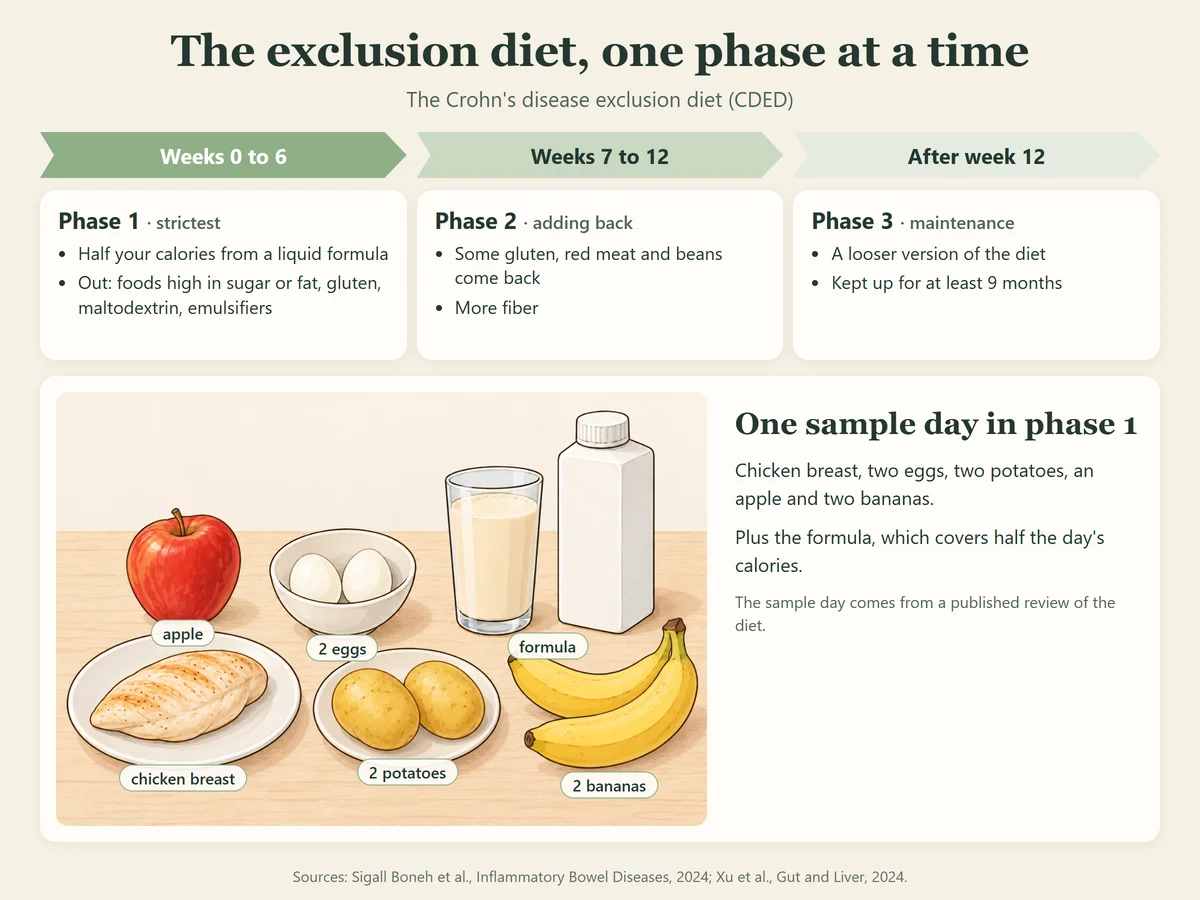
What if you could get that effect while eating actual food? That’s the idea behind the Crohn’s disease exclusion diet (CDED). Its designers cut foods suspected of harming gut bacteria and the gut’s protective lining [2]. For the first six weeks you still get half your calories from a liquid formula. Doctors call that partial enteral nutrition, or PEN [9].
The diet opens back up in three phases, a bit like a road crew reopening a highway one lane at a time [8]:
- Weeks 0 to 6 are the strictest stretch. You drop foods high in sugar or fat, gluten, and additives like maltodextrin, a starch-based filler [9]. Emulsifiers go too; they’re what keep oil and water mixed in processed foods [9]. One review’s sample day was chicken breast, two eggs, two potatoes, an apple and two bananas, plus the formula [9].
- In weeks 7 to 12, you add back some gluten, red meat and beans, and more fiber [9].
- After that comes a looser maintenance version, kept up for at least nine months [8].
Is it better than formula alone? For kids, it’s at least easier to live with. In a 2019 trial of 78 children, 97.5% managed CDED with formula, while 73.6% could stay on formula alone [2]. By week 12, 75.6% of the CDED group were still in remission (the disease gone quiet) without steroids, compared with 45.1% [2].
No wonder North American pediatric GI doctors call formula-only feeding effective, and often underused, for bringing on remission in kids [1]. Not every child goes that route. In that study of 90 kids, more than half started a biologic medicine instead [3]. That’s a targeted drug, given as an injection or infusion, that blocks one part of the immune system.
So why don’t adults get the same diet?
Mostly, it’s the formula. Could you drink nothing but shakes for six to eight weeks? Through work lunches, family dinners and a weekend away? Plenty of adults try. Plenty stop, and I can’t say I blame them.
The numbers say the same thing:
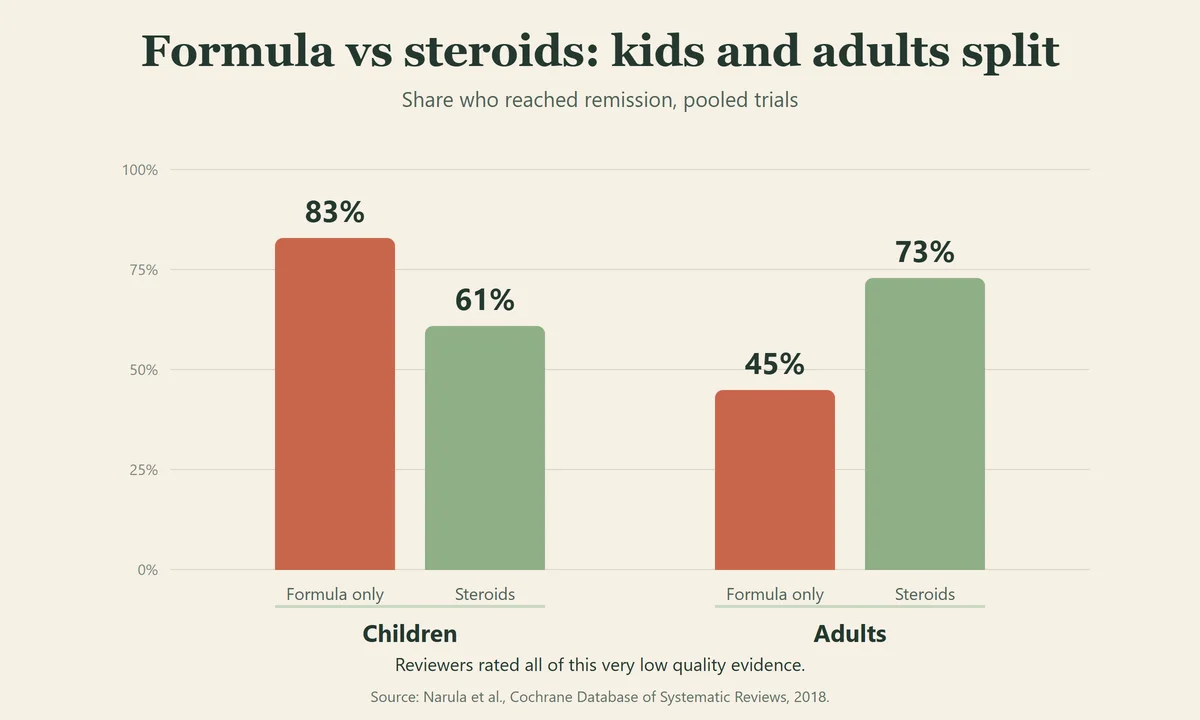
- In a Cochrane review (a large independent summary of the trials), 45% of adults on formula reached remission, compared with 73% on steroids [4]. Children went the other way (83% versus 61%), though reviewers rated all of it very low quality evidence.
- The top reason adults dropped out? They couldn’t tolerate the formula [4].
- Across studies, only 50% to 80% of adults stick with EEN. In one trial, 57% stopped, most of them over the taste [11]. Nobody’s ordering this stuff for the flavor.
- A 2026 analysis of 40 studies and 2,459 adults found EEN put 66% into remission in everyday practice. Head to head, steroids still did better [10].
Then there’s the research gap. Far fewer EEN studies exist in adults [12]. Reviewers point to missing dietitian-led teams and the assumption that adults won’t comply [12]. They add limited experience among adult IBD (inflammatory bowel disease) doctors [12]. Timing may matter, too. In adult studies, EEN seemed to work better in new, untreated Crohn’s [13].
The American Gastroenterological Association (AGA) puts it as carefully as only a guideline can: EEN works for Crohn’s, “with stronger evidence in children than adults” [5].
My own short answer? It’s mostly the formula. Six weeks on shakes is a big ask when you’ve got a job and a family to feed. And few adult clinics have the dietitians to back you up through it.
Exclusive enteral nutrition in adults: when it’s used
Your GI doctor, the gut specialist, may still bring up EEN, just for narrower jobs. The AGA says it can be a bridge that spares you steroids [5]. It can also help undernourished patients get stronger before Crohn’s surgery [5]. Reviews report benefits, too, in adults whose Crohn’s has narrowed the bowel or formed fistulas, tunnels from the bowel to the skin or another organ [11].
An Australian and New Zealand expert pathway suggests 6 to 8 weeks of EEN for adults to bring on remission. No response within 2 weeks? Then it advises stopping [12].
What the adult CDED trials show
Here’s where the adult story gets more hopeful. On the exclusion diet you sit down to real food, and that seems to ease the sticking-with-it problem [8].
| Study | Who | What happened |
|---|---|---|
| CDED-AD, 2022 [6] | 44 adults with mild-to-moderate Crohn’s, diagnosed within 5 years, never on a biologic | Remission at week 6: 68% with formula, 57% without. Of those in remission, 80% still were at week 24. |
| Israel, 2017 [7] | 21 people (11 adults) whose biologic had stopped working | 61.9% in remission at week 6 |
Looks great on paper, right? Now the fine print. Every one of these trials is small, and patients knew which diet they were on. The bigger one enrolled only mild-to-moderate Crohn’s. The formula’s maker also helped fund the 2022 trial [6]. Even its own authors called for a bigger, properly powered trial, one big enough to give a firm answer [6].
The AGA’s wording fits: CDED “may be” effective for mild-to-moderate Crohn’s “of relatively short duration” [5]. In plain English? Promising, in the right person, fairly early on.
What can adults with Crohn’s try?
For most adults, diet works alongside medicine, not in place of it. The AGA notes that no diet has consistently lowered flare rates in adults [5]. A flare is a stretch when the disease acts up. So what can you and your GI team actually build on?
A Mediterranean pattern, for nearly everyone. That means plenty of fruit and vegetables, olive oil, whole grains and lean protein, with few ultra-processed foods. The AGA advises it for you unless your doctor sees a reason not to [5]. Sounds a little boring? It held its own in a trial of 191 adults with Crohn’s against the much stricter Specific Carbohydrate Diet, which drops grains, most sugars and many starchy foods [14]. Symptom remission came out at 43.5% on the Mediterranean diet versus 46.5% on the stricter one [14].
If your Crohn’s is mild and newer, ask about CDED. Plan it as a team: you, your GI doctor and a dietitian who knows the diet [5][8]. And keep taking your medicine.
Curious about additives? Grab a label and look for carrageenan, carboxymethylcellulose and polysorbate 80, three common thickeners and emulsifiers. Yes, they sound like a chemistry final. An international expert group, the IOIBD (International Organization for the Study of Inflammatory Bowel Diseases), suggests people with Crohn’s limit processed foods that contain them [15]. They rated that evidence very low. So treat it as a sensible step, not a treatment (I’ve written more about emulsifiers and Crohn’s).
Got a narrowed section of bowel? That’s a narrower pipe, and raw, stringy vegetables can be hard to get through it. The AGA suggests cooking them soft and chewing well [5].
Had an eating disorder? Go carefully with any strict diet. CDED experts list past eating disorders, cost and access to foods as things to weigh first, because restriction can feed anxiety about food [8].
Inflammation quiet, but still cramping and bloated? That can be IBS-type symptoms (IBS is irritable bowel syndrome) on top of Crohn’s, which I cover in IBD in remission but still have symptoms. Going to try a short low FODMAP trial for those? That means cutting certain hard-to-digest carbs for a few weeks, then adding them back one at a time. Our Chef Savi low FODMAP recipe generator makes it easier to cook through, and so do our low FODMAP recipes. Fair warning: Chef Savi isn’t built for the exclusion diet.
When to call your doctor
Talk to your IBD team before you start any treatment diet. Call promptly if you have:
- blood in your stool
- a fever, or feeling unwell all over
- Losing weight on a restricted diet or formula? Call.
- severe or worsening belly pain, or vomiting, especially if you’ve had a stricture, a narrowed stretch of bowel
- diarrhea that wakes you up at night
- signs of dehydration, like dizziness or very dark urine
Frequently asked questions
What is the exclusion diet for Crohn’s disease?
Can diet put Crohn’s into remission in adults?
Sometimes, in the right person. In a small trial of adults with mild-to-moderate Crohn’s, 57% to 68% were in remission after six weeks on the exclusion diet [6]. Patients knew which diet they were on, and the groups were small. For most adults, diet goes alongside medicine, so plan it with your GI team.
What does exclusive enteral nutrition mean?
Can diet help Crohn’s disease if I’m already on a biologic?
Want a gut-friendly plan you can actually cook?
Chef Savi turns what’s in your fridge into low FODMAP recipes in seconds. For more from Dr. Ted, read The Remission Playbook, browse the Gutsavi learning center, or join the Gutsavi newsletter.
Sources
- Critch J, Day AS, Otley A, et al; NASPGHAN IBD Committee. Use of enteral nutrition for the control of intestinal inflammation in pediatric Crohn disease. J Pediatr Gastroenterol Nutr. 2012;54(2):298-305. doi:10.1097/MPG.0b013e318235b397
- I wrote your answer: mostly the formula, plus too few dietitians in adult clinics. True for you?
- Lee D, Baldassano RN, Otley AR, et al. Comparative effectiveness of nutritional and biological therapy in North American children with active Crohn’s disease. Inflamm Bowel Dis. 2015;21(8):1786-93. doi:10.1097/MIB.0000000000000426
- Narula N, Dhillon A, Zhang D, et al. Enteral nutritional therapy for induction of remission in Crohn’s disease. Cochrane Database Syst Rev. 2018;4(4):CD000542. doi:10.1002/14651858.CD000542.pub3
- Hashash JG, Elkins J, Lewis JD, Binion DG. AGA Clinical Practice Update on diet and nutritional therapies in patients with inflammatory bowel disease: expert review. Gastroenterology. 2024;166(3):521-32. doi:10.1053/j.gastro.2023.11.303
- Yanai H, Levine A, Hirsch A, et al. The Crohn’s disease exclusion diet for induction and maintenance of remission in adults with mild-to-moderate Crohn’s disease (CDED-AD): an open-label, pilot, randomised trial. Lancet Gastroenterol Hepatol. 2022;7(1):49-59. doi:10.1016/S2468-1253(21)00299-5
- Sigall Boneh R, Sarbagili Shabat C, Yanai H, et al. Dietary therapy with the Crohn’s disease exclusion diet is a successful strategy for induction of remission in children and adults failing biological therapy. J Crohns Colitis. 2017;11(10):1205-12. doi:10.1093/ecco-jcc/jjx071
- Sigall Boneh R, Westoby C, Oseran I, et al. The Crohn’s disease exclusion diet: a comprehensive review of evidence, implementation strategies, practical guidance, and future directions. Inflamm Bowel Dis. 2024;30(10):1888-1902. doi:10.1093/ibd/izad255
- Xu D, Peng Z, Li Y, et al. Progress and clinical applications of Crohn’s disease exclusion diet in Crohn’s disease. Gut Liver. 2024;18(3):404-13. doi:10.5009/gnl230093
- Kaur K, Singh A, Kaur S, et al. Exclusive enteral nutrition for induction of remission in Crohn’s disease in adults: a systematic review and meta-analysis of randomized trials and real-world studies. Indian J Gastroenterol. 2026;45(3):452-73. doi:10.1007/s12664-026-01989-3
- Mitrev N, Huang H, Hannah B, Kariyawasam VC. Review of exclusive enteral therapy in adult Crohn’s disease. BMJ Open Gastroenterol. 2021;8(1):e000745. doi:10.1136/bmjgast-2021-000745
- Day A, Wood J, Melton S, Bryant RV. Exclusive enteral nutrition: an optimal care pathway for use in adult patients with active Crohn’s disease. JGH Open. 2020;4(2):260-6. doi:10.1002/jgh3.12256
- Wall CL, Day AS, Gearry RB. Use of exclusive enteral nutrition in adults with Crohn’s disease: a review. World J Gastroenterol. 2013;19(43):7652-60. doi:10.3748/wjg.v19.i43.7652
- Lewis JD, Sandler RS, Brotherton C, et al. A randomized trial comparing the specific carbohydrate diet to a Mediterranean diet in adults with Crohn’s disease. Gastroenterology. 2021;161(3):837-52. doi:10.1053/j.gastro.2021.05.047
- Levine A, Rhodes JM, Lindsay JO, et al. Dietary guidance from the International Organization for the Study of Inflammatory Bowel Diseases. Clin Gastroenterol Hepatol. 2020;18(6):1381-92. doi:10.1016/j.cgh.2020.01.046
This article is for education only and isn’t medical advice. Talk with your own doctor about your care.
This article is for education only and isn't a substitute for advice from your own doctor. If something feels off, talk to your care team.