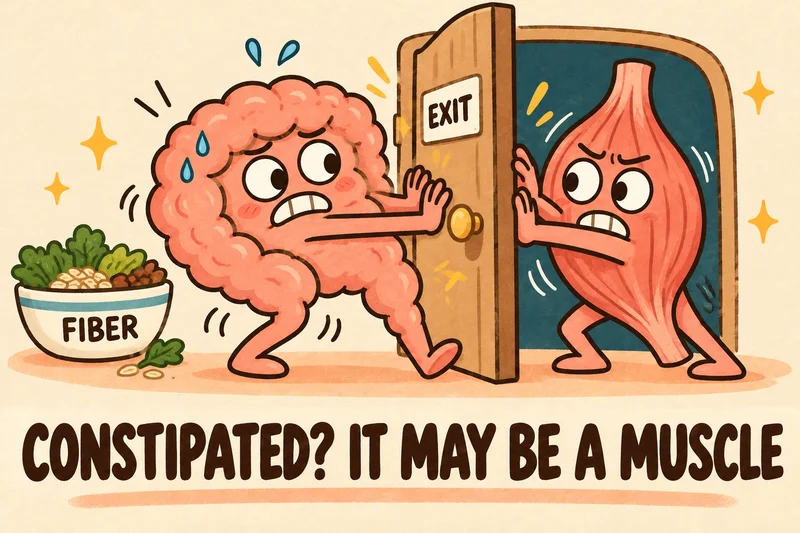


A digital rectal exam for constipation is one gloved, lubricated finger, and the American College of Gastroenterology (ACG) strongly recommends it when constipation gets checked out [1]. That finger can find a tear, hemorrhoids, a rectum packed with hard stool, or a lump. It can also feel whether your muscles let go when you push, or clamp down instead. That second problem is one no laxative fixes [1][2].
If you read nothing else
- America’s GI guideline strongly recommends a rectal exam as part of the constipation workup. It also admits many health care providers skip it [1].
- In a US study of 209 people with chronic constipation, a careful exam picked up 75% of the dyssynergia, a pelvic floor problem, that lab tests confirmed [3].
- It’s awkward, but it isn’t usually painful: expect some pressure, and maybe mild discomfort [5].
- Constipation that hasn’t budged on fiber and laxatives? The finger is step one, and anorectal testing comes next [1].
“If this has never happened for you, be warned”
Here’s what I sent my team one afternoon, word for word: “Everyone who complains of constipation REQUIRES a digital rectal exam by a trained GI, if this has never happened for you, be warned.”
Strong words, I know, so let me show you where they come from.
The ACG’s 2021 guideline on anorectal problems says it plainly: “We strongly recommend DRE as part of the assessment” [1]. (DRE is the digital rectal exam.) The same guideline also says something I find a lot sadder: “Regrettably, many health care providers do not perform a DRE in patients with constipation” [1].
Why would anyone skip it? The research points to comfort and practice. A survey of 652 US doctors and medical students found that patients turned the exam down less often when the doctor was comfortable doing it [4]. Confidence tracked with how many exams a doctor did each year. The authors’ blunt summary: training in the exam “has diminished and may be lost” [4].
Now, the guidelines don’t say it has to be a gastroenterologist. That part is my view. I say “trained” because a review from the American Gastroenterological Association (AGA) notes the exam is likely less useful in less skilled hands [2]. It’s a skill, the same as reading an X-ray. Does your doctor “touch” you anymore? I asked that once about the dying art of the physical exam, and this is the exam I had in mind.
Why do doctors do a rectal exam for constipation?
Because fiber and laxatives work on the stool, and sometimes the stool isn’t the problem at all. The exit is.
Constipation comes in more than one flavor. Some people have hard, slow stool, while others have a perfectly decent stool parked right at the exit, and the muscles down there won’t open the door. Your symptoms alone can’t tell these apart; the ACG says so outright [1]. Straining, feeling blocked and never quite finishing show up in all of them.
I tell patients it’s like a sink that won’t drain: you can pour in all the drain cleaner you want, but if the stopper’s down, nothing moves. The rectal exam is how I check the stopper.
It also catches the things nobody wants to miss, like blood, a lump, or stool packed so hard it won’t come out on its own [1][5]. Some of those need a scope or a procedure, not another bottle from the pharmacy.
What a rectal exam can find
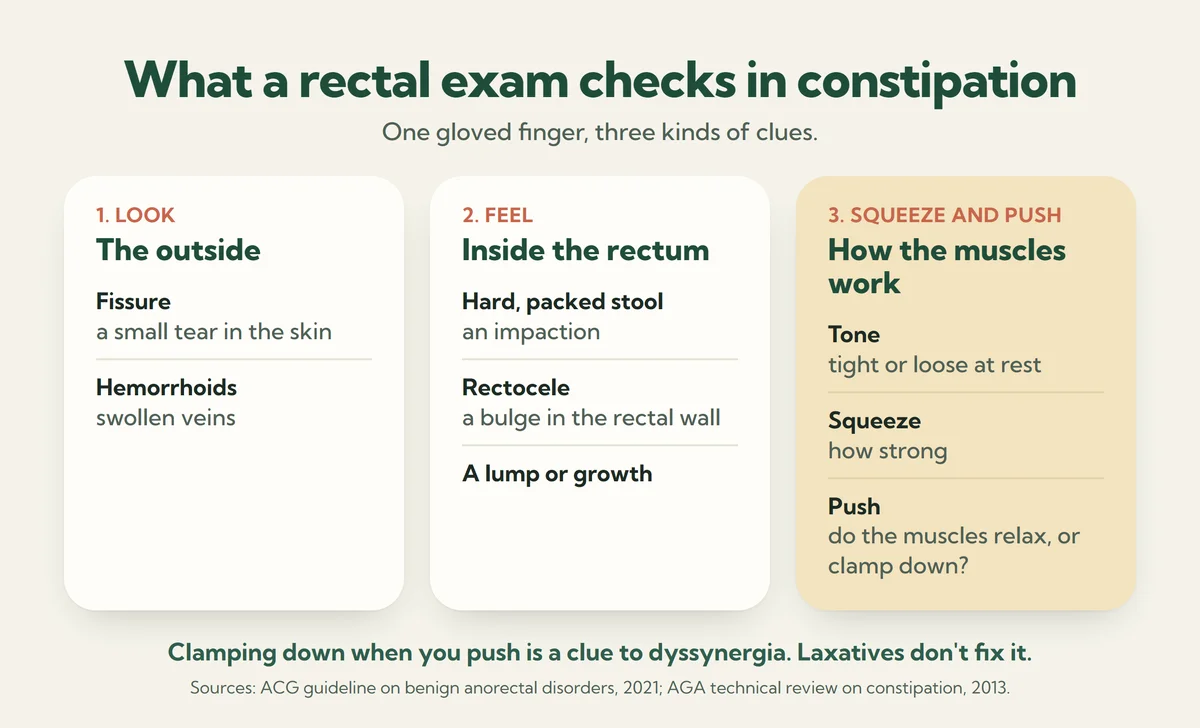
Here’s what a careful exam checks, per the ACG guideline and the AGA review [1][2]:
- A fissure. That’s a small tear in the skin of the anus, which the doctor may spot just by looking [1][5].
- Hemorrhoids, the swollen veins most people have heard plenty about [1].
- Hard stool jammed in the rectum. Doctors call that a fecal impaction [1].
- A rectocele. That’s a weak spot where the wall of the rectum bulges forward [2].
- A lump or growth, including a cancer low in the rectum or anus [1][5].
- How tight your muscles are at rest, and how hard you can squeeze [1][2].
- What happens when you push. This is the big one for pelvic floor dysfunction and constipation.
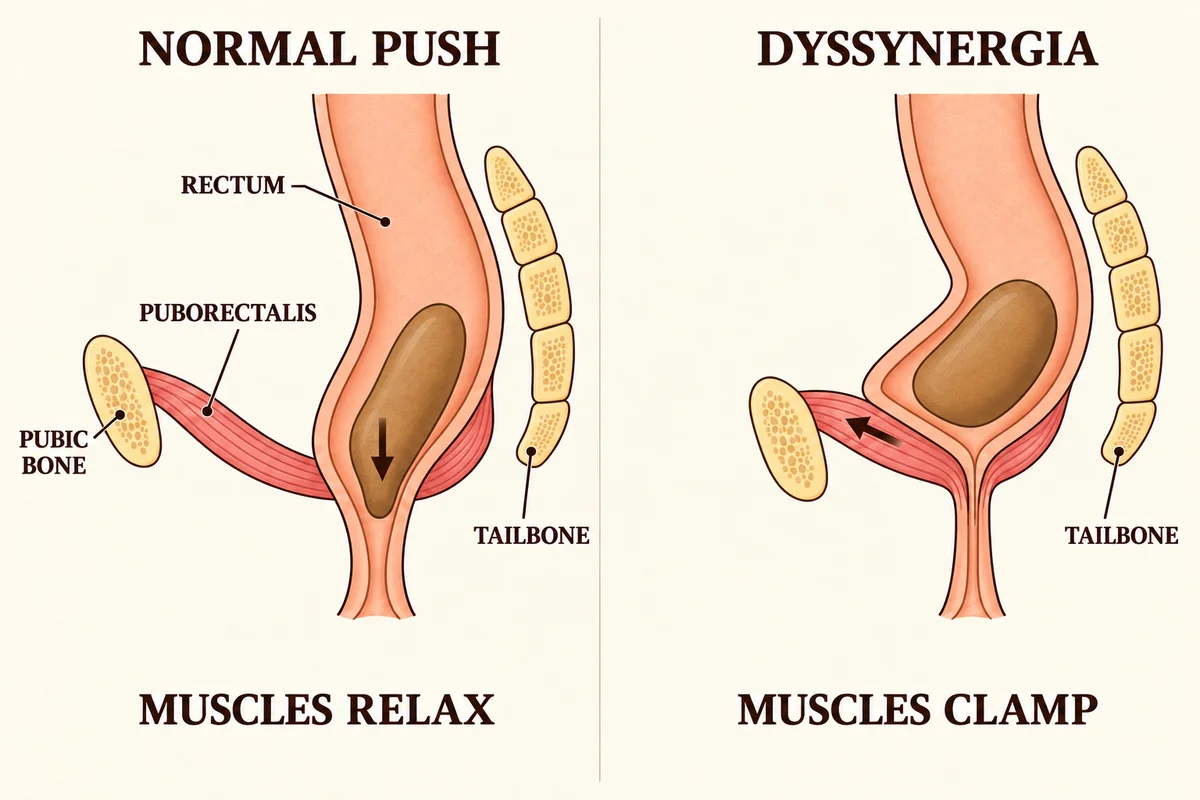
That last check works like this. When you bear down, the ring of muscle around the anus should relax, and so should the puborectalis [1][2]. That’s a sling of muscle that hooks around the rectum and keeps it kinked shut until you’re ready. If those muscles tighten instead, that’s called dyssynergia, or dyssynergic defecation [1]. It’s a coordination problem. Your body is pressing the gas and the brake at the same time.
What happens during a rectal exam
I know the idea alone makes some people want to cancel the appointment, so here’s the whole thing, start to finish, with no surprises.
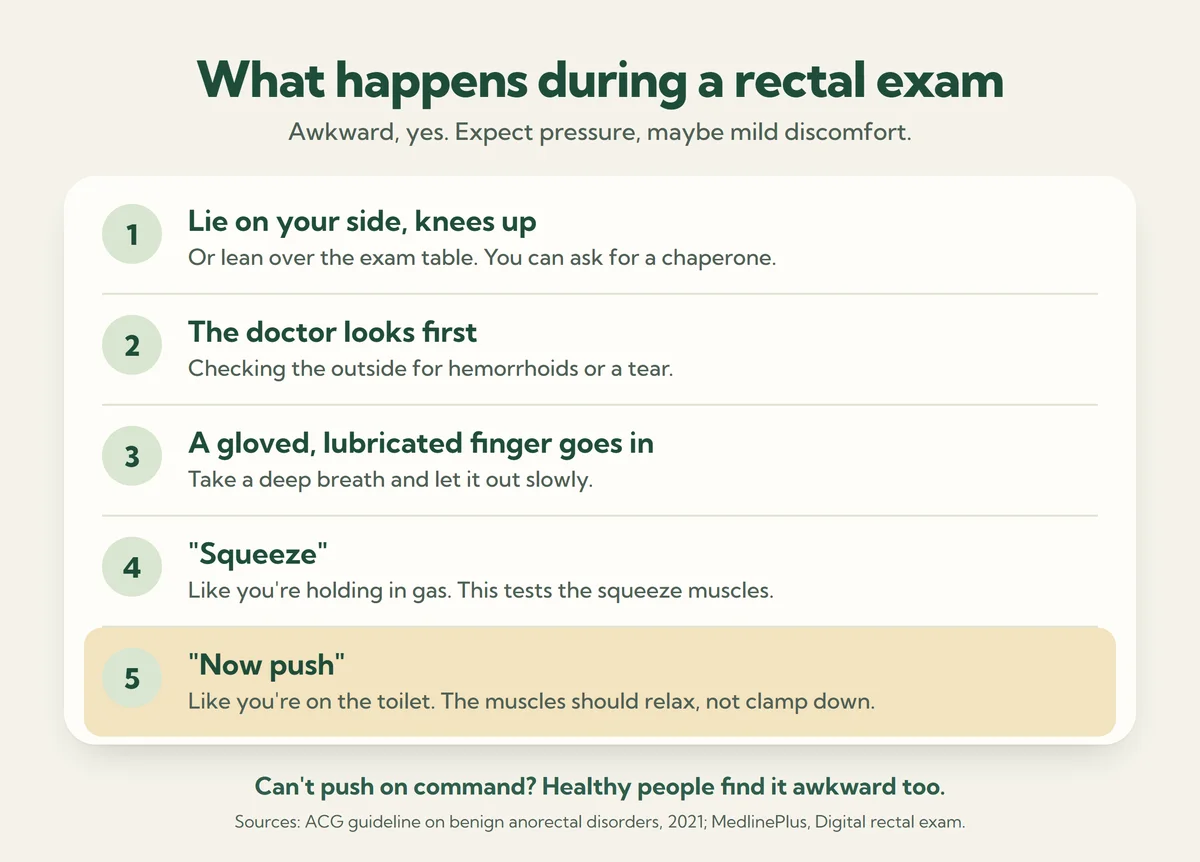
- You lie on your side with your knees pulled up, under a sheet. Some offices have you lean over the exam table instead [5]. Want a chaperone in the room? Ask. In my clinic, the answer is always yes.
- First, I just look. I check the outside for hemorrhoids or tears [1][5].
- A gloved, lubricated finger goes in slowly. I’ll ask you to take a deep breath and let it out [5]. Your job is to stay as loose as you can.
- “Squeeze, like you’re holding in gas.” That tells me how strong the squeeze muscles are [1].
- “Now push, like you’re on the toilet.” Here the muscles should relax around my finger. Then I feel a little higher, for the sling muscle, and ask you to push once more [1].
- Done. Glove off, tissues handed over, and we talk about what I felt.
How does it feel? Pressure, mostly. MedlinePlus, the National Library of Medicine’s patient site, calls it mild discomfort [5]. In my clinic, the whole thing is usually over in about a minute. Nobody has ever called it the highlight of their week, but nobody’s needed a day off for it either.
One more thing. Lots of people can’t “push” on command with a finger in there, and the guideline notes that even healthy people find it awkward [1]. If your muscles tense up, that’s a clue, not a verdict. That’s why the next tests exist.
A patient who’d been checked for everything but this
A guy in his fifties came to see me carrying a folder. Ten years of constipation. Fiber, stool softeners, three different laxatives. A colonoscopy two years earlier, totally clean. He’d heard “eat more fiber” so many times he could recite his daily grams like a ballgame score.
In ten years, nobody had done a rectal exam. Not once.
So I did one. At rest, everything felt normal. Then I asked him to push like he was on the toilet. Instead of letting go, the muscles clamped down on my finger like a fist.
His anorectal manometry and balloon test backed it up: dyssynergia. He couldn’t pass the balloon. His colonoscopy hadn’t been wrong, by the way. A scope looks at the lining of the colon. It never asks the muscles at the exit to do their job. I sent him for biofeedback. A few months later, he told me the laxatives in his cabinet were collecting dust.
How good is a finger, really?
Better than you’d guess, in the right hands. Researchers at the University of Iowa examined 209 people with chronic constipation, and each one also had the full set of lab tests [3]. Here’s how the finger did against those tests:
- It picked up 75% of the people whose tests showed dyssynergia [3].
- Of the people without it, the exam correctly called 87% of them clear [3].
- It was good at confirming normal muscle tone, but weaker at spotting tone that was off [3].
So it’s a strong first look, not the final word. The ACG calls the balloon test “arguably the most useful” test for this problem [1]. It also says that anyone whose constipation hasn’t responded to standard treatment should go on to anorectal testing [1]. That’s true even after a normal exam.
And remember who did the Iowa exams. The AGA review describes them as done “by a skilled clinician” and adds that the exam is likely less useful for less skilled examiners [2]. That’s the “trained” part of my message.
What comes after the exam: manometry, the balloon test and biofeedback
The ACG says you need two tests to diagnose a defecation disorder: anorectal manometry and a balloon expulsion test [1]. I do manometry myself. Here’s what each one is:
- Anorectal manometry uses a thin tube lined with pressure sensors [1]. It checks how sensitive your rectum is and how well the anal muscles work [6].
- The balloon test has you sit on a toilet, in private, and push out a small balloon filled with 50 mL of warm water. Getting it out within a minute counts as normal [1].
If they confirm dyssynergia, the fix isn’t a stronger pill. It’s biofeedback, which is coached muscle training. You watch your own muscles on a screen and learn to relax them while you push. The ACG gives it a strong recommendation, and it usually means 4 to 6 sessions spaced several weeks apart, plus practice at home [1]. It’s very safe, though it isn’t offered everywhere [1]. I refer my patients to therapists who do it.
Up to half of people with this problem also have a slow-moving colon [1]. That one may need its own treatment. I walk through the testing and biofeedback in detail in pelvic floor dyssynergia: when constipation is a muscle problem.
Never had one? Here’s what to ask
If you’ve had constipation for months and this has never happened, don’t just stew about it. Bring it up:
- “Has anyone checked my muscles, or only my stool?”
- Fiber and laxatives haven’t worked after a fair try? Ask about anorectal testing. The ACG and the AGA both back it [1][2].
- “Can you do a rectal exam, or send me to someone who does them often?”
- Nervous about it? Say so, and ask for a chaperone. A good doctor will slow down.
While you’re working on it, the basics still count. Food matters, and our guide to the best diet for constipation covers it. Short on ideas for fiber-friendly meals? Chef Savi can build a recipe from what’s in your pantry. Some people also ask me about acupressure for constipation; it’s not a substitute for a proper exam.
When to call your doctor
Constipation is common: about 16 in 100 adults have symptoms, and 33 in 100 adults age 60 and up [7]. These signs, though, call for a prompt visit [2]:
- blood in your stool
- Losing 10 pounds or more without trying? That needs a look.
- low blood counts (anemia) nobody can explain
- a lump you can feel in your belly or your bottom
- constipation that hasn’t responded to treatment
Seeing blood? Read do you need a colonoscopy for rectal bleeding. And if you’re due for colon cancer screening and haven’t had it, mention that too [2].
Frequently asked questions
Does a rectal exam hurt?
Will a gastroenterologist do a rectal exam?
Do doctors still do rectal exams?
I had a clean colonoscopy. Do I still need a rectal exam?
Yes, if constipation is the problem. A colonoscopy looks at the lining of your colon. It doesn’t test whether the exit muscles relax when you push. That takes a rectal exam, then manometry and a balloon test if needed [1].
Questions about your gut? I read every one
Join the Gutsavi newsletter for straight answers on gut health, sent to your inbox. More on stubborn constipation lives on our constipation hub. Got a question about your own workup? Send it through Ask Dr. Ted.
Sources
- Wald A, Bharucha AE, Limketkai B, et al. ACG clinical guidelines: management of benign anorectal disorders. Am J Gastroenterol. 2021;116(10):1987-2008. doi:10.14309/ajg.0000000000001507
- Bharucha AE, Pemberton JH, Locke GR 3rd. American Gastroenterological Association technical review on constipation. Gastroenterology. 2013;144(1):218-38. doi:10.1053/j.gastro.2012.10.028
- Tantiphlachiva K, Rao P, Attaluri A, Rao SS. Digital rectal examination is a useful tool for identifying patients with dyssynergia. Clin Gastroenterol Hepatol. 2010;8(11):955-60. doi:10.1016/j.cgh.2010.06.031
- Wong RK, Drossman DA, Bharucha AE, et al. The digital rectal examination: a multicenter survey of physicians’ and students’ perceptions and practice patterns. Am J Gastroenterol. 2012;107(8):1157-63. doi:10.1038/ajg.2012.23
- MedlinePlus, US National Library of Medicine. Digital rectal exam. Reviewed October 19, 2025. medlineplus.gov
- National Institute of Diabetes and Digestive and Kidney Diseases (NIDDK). Diagnosis of constipation. Reviewed May 2018. niddk.nih.gov
- NIDDK. Definition & facts for constipation. Reviewed May 2018. niddk.nih.gov
This article is for education only and isn’t medical advice. Talk with your own doctor about your care.
This article is for education only and isn't a substitute for advice from your own doctor. If something feels off, talk to your care team.