
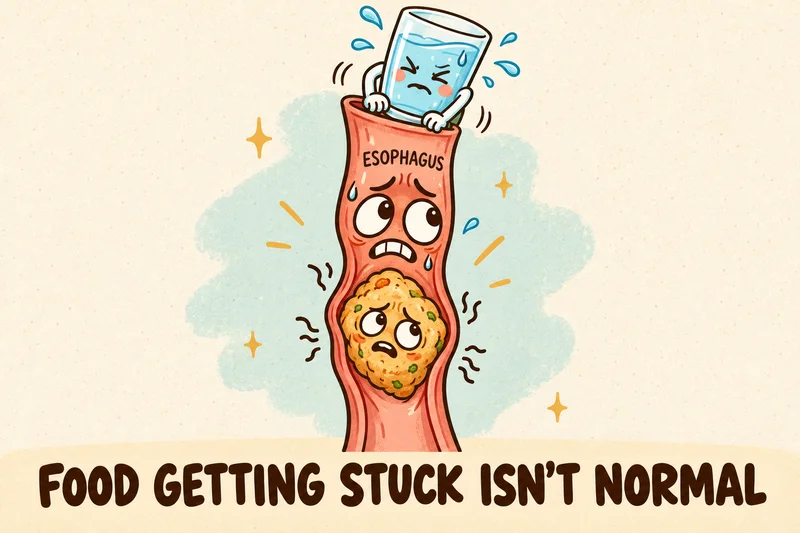
Food getting stuck in throat or chest, even once in a while, means your esophagus needs a look. Yep, the food pipe, the one running from the back of your throat down to your stomach. Do you need a sip of water to get every bite down? That’s not normal either. The usual reason is a pipe that’s inflamed or has gotten narrow. If you’re on the younger side, one of the most common reasons has a long name: eosinophilic esophagitis, or EoE, an allergy-type inflammation of the esophagus [1][2]. And the first test we reach for is an upper endoscopy, a camera look down the tube [1][2].
If you read nothing else
- Stuck right now and you can’t swallow your own spit? That’s a full blockage, so go to the ER now [3].
- Can’t breathe or talk? Call 911 [4].
- If food sticks and then passes, book a visit and ask about a scope with biopsies, tiny tissue samples [1][2].
Is it normal for food to get stuck in your throat?
No. Not even the small stuff. A bite that crawls down slowly counts, and so does one that needs a water chaser. You think that’s normal? It isn’t.
The sneaky part is how quietly people work around it. Of course there’s an acronym for the workarounds. Medicine has never met a problem it couldn’t abbreviate. EoE doctors call these habits IMPACT, and you may recognize a few [2]:
- There’s a glass next to your plate, and you sip after nearly every bite.
- You cut everything into tiny pieces, and some foods get mashed into a puree before you’ll even try them.
- Everyone else is clearing plates while you’re still halfway through yours.
- Steak, crusty bread and sticky foods have quietly dropped off your menu.
- You chew and chew, until it’s mush.
- Pills get stuck, and for some people that’s the only symptom [2].
These tricks work, and that’s exactly the trouble. They can hide the problem for years, and the 2025 guideline from the American College of Gastroenterology (ACG) names them as one reason the diagnosis comes so late [2].
The kid whose esophagus was as wide as my pinky finger
I took care of a kid whose esophagus was as wide as my pinky finger, and food had been getting stuck.
Go ahead, hold up your pinky and look at it. That’s the picture I want in your head the next time a bite won’t go down. You better get checked out before you become this kid.
Waiting it out makes it harder to fix
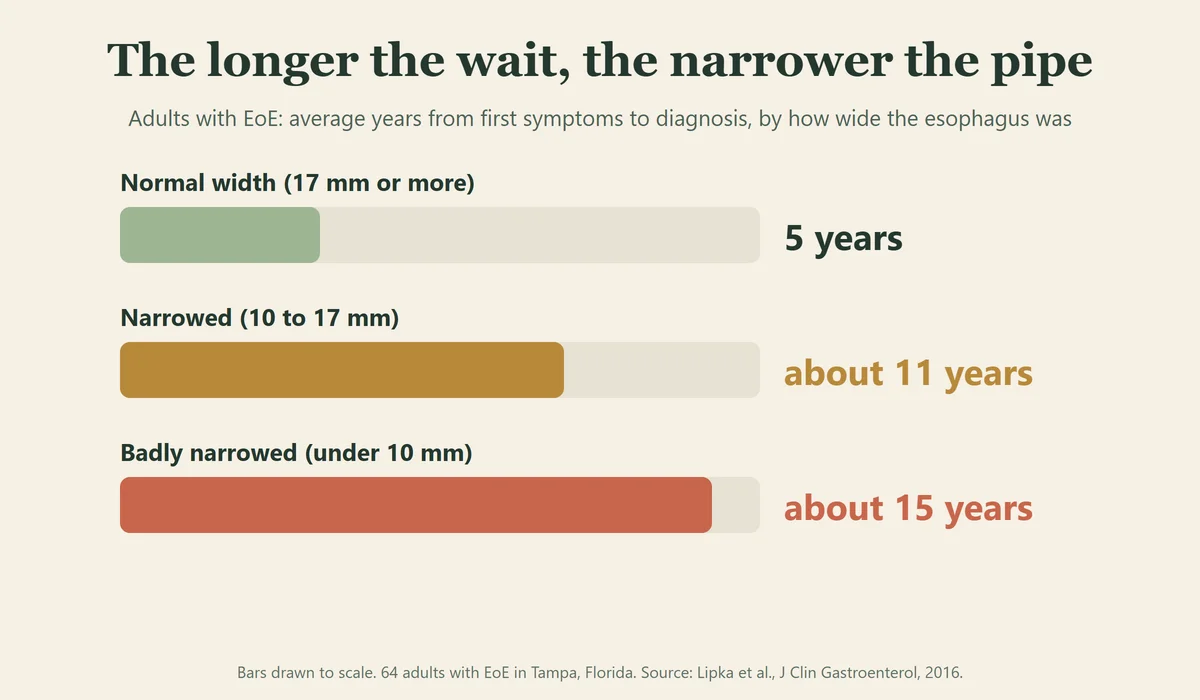
A narrowing like that doesn’t happen overnight. It builds slowly, the way scale builds up inside an old water pipe. When researchers in Tampa, Florida, looked back at 64 adults with EoE, the wait for a diagnosis lined up with how narrow the esophagus had become [5].
People whose esophagus was still a normal width had waited about 5 years on average. Those with a badly narrowed one, under 10 millimeters across? Almost 15 years [5]. A narrowed segment like that is called a stricture. Left untreated, EoE drifts from inflammation toward scarring in most people, though not in everyone [2].
Once the opening gets narrow enough, solid food starts sticking while drinks still go down [6]. By that point, you may need the esophagus stretched as well as medication.
Why does food keep getting stuck in my throat?
Honestly, your own description does half the work here. Where does it stick, and what does it stick on? Tell a doctor those two things, and you’ve done the first step of the workup: sorting a throat problem from an esophagus problem [6].
| What you notice | What it can point to |
|---|---|
| Solid food sticks some days and not others. Maybe you have allergies or asthma too | EoE [2][6] |
| Bread or meat sticks, but drinks always go down | A narrowing, such as a ring (a thin band of tissue inside the tube), a stricture, or EoE [6] |
| You’ve had heartburn for years, and now food sticks too | A reflux stricture: acid has scarred the tube. GERD (gastroesophageal reflux disease, ongoing acid reflux) is the most common cause of trouble swallowing [6] |
| Even drinks stick, not just food. Maybe chest pain, or food coming back up | A muscle problem, such as achalasia, where the tube stops squeezing and its bottom valve won’t relax [6][12] |
| Worse week by week, the scale keeps dropping, especially if you’re older | We have to rule out cancer [6] |
| You can’t get the swallow started, you cough, or a drink comes out your nose | The trouble’s in the throat (oropharyngeal), often from a nerve condition like a stroke or Parkinson’s [6] |
Ever had a kitchen drain that takes water just fine, then clogs the second something chunky goes down? That’s the narrowing pattern. When even the water backs up, we start thinking about the pump instead of the pipe.
Do you feel a lump in your throat even when you’re not eating? That’s a different thing called globus, and doctors keep it separate from food actually sticking [6].
What is eosinophilic esophagitis?
The name’s a mouthful, which is why everybody just says EoE. In EoE, eosinophils, a kind of white blood cell, pile up in the lining of the esophagus. Over time, the wall can stiffen and narrow, and that’s when food starts catching [2]. It’s confirmed on biopsy, when a pathologist, the doctor who reads tissue under a microscope, counts at least 15 of these cells in one microscope field [2].
EoE isn’t a rare disease anymore. In 2022, about 1 in 617 Americans under 65 had the diagnosis, five times the 2009 rate, and it’s more common in males [7]. Most people with EoE, 60-80% of them, also have food allergies, asthma, eczema or hay fever [2]. So if that’s you, tell your doctor.
Teenagers and adults mostly notice food sticking, or a bite that gets stuck outright. Younger children rarely tell you food is stuck. Instead, a toddler may grow poorly, refuse food or never move on to solids, while school-age kids tend to get belly pain, vomiting, food coming back up, or heartburn [2].
Parents, watch for the kid who takes forever to finish a meal. According to the guideline, slow eating and refusing food can be swallowing trouble in disguise [2].
EoE also explains a lot of food impactions, the bites that get stuck and have to be removed. When researchers pooled 14 studies, EoE turned out to be the cause in 54% of the cases that got biopsied [8]. The catch? Only about half of the people in those studies had biopsies at all [8].
How we figure out what’s going on
First comes an upper endoscopy. That’s a thin camera passed through your mouth while you’re sedated. The GERD guideline makes it the first test for trouble swallowing [1].
- Biopsies. Your doctor should take at least six, from two levels of the esophagus, even if it looks normal [2].
- Timing. If EoE is suspected, the ACG advises scoping before you start a PPI (an acid-lowering pill like omeprazole) or cut foods, since either one can hide it [2]. So before starting anything, ask your doctor about timing.
- If you’ve had food removed in the ER, ask whether biopsies were taken. In a survey of 428 GI doctors (gut specialists), only 34% took them during a food impaction scope [9]. Many people never come back for a second look, so the chance gets missed [2].
- A barium swallow X-ray, sometimes. You drink a chalky liquid that shows up on the X-ray. Why bother, if you’ve had a scope? A scope can miss a narrowing, and in one study it caught only about 15% of them [2]. For kids with EoE and swallowing trouble, the ACG suggests one [2].
- Manometry checks the pressure of your esophagus muscles. It’s the next step if solids and liquids both stick [12].
Is EoE treatable?
Yes. The ACG’s 2025 guideline backs five kinds of treatment [2].
Acid pills (PPIs). No heartburn, and you walked out with a reflux pill? Nobody mixed up your chart. PPIs calm EoE too, and they can work whether or not you have reflux [2].
Swallowed steroids. These are steroids, the strong anti-inflammatory kind. Budesonide or fluticasone is swallowed so it coats the esophagus, instead of being inhaled into your lungs [2]. It was the one strong recommendation in the 2020 guideline from the American Gastroenterological Association (AGA) [10].
Cutting trigger foods. Doctors usually suspect milk first, so that’s often where you start. In a trial of 129 adults, 34% went into remission (their inflammation settled) after cutting only milk. After cutting six food groups, it was 40%, a gap too small to call a real difference [11]. And skip the allergy tests for picking foods; the ACG doesn’t recommend them for this [2].
A biologic shot. Dupilumab, an antibody that blocks allergy-type signals, for people 12 and older, and kids ages 1 to 11, when PPIs haven’t worked [2].
Stretching (dilation) opens a narrowed esophagus. About 95% of people feel better, and a tear happens in fewer than 1 in 200 dilations [2]. Widening the pipe doesn’t touch the inflammation that narrowed it, though, so it’s paired with medicine or diet [2].
With new EoE, I usually start with a PPI. Then we repeat the scope with biopsies to check that it worked.
Now the part nobody loves hearing. EoE is chronic, meaning it sticks around. Stop treatment, and the guideline says the inflammation comes back “nearly universally,” whichever treatment you used [2]. That’s why we plan for the long haul: check-ups, and every so often another scope.
Food stuck right now? What to do
- Can’t breathe, can’t talk, weak cough? That’s choking. Call 911, and start back blows and abdominal thrusts (the Heimlich maneuver) [4].
- Breathing okay, but even your own saliva won’t go down, and you’re drooling or spitting up? That means your esophagus is fully blocked, so go to the ER now. GI doctors treat that as an emergency scope [3].
- Saliva still going down? It’s less urgent, but plan on being seen the same day. The American Society for Gastrointestinal Endoscopy (ASGE) wants a stuck bite out within 24 hours [3].
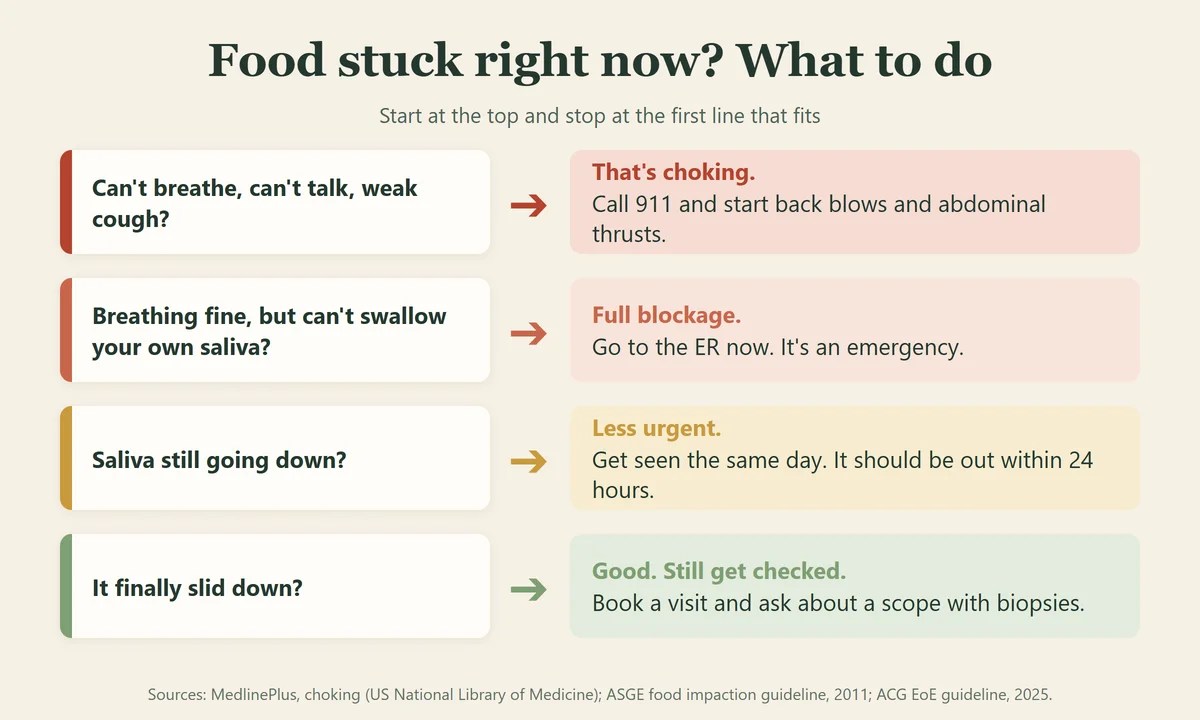
Don’t let home tricks delay care. Medicines to loosen a stuck bite are hit or miss, and the ASGE says they shouldn’t hold up the scope [3].
And if it finally slid down? Good, but book the appointment anyway. After a food impaction, the ACG wants biopsies taken to look for EoE [2].
When to call your doctor
Book a visit when food sticks more than once, even if it always passes. What else should send you in?
- You’ve started cutting food small, eating slowly, or skipping meat and bread to get by [2].
- Swallowing is getting harder week by week. That can mean a growth, so don’t sit on it [6].
- Losing weight without trying? Call sooner [1][6].
- Black stools, or vomiting blood [1].
- Your child eats very slowly, refuses textures, vomits often, or isn’t growing well [2].
New chest pain gets your heart checked first, before anyone blames the esophagus [1].
Frequently asked questions
What are three warning signs of dysphagia?
First, food that sticks, in your throat or your chest. Coughing or choking when you swallow is another. The sneaky one is when you change how you eat to cope, like water with every bite [2][6]. Unexplained weight loss? That counts too. You don’t need all three; any one of them is worth a visit, and the first test is usually a scope [1].
Will food stuck in the throat eventually go down?
Can dysphagia go away on its own?
It can seem to, because it comes and goes. The usual causes in younger people don’t just vanish, though. Untreated EoE tends to move from inflammation toward scarring in most people [2], and rings and strictures are treated by stretching [6]. Had a quiet week? Nice, but that’s not a cure. Only a scope shows what’s actually going on in there.
Why does it feel like food is stuck in my chest?
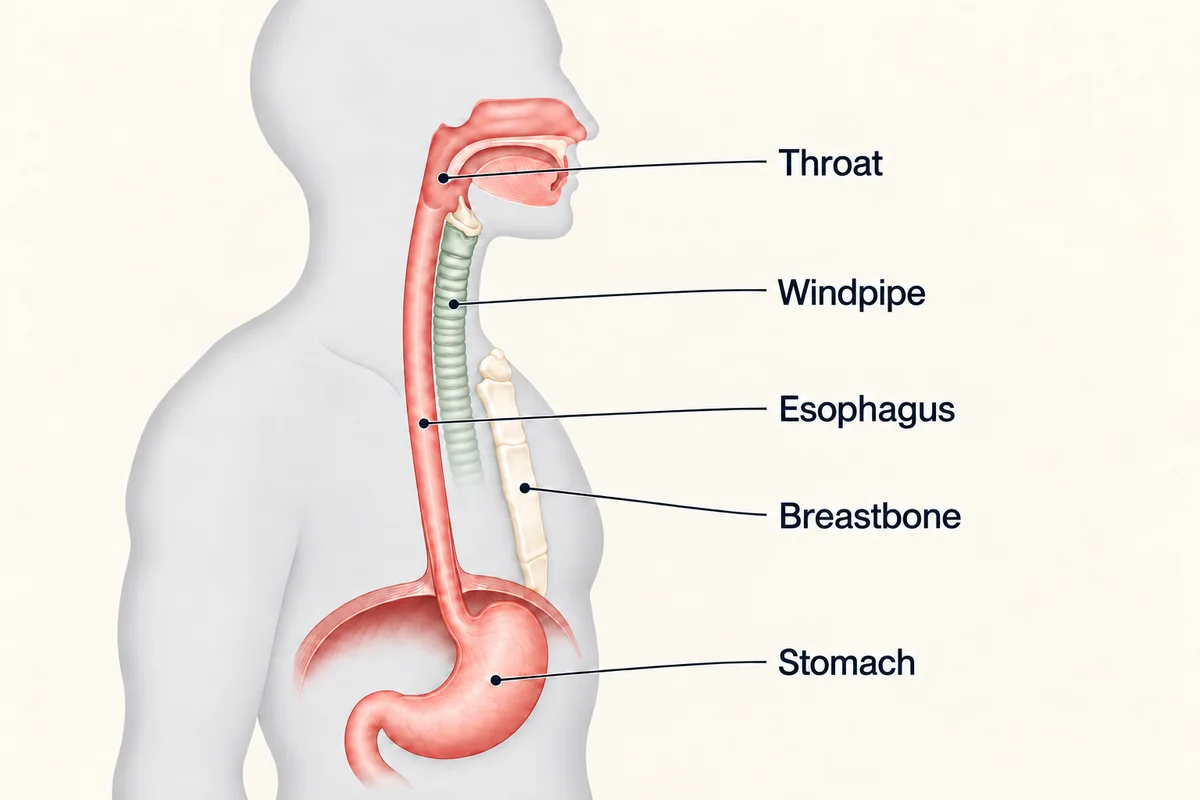
Put your hand flat on your breastbone. Your esophagus runs right behind it, so when a bite hangs up low in the tube, that’s where you feel it. The spot you feel doesn’t always match the problem, though, and some esophagus problems are felt up in the neck [6]. New chest pain needs a heart check before anyone blames your esophagus [1].
Swallowing trouble? Start here
If you have a question about your own swallowing, send it through Ask Dr. Ted. For more on the esophagus, read our Acid Reflux/GERD guide, Understanding Acid Reflux/GERD, or Reflux in the Throat, Polyps in the Colon? Let’s Talk About That. If you’re cooking around a sensitive gut, try Chef Savi, our low FODMAP recipe tool (FODMAPs are carbs that ferment in the gut). And join the Gutsavi newsletter to get the next article in your inbox.
Sources
- Katz PO, Dunbar KB, Schnoll-Sussman FH, et al. ACG clinical guideline for the diagnosis and management of gastroesophageal reflux disease. Am J Gastroenterol. 2022;117(1):27-56. doi:10.14309/ajg.0000000000001538
- Dellon ES, Muir AB, Katzka DA, et al. ACG clinical guideline: diagnosis and management of eosinophilic esophagitis. Am J Gastroenterol. 2025;120(1):31-59. doi:10.14309/ajg.0000000000003194
- Ikenberry SO, Jue TL, Anderson MA, et al; ASGE Standards of Practice Committee. Management of ingested foreign bodies and food impactions. Gastrointest Endosc. 2011;73(6):1085-91. doi:10.1016/j.gie.2010.11.010
- MedlinePlus Medical Encyclopedia. Choking: adult or child over 1 year. US National Library of Medicine. medlineplus.gov/ency/article/000049.htm
- Lipka S, Kumar A, Richter JE. Impact of diagnostic delay and other risk factors on eosinophilic esophagitis phenotype and esophageal diameter. J Clin Gastroenterol. 2016;50(2):134-40. doi:10.1097/MCG.0000000000000297
- Wilkinson JM, Codipilly DC, Wilfahrt RP. Dysphagia: evaluation and collaborative management. Am Fam Physician. 2021;103(2):97-106. aafp.org
- Thel HL, Anderson C, Xue AZ, Jensen ET, Dellon ES. Prevalence and costs of eosinophilic esophagitis in the United States. Clin Gastroenterol Hepatol. 2025;23(2):272-80. doi:10.1016/j.cgh.2024.09.031
- Hiremath GS, Hameed F, Pacheco A, et al. Esophageal food impaction and eosinophilic esophagitis: a retrospective study, systematic review, and meta-analysis. Dig Dis Sci. 2015;60(11):3181-93. doi:10.1007/s10620-015-3723-8
- Hiremath G, Vaezi MF, Gupta SK, Acra S, Dellon ES. Management of esophageal food impaction varies among gastroenterologists and affects identification of eosinophilic esophagitis. Dig Dis Sci. 2018;63(6):1428-37. doi:10.1007/s10620-018-4972-0
- Hirano I, Chan ES, Rank MA, et al. AGA Institute and the Joint Task Force on Allergy-Immunology Practice Parameters clinical guidelines for the management of eosinophilic esophagitis. Gastroenterology. 2020;158(6):1776-86. doi:10.1053/j.gastro.2020.02.038
- Kliewer KL, Gonsalves N, Dellon ES, et al. One-food versus six-food elimination diet therapy for the treatment of eosinophilic oesophagitis: a multicentre, randomised, open-label trial. Lancet Gastroenterol Hepatol. 2023;8(5):408-21. doi:10.1016/S2468-1253(23)00012-2
- Vaezi MF, Pandolfino JE, Yadlapati RH, Greer KB, Kavitt RT. ACG clinical guidelines: diagnosis and management of achalasia. Am J Gastroenterol. 2020;115(9):1393-411. doi:10.14309/ajg.0000000000000731
This article is for education only and isn’t medical advice. Talk with your own doctor about your care.
This article is for education only and isn't a substitute for advice from your own doctor. If something feels off, talk to your care team.