


If you’ve got an object stuck in rectum and it won’t come out, stop trying and get yourself to an emergency room today, even if you feel fine. Doctors call it a rectal foreign body, which just means something is lodged in your rectum. Your rectum is the last few inches of bowel before the anus, and the longer anything stays parked there, the higher your chance of a tear, bleeding or infection [1]. Most people are treated and go home the same day [5].
The short version
- Don’t pull, dig, or use an enema (liquid squirted into your bottom to flush it out). Every extra try can push it deeper and make it harder for your doctor to remove [1].
- Bad belly pain, a fever, or feeling faint? Call 911.
- Often, the ER team can take it out right at your bedside with numbing medicine or sedation, a drug that makes you relaxed and drowsy (74% in one large series) [3].
- ER staff see this regularly. They’re there to get it out, not to judge you.
Embarrassed? I get it, but don’t be. You’re far from the first person I’ve seen with this, and you won’t be the last.
Can you get it out at home?
Please don’t try. I understand why people do. It’s embarrassing, and one more go at it feels a lot easier than walking into a hospital. Already tried a few times? You’re not unusual. Most people try to get it out themselves first, and many wait days or weeks before coming in [1][2].
Here’s the trouble with one more try. Every attempt risks hurting the lining of your rectum [1]. The lining around the object can swell, and swelling at the opening makes it harder to pull out [2]. Then the ring of muscle at the opening (the anal sphincter) clamps down in spasm, which is why doctors often relax it with anesthesia [2].
Each push can also move the object higher, out of your reach [1]. It’s the cork-in-the-wine-bottle problem: you went to grab it, and now it’s further in.
Glass is worse still. A bottle or cup can stick to the bowel wall by suction, the way a wet glass grabs a countertop, and it can break [2][4].
Skip enemas and laxatives, too. Colorectal surgeons advise against using them to push an object along [4].
Not sure it’s an object at all? If it might be hard stool, that’s a different problem, and our constipation guide covers it.
When to go to the ER right now
Any object you can’t remove easily is worth a same-day ER visit. Some signs can’t wait at all. Go right now if:
- pain in your belly or rectum is getting worse
- you’re bleeding from your bottom, more than a streak on the paper
- You have a fever, feel faint or dizzy, or your heart is racing. Your doctors will watch closely for these, because they can signal a tear [4].
- you can’t pass stool or gas
- The object is lost, and you can no longer see or feel the end of it.
- Is it glass or sharp, or has it broken? Leave it alone and go.
- It’s been in for more than a day or two. After 2 days, your odds of needing surgery go up [2].
Call 911 if the belly pain is severe, your belly feels hard, or you feel faint.
What happens at the hospital
Knowing what’s coming takes some of the dread out of the drive over. Here’s how it usually goes.
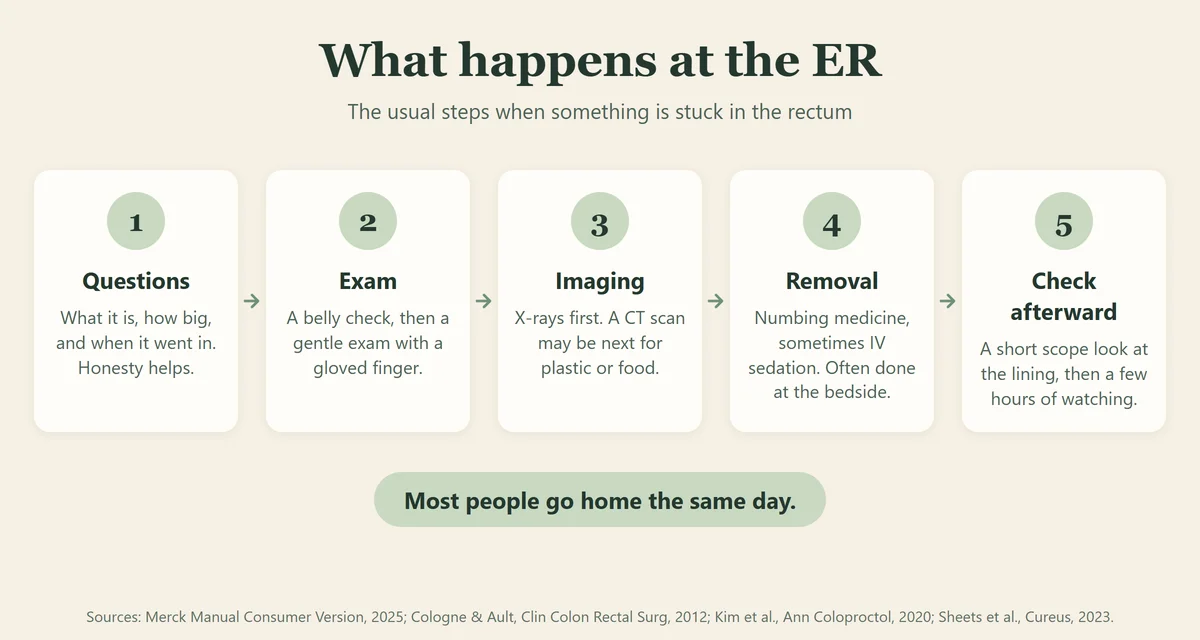
- Questions. This is the awkward part, and it’s also the part that matters most. Tell the team what the object is, how big it is, and when it went in, because that changes how they remove it. Only 10% to 30% of people give an accurate story at first, mostly out of embarrassment [2]. Be as honest as you can. The team can’t plan around a guess.
- An exam. The doctor checks your belly, then does a gentle exam with a gloved finger to feel how low the object sits [4][7].
- Imaging. X-rays show where it is and whether air has leaked from a tear. Plastic and food often don’t show up on X-rays, so for a vegetable, say, you may get a CT scan, a more detailed 3D X-ray [2][7].
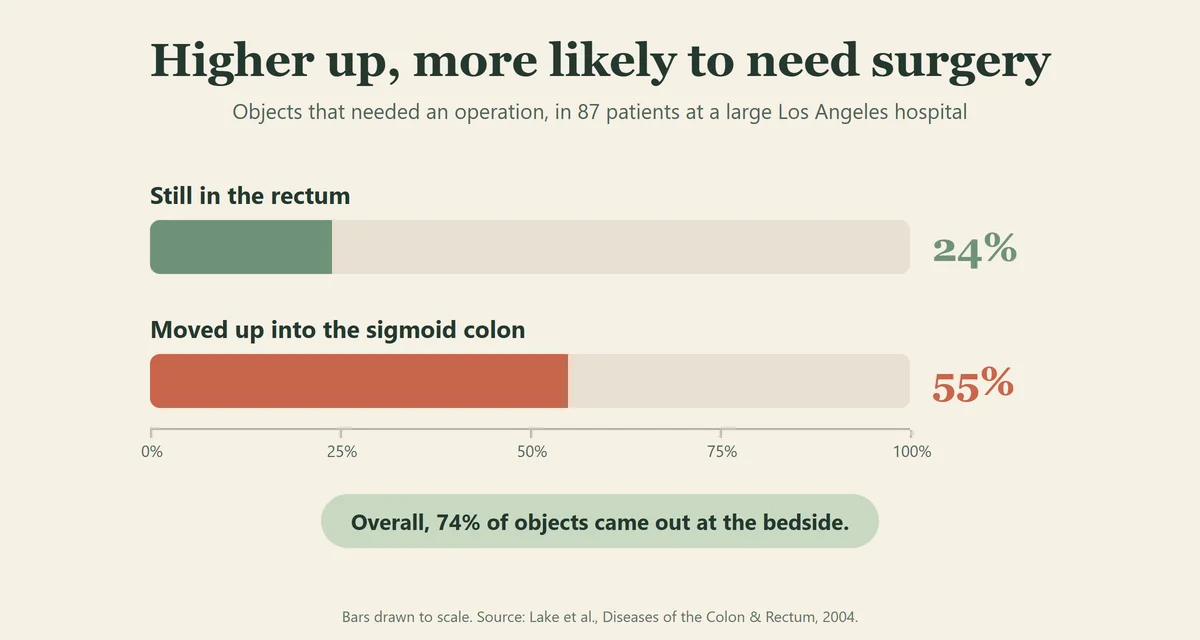
- Removal. If the doctor can reach it, you’ll get a local anesthetic to numb the area first. Then they gently hold the anus open with a small instrument and grasp the object [7]. You may also get sedation through an IV (a thin tube in a vein), which relaxes those clamped-down muscles [2][4]. In a series of 87 patients at a large Los Angeles hospital, 74% of objects came out right there at the bedside [3].
- A check afterward. Next comes a sigmoidoscopy, a short scope exam with a thin camera on a flexible tube, to look at the lining for injury [7]. You’re usually watched for a few hours before going home [4].
So when does it take an operation? Where the object sits matters most. In that same series, objects that had moved up into the sigmoid colon (the lowest part of the colon) needed surgery 55% of the time. For objects still in the rectum, it was 24% [3].
Even then, surgery often just means removing it from below while you’re fully asleep under general anesthesia [2]. Opening the belly is the last resort, kept for a tear with infection or an object that won’t budge [2][4].
Can it cause lasting damage?
It can, and that’s the whole reason I keep saying don’t wait. If the bowel wall tears (a perforation), stool can leak into your belly and cause a serious infection, which happens in about 1 in 10 cases [1][2][4].
Worried about the muscles that control your bowels? Lasting damage to them, the kind that causes leakage afterward, is uncommon, according to a review in a colorectal surgery journal [4].
Will the ER staff judge me?
They shouldn’t, and the medical literature tells them so in plain words. A surgical review tells doctors to be “nonthreatening and nonjudgmental” [4], and a colorectal surgery team calls a nonjudgmental attitude and respect for privacy “imperative” [2].
Explaining this at the front desk is nobody’s idea of a great night out. It’s also more common than most people guess. About 100 US emergency departments recorded 1,806 visits for it over 10 years, rising from 144 in 2012 to 236 in 2021 [5]. The average patient was 30 years old, and about 2 in 3 were men. Vibrators and massagers were the most common object recorded, at 23%, and jewelry, pens and food items show up in reports too [2][5].
If you’re sitting in the waiting room wishing the floor would swallow you, here’s what I’d tell you. The team has one question, and it’s how to get the object out safely.
And not every case is something a person did to themselves. Some objects are put there by force, as an assault [4]. If someone did this to you, tell the nurse or doctor; they can treat you and help you find support.
Is New Year’s Day really busier?
When I sent this topic to my team, my note ended with “look out for New Year’s Day…”.
We checked the numbers. They back it up less than you’d think. A 10-year look at US ER visits found no clear seasonal pattern; July through October had the most cases [5]. A study of US hospital admissions found the peak month was October, not December or January [6]. Neither study looked at holidays, and we couldn’t find one that did. So until someone counts it, the New Year’s rush stays a story doctors tell. A good one, I’ll admit.
Safer habits if you use toys
No lecture from me, just a few habits that make an ER trip less likely:
- Choose toys made for anal use, with a flared base (wider at the bottom) so they can’t slip all the way in [8].
- Never use anything that can break, like a drinking glass or bottle. Glass can break inside you, and it sometimes takes an operation to get out [2].
- If it’s going inside your body, Planned Parenthood recommends body-safe materials such as 100% silicone, hard plastic, stainless steel or break-resistant glass [8].
- Use plenty of lube, since the anus doesn’t make its own [8].
- Sharp, intense pain means you stop. If it hasn’t eased within 30 minutes, Cleveland Clinic advises going to the ER [9].
When to call your doctor after it’s out
Once it’s out, most people go home that day [5]. A small tear can show up later, though, so your doctor may plan a follow-up check [4]. Call your doctor, or go back to the ER, if over the next few days you notice:
- fever or chills, even mild ones
- Your belly pain is getting worse instead of better.
- Is there bleeding beyond light spotting? Call.
- trouble passing stool or gas
- any new leakage of stool, especially if you can’t hold it
Frequently asked questions
Will a foreign object work its way out on its own?
How is a rectal foreign body removed?
Usually from below, often right at your bedside. You get numbing medicine, often IV sedation too, and the doctor grasps the object with instruments. In one large series, about 3 in 4 came out this way [3][7]. If that fails, it’s removed in the operating room under anesthesia. Surgery through the belly is kept for tears, or objects that can’t be moved any other way [2][4].
How long can a foreign object stay in your rectum?
There’s no safe length of time. Some people wait days or weeks before coming in [1], but the risk climbs the longer it stays. Objects left more than 2 days are more likely to need surgery [2]. Steady pressure on the bowel wall can also wear a hole through it, the way a rope slowly rubs through a dock post [2].
Questions about your gut? Ask Dr. Ted
Got a question you’d rather not ask out loud? Send it to Ask Dr. Ted. Want more plain-language guides? Browse Learn, or join the Gutsavi newsletter.
Sources
- Easton-Carr R, Paish LM. Rectum foreign body removal. In: StatPearls. StatPearls Publishing; updated 2025. NBK557557
- Kim JH, Um E, Jung SM, et al. The management of retained rectal foreign body. Ann Coloproctol. 2020;36(5):335-343. doi:10.3393/ac.2019.10.03.1
- Lake JP, Essani R, Petrone P, et al. Management of retained colorectal foreign bodies: predictors of operative intervention. Dis Colon Rectum. 2004;47(10):1694-8. doi:10.1007/s10350-004-0676-4
- Cologne KG, Ault GT. Rectal foreign bodies: what is the current standard? Clin Colon Rectal Surg. 2012;25(4):214-218. doi:10.1055/s-0032-1329392
- Sheets NW, Waldrop I, Carpenter WC, et al. Rectal foreign bodies: a 10-year review of the National Electronic Injury Surveillance System. Cureus. 2023;15(7):e41471. doi:10.7759/cureus.41471
- Pathak R, Karmacharya P, Alweis RL. Seasonal variation of rectal foreign bodies: data from Nationwide Inpatient Sample. N Am J Med Sci. 2016;8(4):191-193. PMC4866476
- Ansari P. Foreign objects in the rectum. Merck Manual Consumer Version. Reviewed January 2025. merckmanuals.com
- Planned Parenthood. Sex toys. plannedparenthood.org
- Cleveland Clinic. Is anal sex safe? Health Essentials. 2022. health.clevelandclinic.org
This article is for education only and isn’t medical advice. Talk with your own doctor about your care.
This article is for education only and isn't a substitute for advice from your own doctor. If something feels off, talk to your care team.