
Med Opinion: Dr. Ted’s personal view on a healthcare issue, with the evidence linked below. Agree or disagree? Tell us in the comments.
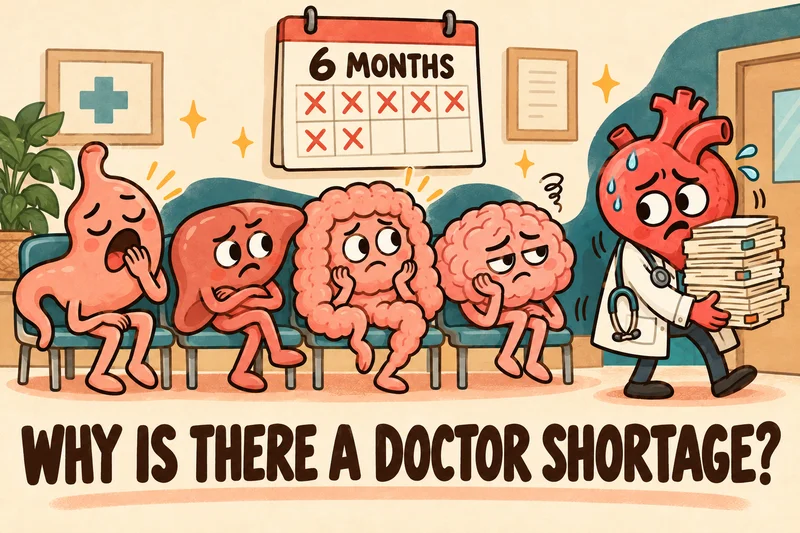
Why is there a doctor shortage? Mostly because America isn’t training new doctors as fast as its population is aging. Before any doctor can see you on their own, they have to finish a residency, which means years of supervised training in a hospital. And Medicare, the federal health plan mainly for people 65 and older, still caps the residency jobs it pays for at most hospitals at 1996 levels [6][7]. Where does that lead? Up to 86,000 too few physicians by 2036, says the Association of American Medical Colleges (AAMC) [4].
I’m a gastroenterologist, a doctor for the digestive system, and here’s my take. The American healthcare system is failing us all, because there aren’t enough doctors to see people.
The short version, for the waiting room
- Waiting a month for a new-patient visit? That’s the average now in 15 big US cities, and 40 days for a gastroenterologist [1][2].
- The bottleneck? Residency, the hospital training every new doctor has to get through.
- Long waits can matter. In one large study, waiting 10 months or more for a colonoscopy (a camera exam of the colon) after a positive stool test was linked to more cancers [9].
- I’ve laid out five possible fixes below, and I’d like to hear yours.
What patients tell me every day
It’s a huge hot topic for patients. The lack of doctors comes up with me daily, and you can hear the frustration.
You’ve probably lived some version of it. Sometimes you wait months for an appointment and it gets canceled. Or, after all that waiting, you find out they don’t accept your insurance. In certain places in America, you’ll wait three to six months just to see a specialist.
It’s like waiting all day for the cable guy, and he finally shows up with the wrong box.
So are patients exaggerating? Not according to the numbers. In 2025, AMN Healthcare, a firm that fills doctor jobs, surveyed 1,391 offices across 15 big metro areas [2]. New patients waited 31 days on average. In 2022 it was 26, and back in 2004, 21 [3].
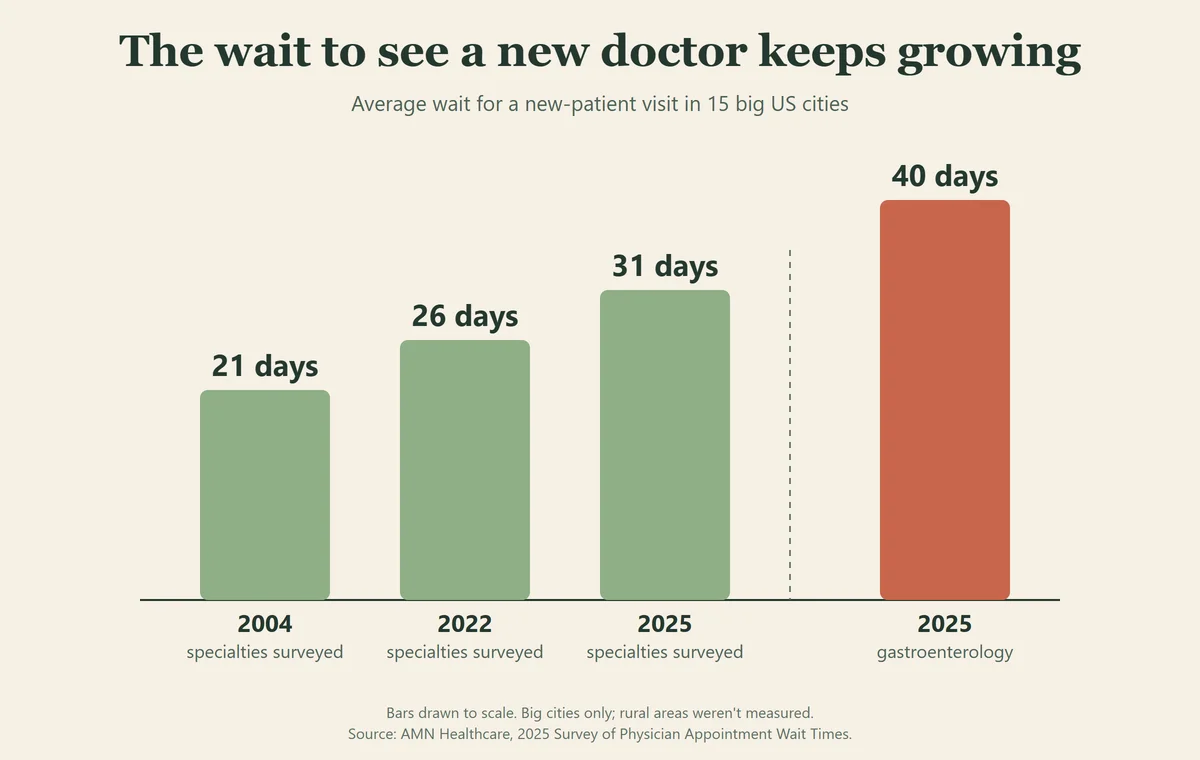
For a gastroenterologist, you’re looking at about 40 days. Live in Detroit? The wait for a GI doctor there reached 208 days [3]. GI is short for gastrointestinal, meaning your digestive tract. Have Medicaid, the public plan for people with low incomes? Then your choices shrink further, since only 53% of the doctors surveyed accepted it [3]. And those numbers come from big cities; rural areas weren’t measured.
Why is there such a shortage of doctors in the US?
Part of it is just how hard it is to become a doctor. Medical school, residency and fellowship are all hard to get into, for all the right reasons. Fellowship is the extra years of specialty training after residency. You want the person doing your colonoscopy to be well trained. Nobody’s asking for the guy who skimmed that chapter. But it also means there aren’t a lot of doctors.
Residency is the tightest squeeze. After medical school, a new doctor can’t practice alone until they’ve spent years training in a hospital. Picture a four-lane highway that drops to one lane at a bridge. Medical school is the highway, and residency is the bridge.
Who pays for the bridge? Medicare is by far the biggest federal funder of those training jobs, about $15 billion in 2018 [6]. At most hospitals, it caps the residents it funds at the number that hospital trained in 1996 [6][7].
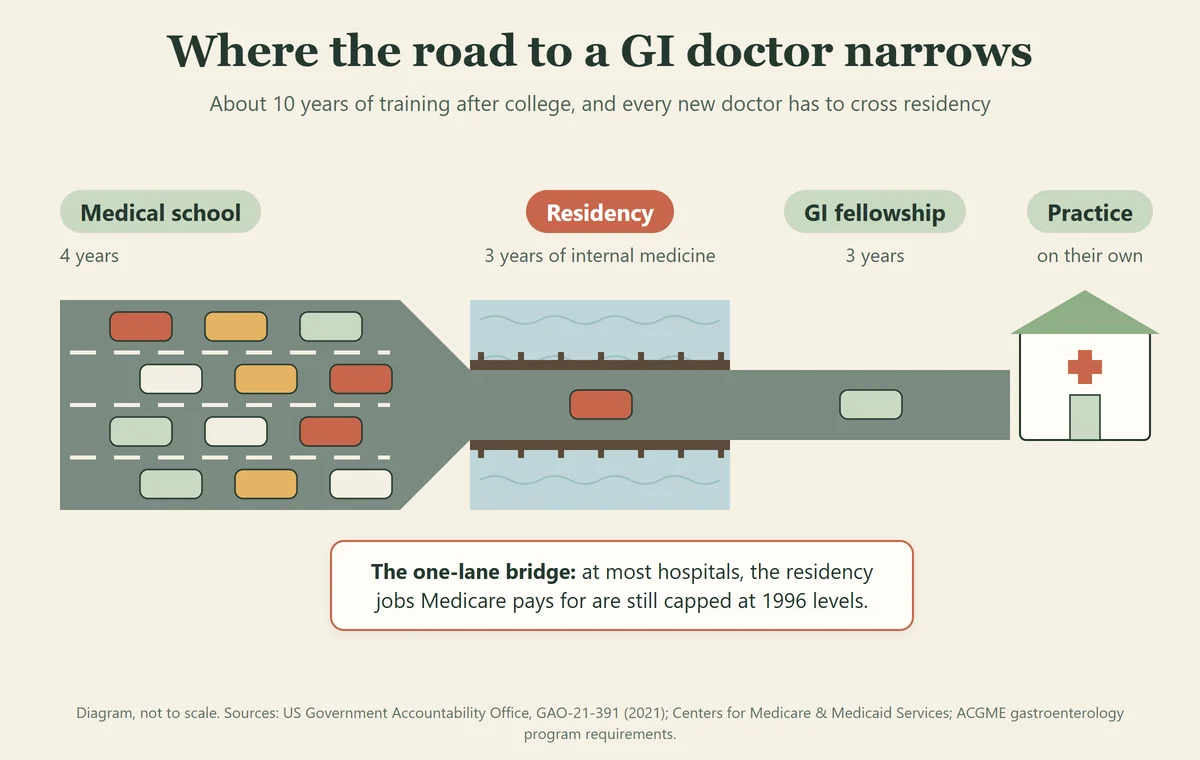
Has that cap moved since 1996? Barely. Congress added 1,000 Medicare-funded residency slots in 2021, and no more than 200 get phased in each year [7]. That’s for the whole country, not per state. Hospitals were already stretching. In 2018, 70% of teaching hospitals trained more residents than Medicare would pay for, using other money [6].
Meanwhile, the patients keep getting older. By 2036, there should be 34% more Americans 65 and up, and 55% more who are 75-plus [4]. So are your doctors. One in five who still practice is 65 or older already [4]. More cars are pulling into the shop, and a lot of the mechanics are eyeing retirement.
Put it together, and the AAMC’s range for 2036 runs from 13,500 to 86,000 physicians too few [5]. Primary care, the family doctors you see first, takes the biggest hit, short 20,200 to 40,400 doctors [5]. For medical specialists like me, it’s mixed, anywhere from a small shortage to a small surplus [5]. That’s cold comfort if the next GI opening in your city is months away.
The referral maze doubles the wait
Are you on an HMO (health maintenance organization) plan? A lot of people are. Take Medicare’s HMO plans: in most of them, you need a referral before a specialist visit is covered [8].
So your clock starts twice. Say it takes three to six months just to get in with a primary care doctor. Then double it for the specialist, and you could be waiting half a year or more from the day you first noticed a problem. It’s two lines at the DMV, back to back.
Every handoff is a place where things slip. Maybe your referral gets lost. Maybe your appointment gets canceled. Or you find out the office is out of network, so your plan pays less or nothing.
What waiting can cost
Here’s how I put it: “by that time whatever disease you got referred for either kills you or is worse than it originally was.”
Is that too strong? Sometimes. In the study below, a wait of a few months didn’t make a measurable difference. But colon cancer screening shows where long waits start to matter. The study comes from Kaiser Permanente, a large US health system. It followed 70,124 people with a positive FIT, a take-home stool test for hidden blood [9]. When did they get their colonoscopy, and what turned up?
- Within a month, about 30 cancers per 1,000 people.
- Up to 9 months later, no clear difference.
- At 10 to 12 months, 49 per 1,000, with more found at an advanced stage.
- After more than a year? 76 per 1,000.
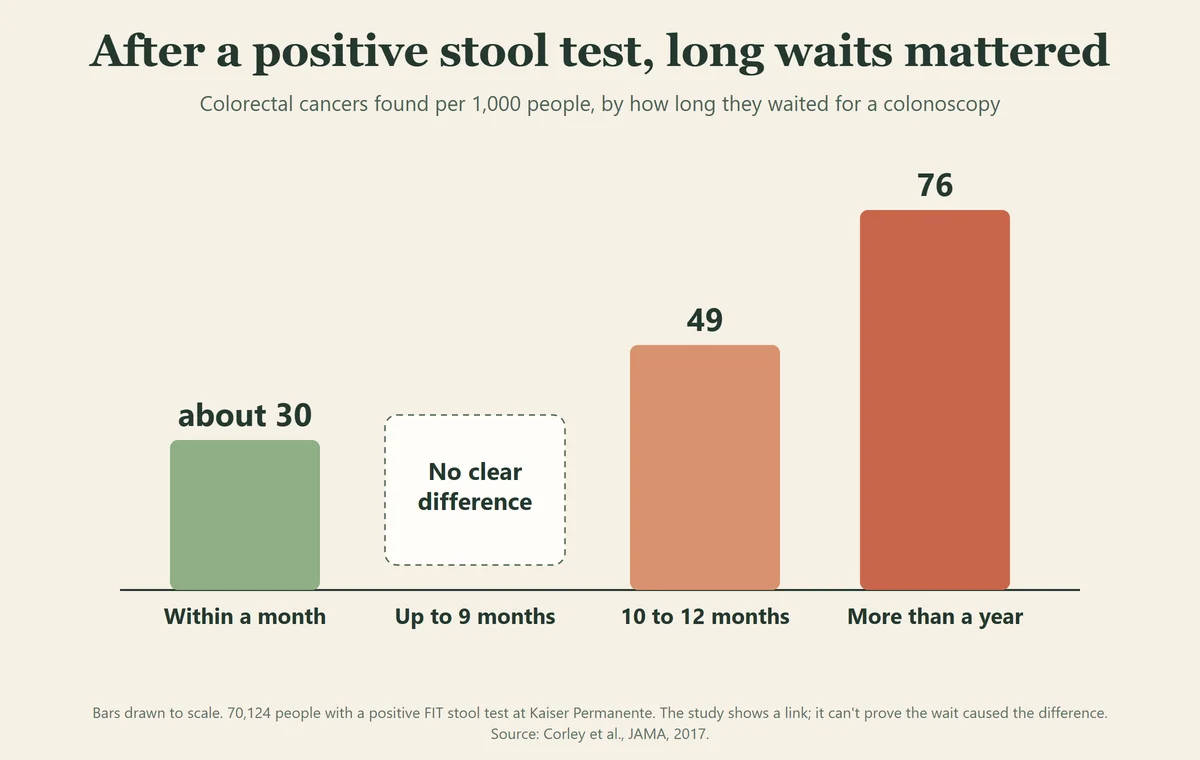
The study can’t prove the wait caused the difference [9]. Still, if your stool test comes back positive, don’t let that colonoscopy drift. I’ve also written about why GI cancers are striking younger adults.
Can PAs and NPs fill the gap?
The fix you hear most right now is more physician assistants and nurse practitioners. You’ll see them called PAs and NPs. You’ve likely seen one already. They see a lot of patients today, and PAs describe their work as team-based care [10].
In my view, “the training … is significantly different.” What does that look like on paper?
- A gastroenterologist trains for about 10 years after college. That’s four years of medical school, three of internal medicine (adult general medicine) residency, then a three-year GI fellowship [12].
- PA programs take about 27 months, with 2,000 hours of clinical rotations, hands-on training with patients [10].
- NPs start from a nursing degree, and the 2022 national standards add a minimum of 750 direct patient care hours in NP programs [11].
I’m comparing training here, not people, and it matters most when your problem is complex.
On a team led by a doctor, PAs and NPs are a real help. For a complex GI problem, though, I’d still want you to see a specialist.
Five fixes worth arguing about
There’s no single magic fix, and anybody who promises you one probably has a book to sell. So here are options. Each one’s got a real upside and a real catch.
1. Pay for more residency slots
The Resident Physician Shortage Reduction Act would add 14,000 Medicare-supported residency positions over seven years [4]. That’d go straight at the bottleneck, like adding lanes to the bridge. The catch is time. A doctor starting internal medicine residency next year won’t finish GI training for six years. And it’d need federal money.
2. Bigger care teams, led by a physician
More PAs and NPs working alongside doctors would mean more appointments for you now. But don’t forget the training gap above. Who sees the complicated cases, and who’s responsible for them?
3. Let specialists answer questions without a visit
With an e-consult, your primary care doctor sends a specialist a question and gets advice back, sometimes with no visit needed. Think of your regular mechanic calling the transmission guy before anybody tows your car across town. In more than a dozen studies, specialists replied within a few days or less [13]. Does it shorten the wait for in-person visits? Unclear. Two studies found shorter waits, two found no change, and the review rated that evidence low quality [13].
4. Cut some referral hoops
If you’re in a Medicare HMO plan, a few services already skip the referral, like a yearly screening mammogram (a breast X-ray) [8]. Could a colonoscopy after a positive stool test join that list? I think it could, since that colonoscopy is the next step anyway. There’s a flip side. Primary care sorts out who really needs a specialist, and opening the door wider could make your specialist wait even longer.
5. License experienced doctors trained abroad
As of May 2026, 27 states and 2 territories had created new licensing paths for internationally trained physicians, 25 of them since 2021 [14]. Each one requires a job offer first, and many focus on primary care in rural or underserved areas [14]. So how do you check years of training done somewhere else, quickly but properly? That’s the open question.
What would you do?
I’d like this to get people talking, or at least thinking about it. So, tell me in the comments:
- Which of these five would you fund first?
- How long did you last wait to see a specialist, and what happened while you waited?
- Is there a fix I missed?
If I had to start with one, I’d pay for more residency slots. The other fixes help, but residency is where the bottleneck is. You can repaint the lines on the highway all day long. If the bridge has one lane, traffic still backs up.
Stuck on a waitlist? What you can do now
You can’t fix the system from a waiting room. These steps can make your wait shorter, or safer:
- Ask to go on the cancellation list. Then pick up unknown numbers for a while, so you don’t miss the call. Yes, even the ones that look like spam.
- Before the visit, call your insurer. Is the office in network? Is your referral on file? Ask both.
- Getting worse? Tell your primary care doctor, and ask if they can mark the referral urgent.
- Ask about an e-consult or a telehealth (video or phone) visit, since either might get you an answer sooner.
- Jot down your symptoms with dates, foods and medicines, so your first visit doesn’t start from scratch.
- Told to try a diet change while you wait, like low FODMAP, which cuts certain gut-fermenting carbs? Our Chef Savi recipe generator can help you cook through it.
A few symptoms can’t sit on a waitlist. If you have black or bloody stools, vomit blood, have trouble swallowing, or lose weight without trying, call your doctor that day. Severe belly pain or heavy bleeding? Don’t wait at all; go to urgent care or the ER.
Frequently asked questions
How long does it take to see a gastroenterologist?
What type of doctor has the biggest shortage?
Is the doctor shortage getting worse?
Wait times say yes. The average new-patient wait in 15 big cities went from 21 days in 2004 to 26 in 2022, then 31 in 2025 [3]. Demand keeps rising as the number of Americans 75 and older grows a projected 55% by 2036 [4]. New residency slots help, but they’ll take years to turn into doctors [4][7].
Want the next Med Opinion?
Want the next one in your inbox? Join the Gutsavi newsletter for more evidence-checked takes on gut health. Got a topic you’d like covered? Send it through Ask Dr. Ted. You can also read my other Med Opinion, on why alcohol is legal if it causes cancer, or browse more on the Gutsavi blog.
Sources
- AMN Healthcare. 2025 Survey of Physician Appointment Wait Times. June 2025. amnhealthcare.com
- Medical Economics. Physician wait times increase as numbers of doctors decrease: survey. May 27, 2025. medicaleconomics.com
- Patient Safety & Quality Healthcare. Survey: physician appointment wait times surge 19% since 2022. 2025. psqh.com
- Association of American Medical Colleges. New AAMC report shows continuing projected physician shortage (The Complexities of Physician Supply and Demand: Projections From 2021 to 2036). March 21, 2024. aamc.org
- Medical Economics. Med school association projects physician shortfall of 86,000 by 2036. April 26, 2024. medicaleconomics.com
- US Government Accountability Office. Physician Workforce: Caps on Medicare-Funded Graduate Medical Education at Teaching Hospitals. GAO-21-391. May 2021. gao.gov
- Centers for Medicare & Medicaid Services. Direct Graduate Medical Education (DGME). cms.gov
- Medicare.gov. Health Maintenance Organization (HMO) plans. medicare.gov
- Corley DA, Jensen CD, Quinn VP, et al. Association between time to colonoscopy after a positive fecal test result and risk of colorectal cancer and cancer stage at diagnosis. JAMA. 2017;317(16):1631-41. doi:10.1001/jama.2017.3634
- American Academy of Physician Associates. What is a PA? aapa.org
- National Task Force on Quality Nurse Practitioner Education. Standards for Quality Nurse Practitioner Education, 6th ed. 2022. Summary: APEA
- Accreditation Council for Graduate Medical Education. Program requirements for graduate medical education in gastroenterology. acgme.org
- Vimalananda VG, Orlander JD, Afable MK, et al. Electronic consultations (e-consults) and their outcomes: a systematic review. J Am Med Inform Assoc. 2020;27(3):471-9. doi:10.1093/jamia/ocz185
- World Education Services. Policy brief: alternative pathways to licensure for internationally trained physicians in the U.S. Updated May 2026. wes.org
This Med Opinion is Dr. Ted’s personal view. It’s for education only and isn’t medical advice. Talk with your own doctor about your care.
This article is for education only and isn't a substitute for advice from your own doctor. If something feels off, talk to your care team.