
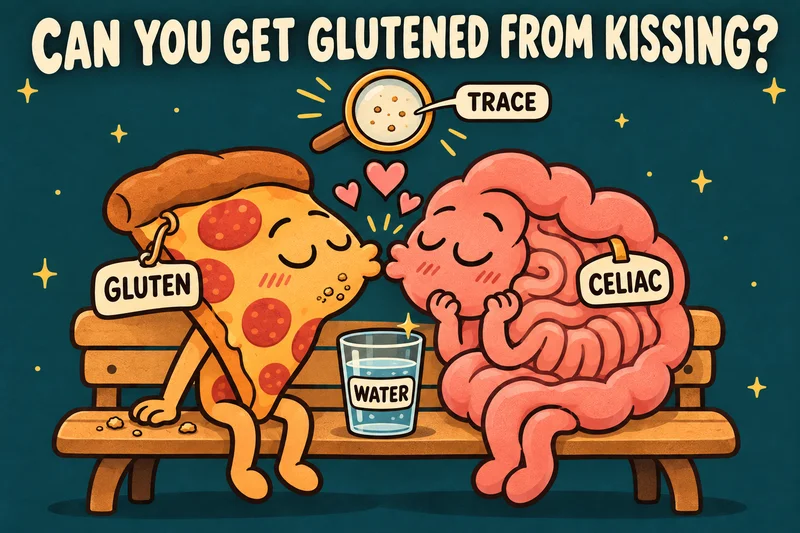
Can you get glutened from kissing? A little gluten can get across, sure, but when somebody finally sat down and measured it, it was a tiny amount [1]. Researchers at Columbia University had 10 couples kiss right after one partner ate gluten, and in 18 of the 20 kisses the gluten in the celiac partner’s saliva stayed under 20 parts per million, the cutoff for a “gluten-free” food label [1][2]. And when the person who ate the gluten drank half a cup of water first? All 10 came in under it [1].
The short version
- “Glutened” is what people with celiac call getting hit with gluten by accident. A kiss passed on very little, and a glass of water passed on even less [1].
- It was a small study, so it doesn’t prove a kiss is always safe [2].
- Honestly, your own fork, your lip balm and your kitchen deserve more of your attention than your partner’s lips [7][8].
“I get asked this question all the time in clinic”
Could kissing someone who just ate gluten completely ruin your diet if you’re eating gluten-free? I get asked this question all the time in clinic. Usually it’s somebody newly diagnosed, and a lot of times their partner is sitting right there next to them, and they’re both kind of embarrassed to bring it up.
Celiac disease is an autoimmune condition where eating gluten can damage the lining of your gut. Gluten is a protein that’s found in wheat, barley, and rye [10]. So these patients absolutely have to, without a doubt, avoid gluten for their entire lives. This is very important.
But here’s the problem. What if you’re gluten-free, but your partner just maxed out an entire pizza, and now they want to kiss you?
Turns out a lot of folks just skip the kiss. When Columbia surveyed 538 adults with celiac about dating, 39% said they’d been hesitant to kiss their partner because of it [4]. Women held back a lot more than men did, 41% versus 23% [4]. That’s a whole lot of missed kisses over something nobody had ever measured.
The kissing study: what the researchers did
Well, this question gets asked so much in clinic that researchers decided to finally figure it out. Scientists made volunteers swap spit to find out. No, I am not making this up. It is pretty hilarious.
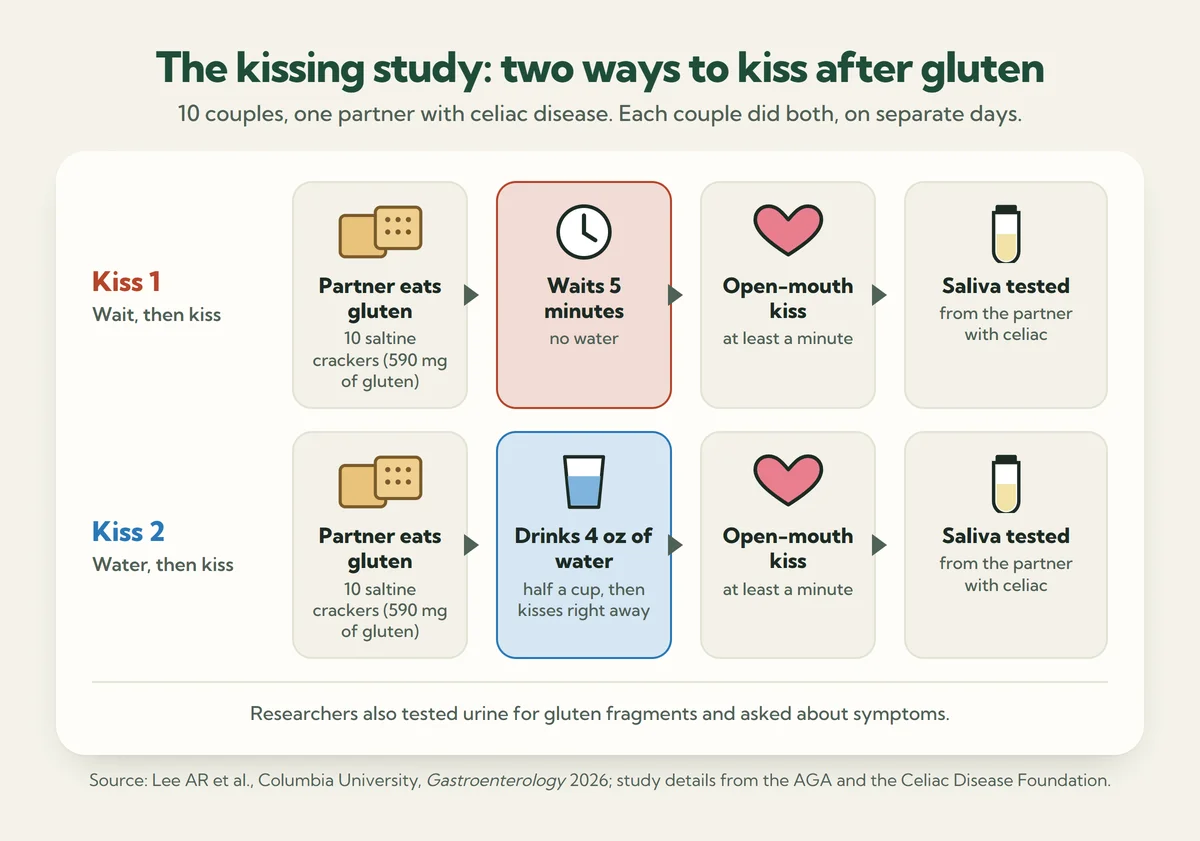
The team at Columbia’s Celiac Disease Center recruited couples where one partner had celiac disease and the other partner did not [1][2]. Everybody with celiac had it confirmed by biopsy and had been gluten-free for a year or more [2]. They had the partners without celiac eat gluten, 10 saltine crackers’ worth, which is about 590 milligrams [1][2], and then they told them to kiss their partners with celiac disease.
And no, I’m not just talking about a little peck on the cheek. I’m talking about full-on Frenching for one whole minute [2][3]. Imagine signing up for a clinical trial like that.
The researchers tested two different scenarios, on two different days [2]:
- Kiss 1: the cracker eater waited five minutes before kissing.
- Kiss 2: they drank four ounces of water, half a cup, and kissed right away [1].
Right after the kiss they grabbed a saliva sample from the celiac partner and measured the gluten in it [1]. They also checked urine for gluten fragments (those show up once you’ve actually swallowed some) and asked about symptoms [2].
What they found in the saliva
Here’s the crazy part.
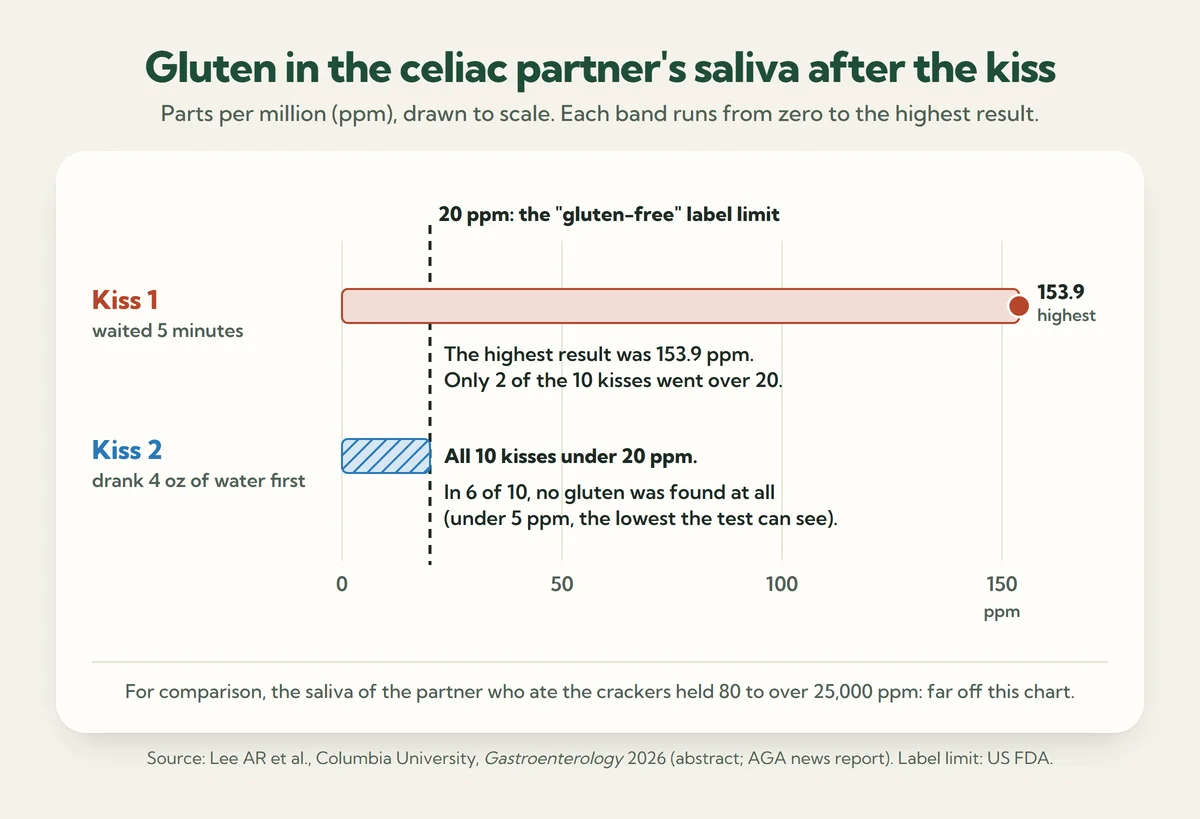
The partner who ate the crackers had a mouth full of gluten, anywhere from 80 to over 25,000 parts per million (ppm) in their own spit [1]. Parts per million is just how labs count really small amounts; the 20 ppm label limit works out to 20 milligrams of gluten in a whole kilogram of food.
Hardly any of that made the trip. With just the five-minute wait, the celiac partner’s saliva got as high as 153.9 ppm [1]. Only 2 of the 10 went over 20, though [1][2]. And after that water? Every single sample was under 20 ppm, and in 6 of the 10 they couldn’t find any gluten at all [1][2].
The urine tests were negative for everybody except one person, and the AGA (American Gastroenterological Association) write-up says that one probably got gluten from somewhere else [2]. Symptom scores stayed low [2].
The authors actually went a step further than I would. They concluded kissing didn’t raise the risk of significant gluten transfer, that 4 ounces of water first cuts it further, and that doctors should tell patients so, “to help reduce the burden of the diet” [1].
Why 20 ppm is the number everyone quotes
So why does this even matter? It matters because 20 parts per million is the cutoff that is commonly used to label foods as gluten-free. Here in the US, anything labeled “gluten-free” has to come in under it [5][7].
The FDA (Food and Drug Administration) went with 20 ppm partly because back then the tests couldn’t reliably measure anything lower [5]. It also points to research suggesting most people with celiac can handle trace amounts below that without harm [5].
But spit isn’t food, so the better question is how much you’d actually swallow. The researchers ran the numbers on the worst kiss: if you swapped about 10 milliliters of saliva (2 teaspoons), 153.9 ppm comes out to roughly 1.5 milligrams of gluten [2].
Now put that next to what we know about daily gluten. In a trial run out of the University of Maryland, adults with celiac swallowed a capsule every day for 3 months [6]. At 50 milligrams a day, their villi, the tiny finger-like bumps that soak up your food, shrank. At 10 milligrams a day most of them held steady, though one person relapsed [6].
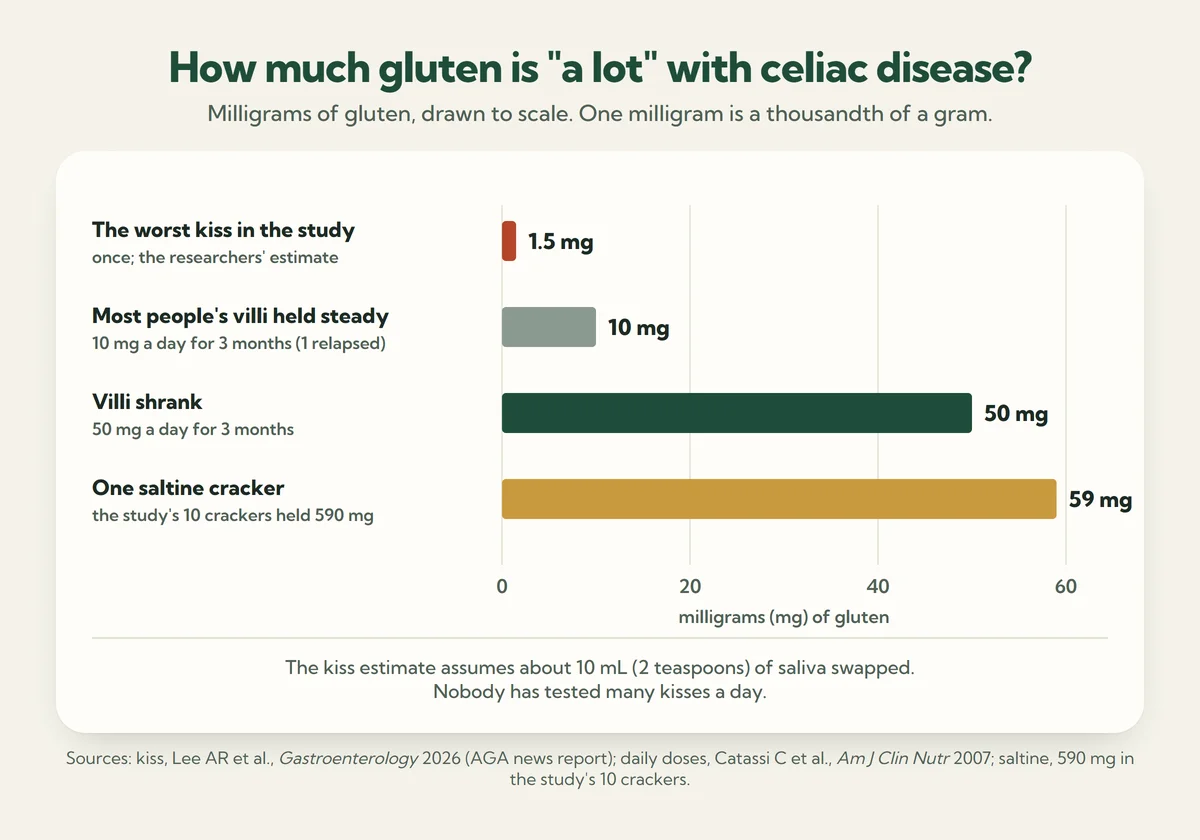
One saltine from that study had about 59 milligrams in it [1]. So that one bad kiss carried maybe a fortieth of a cracker. Nobody’s tested a dozen kisses a day, I’ll grant you, but that’s a whole different ballgame from cheating with a slice of pizza.
What the study doesn’t tell you
Now that doesn’t mean that it’s always safe. It was a small sample size, and the gluten concentration in the saliva is not the same amount as somebody would actually consume.
Ten couples, one center [2]. The AGA write-up adds a couple more limits [2]. Nobody standardized the kissing, and let’s just say some folks are more enthusiastic than others. And the volunteers might not look like everyone with celiac, especially the really sensitive ones.
The setup itself leaves a couple of holes too [1]:
- The partners ate crackers. Nobody tested a beer, a bagel or a big plate of pasta.
- Spit got collected once, right after the kiss. That’s a snapshot, not a whole evening together.
So I’d take it as reassuring, not as a free pass for everything. But it does suggest that something as simple as drinking some water may help cut down the gluten that moves during kissing.
A couple who stopped kissing on weeknights
A woman in her late twenties came in for a follow-up about six months after her celiac diagnosis, and her husband tagged along. She’d been doing great on the diet. Her celiac blood test had come down nicely, which told me the gluten-free part was working.
Then she got to what was really bugging her. He ate a sub at work most days. So on weeknights she’d been skipping the goodnight kiss, and he’d started brushing his teeth twice before bed “just in case.” Both of them were sick of it.
We went through the study together. His job now is a glass of water after he eats gluten, before he kisses her. Hers is to keep her own fork, her own drink and her own lip balm. Her last blood test kept heading the right way, and the goodnight kiss is back.
Kissing is the small stuff. Watch these instead
If you’ve got celiac, there are a few everyday habits I’d worry about way before your partner’s last meal.
Sharing a fork, straw or drink right after they eat gluten. Remember, their own spit held anywhere from 80 to over 25,000 ppm [1]. A kiss passed along a sliver of that. A shared spoon goes straight from their mouth to yours, so I’d just keep your own.
Lip products. The National Institutes of Health lists lipstick, lip gloss and lip balm, plus toothpaste and mouthwash, as places gluten can hide [7]. And unlike a kiss, that stuff sits on your lips all day. Check the label, or ask whoever makes it.
The shared kitchen. A small study out of Children’s National Hospital in Washington, DC, tried out common habits in a shared kitchen [8]:
- Gluten-free bread went in a toaster right after wheat bread. None of the 40 slices went over 20 ppm [8].
- A knife that had just cut regular cupcakes got 2 of 30 gluten-free cupcakes over 20 ppm. Soap, a rinse under the tap or a wipe took care of it [8].
- Gluten-free pasta boiled in the same water as regular pasta? Every sample went over 20 ppm [8]. Fresh water, clean pot.
My take from that study: the shared pot of pasta water is the real troublemaker in the kitchen, not your partner’s lips.
A dietitian who knows celiac can walk through your whole home with you [7][11], and I’d bring your partner to that visit. They’re half of the kitchen, and half of the kiss. And if you’re after a gluten-free dinner for two, Chef Savi can build a recipe out of whatever’s in your pantry.
A food allergy is a different story
Please don’t stretch this study to food allergies. In a Mount Sinai study, peanut protein hung around in the spit of people who’d just eaten peanut butter [9]. Brushing, rinsing or chewing gum cut it down, but it was still there in about 40% of samples [9]. Waiting a few hours and eating a peanut-free meal worked better [9].
Celiac isn’t an allergy [10]. An allergic reaction can hit within minutes and it can be dangerous, so a glass of water just isn’t enough there. If you’ve got a food allergy, go by what your allergist tells you about kissing.
When to see a GI doctor
Come talk to your gastroenterologist if:
- Your symptoms hang on, or come back, while you’re strictly gluten-free. Hidden gluten is the first thing to hunt for [11].
- Your celiac blood test stays high even though you’re on the diet [11].
- Worrying about gluten is keeping you from eating out, traveling or getting close to people. Bring that up too [4].
- You’re newly diagnosed and nobody’s sent you to a dietitian yet [7][11].
I’d look at your food and your kitchen long before I’d blame a kiss. If you think gluten’s still sneaking in, read what happens if you eat gluten with celiac disease; I also get into hidden sources in my piece on probiotics for celiac disease.
Frequently asked questions
Can I kiss my boyfriend if I have celiac?
Yes. In the Columbia study, 18 of 20 kisses kept the gluten in the celiac partner’s saliva under 20 ppm, the gluten-free label limit [1]. When the gluten eater drank 4 ounces of water first, every kiss stayed under it [1]. It was a small study, though, so a glass of water for him first is an easy extra step [1][2].
Can gluten be transferred through kissing?
A little can. Gluten turned up in the celiac partner’s saliva after some kisses, as high as 153.9 ppm [1]. The researchers figured the worst kiss at about 1.5 milligrams of gluten, assuming 2 teaspoons of saliva got swapped [2]. For comparison, a trial of daily gluten saw damage at 50 milligrams a day [6].
What if my partner drank beer?
Can gluten be transferred by touch?
You don’t have to pick
So you are all lucky. It does not seem like you have to choose your diet over your date. Keep the diet strict, keep your own fork, and let your partner have a glass of water before the kiss. There’s more on celiac and food sensitivities in our Food intolerances hub, and the Gutsavi newsletter brings new articles straight to your inbox.
Sources
- Lee AR, Chen Z, Jossen J, et al. A prospective study of gluten transfer through kissing in celiac-discordant couples. Gastroenterology. 2026;170(7):1600-5. gastrojournal.org (doi:10.1053/j.gastro.2026.01.024)
- American Gastroenterological Association. Kissing poses low gluten transfer risk, study finds. AGA News, April 2026. news.gastro.org
- Celiac Disease Foundation. Smooching safely: new study finds kissing after gluten is (mostly) OK for people with celiac disease. May 4, 2025. celiac.org
- Lebovits J, Lee AR, Ciaccio EJ, et al. Impact of celiac disease on dating. Dig Dis Sci. 2022;67(11):5158-67. PMC9150385
- US Food and Drug Administration. Questions and answers on the gluten-free food labeling final rule. Updated June 2022. fda.gov
- Catassi C, Fabiani E, Iacono G, et al. A prospective, double-blind, placebo-controlled trial to establish a safe gluten threshold for patients with celiac disease. Am J Clin Nutr. 2007;85(1):160-6. doi:10.1093/ajcn/85.1.160
- National Institute of Diabetes and Digestive and Kidney Diseases (NIDDK). Treatment for celiac disease. Reviewed October 2020. niddk.nih.gov
- Weisbrod VM, Silvester JA, Raber C, et al. Preparation of gluten-free foods alongside gluten-containing food may not always be as risky for celiac patients as diet guides suggest. Gastroenterology. 2020;158(1):273-5. PMC6917866
- Maloney JM, Chapman MD, Sicherer SH. Peanut allergen exposure through saliva: assessment and interventions to reduce exposure. J Allergy Clin Immunol. 2006;118(3):719-24. doi:10.1016/j.jaci.2006.05.017
- NIDDK. Definition & facts for celiac disease. Reviewed October 2020. niddk.nih.gov
- Rubio-Tapia A, Hill ID, Semrad C, et al. American College of Gastroenterology guidelines update: diagnosis and management of celiac disease. Am J Gastroenterol. 2023;118(1):59-76. doi:10.14309/ajg.0000000000002075
This article is for education only and isn’t medical advice. Talk with your own doctor about your care.
This article is for education only and isn't a substitute for advice from your own doctor. If something feels off, talk to your care team.