
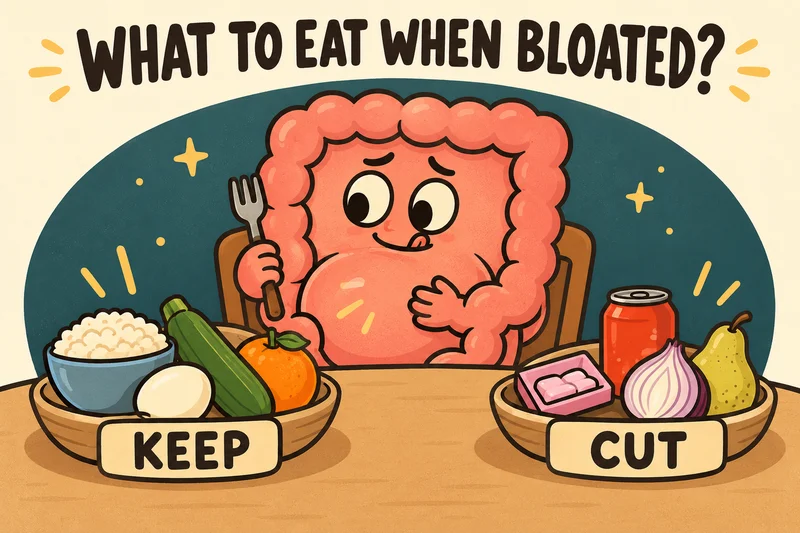
What to eat when bloated depends on why you’re bloated. Most of the time I’d start with how you eat, not what. Slow down, eat smaller meals, and get rid of the gum, the fizzy drinks and the sugar-free sweets. Next, go easy on the gas makers; beans, onions, garlic, apples, pears and milk are the usual ones [1]. If the bloating keeps coming back, the best-studied fix is a short low FODMAP trial. You cut certain carbs that ferment easily for a few weeks, then add them back one at a time [2][3].
If you read nothing else
- No one diet fixes every bloated belly, because gas, constipation, lactose, a slow stomach and celiac disease each want a different menu [4].
- Start cheap: eat slower and smaller, and lose the gum, straws, fizzy drinks and “-ol” sweeteners [1].
- Low FODMAP is a test, not a lifestyle. Cut for a few weeks, add foods back, keep what you tolerate [3].
- Probiotics? The American Gastroenterological Association (AGA) says don’t use them to treat bloating [4].
“What’s the best diet for bloating?”
When we sat down to plan this series, I said the questions patients bring me are simple ones: “It’s just what is the best diet for bloating?” Simple question, sure. The honest answer takes you a few minutes, though.
You know the feeling: full, tight, pumped up like somebody left the air hose on. When your belly actually grows and the waistband starts to dig in, doctors call it distention [6]. In a national survey, nearly 1 in 7 Americans had bloating in the past week, and more than half of them never asked anyone about it [5].
Most of my patients want to fix it with food before anything else. Like I’ve said about patients and diets, “if they can do things all naturally, that’s what they want to do.” I’m all for that, and food is a fair place to start. You just need the right change for your problem, because the diet that fixes one kind of bloating can make another kind worse.
Want the full tour of causes, tests and treatments? That’s in our guide to abdominal pain and bloating. This article is about your plate.
Match the food to the cause
Gas gets into your gut two ways: you swallow air, and the bacteria in your colon ferment carbs your small intestine didn’t absorb [6]. On top of that, things in your gut can move too slowly, or its nerves can have the volume turned up, so you feel a normal amount of gas as a lot [7].
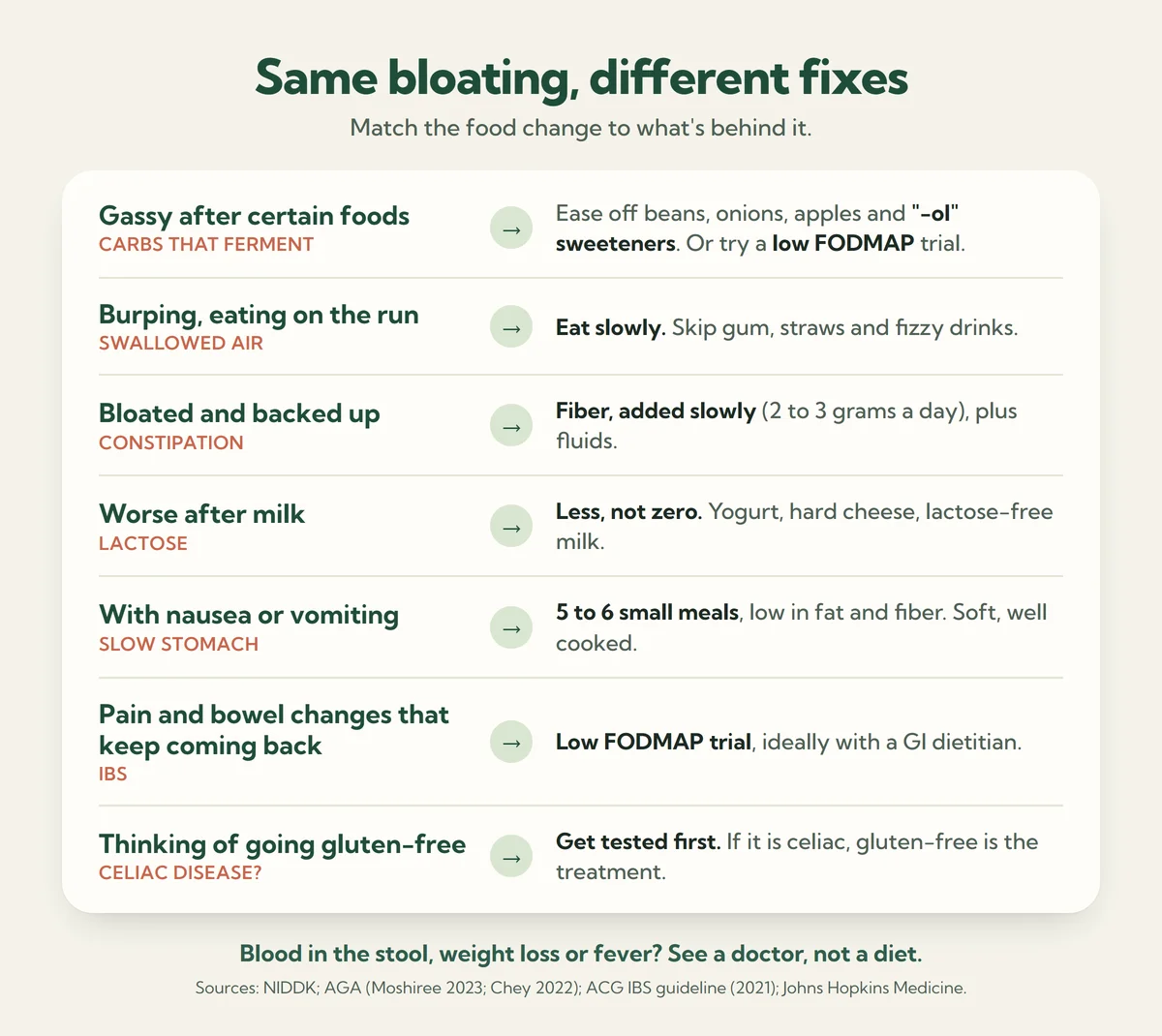
So before you change what you eat, figure out which bucket you’re in:
- Gassy after certain foods? Usually carbs that ferment. Ease off the worst offenders, or try low FODMAP [1][2].
- Burping a lot, eating on the run? Probably swallowed air. Change how you eat before you change what you eat [1].
- Bloated and backed up? Then it’s constipation, and you want fiber and fluids, added slowly [8][11].
- Worse after milk or ice cream? You may only need less lactose, not zero [10].
- Bloated with nausea or vomiting? Ask about a slow stomach, called gastroparesis [4]. It wants smaller, softer, lower-fat meals [12].
- Belly pain that keeps coming back, with diarrhea, constipation or both? That’s the pattern of IBS (irritable bowel syndrome) [16], and low FODMAP has the best evidence there [3][9].
What to eat when bloated
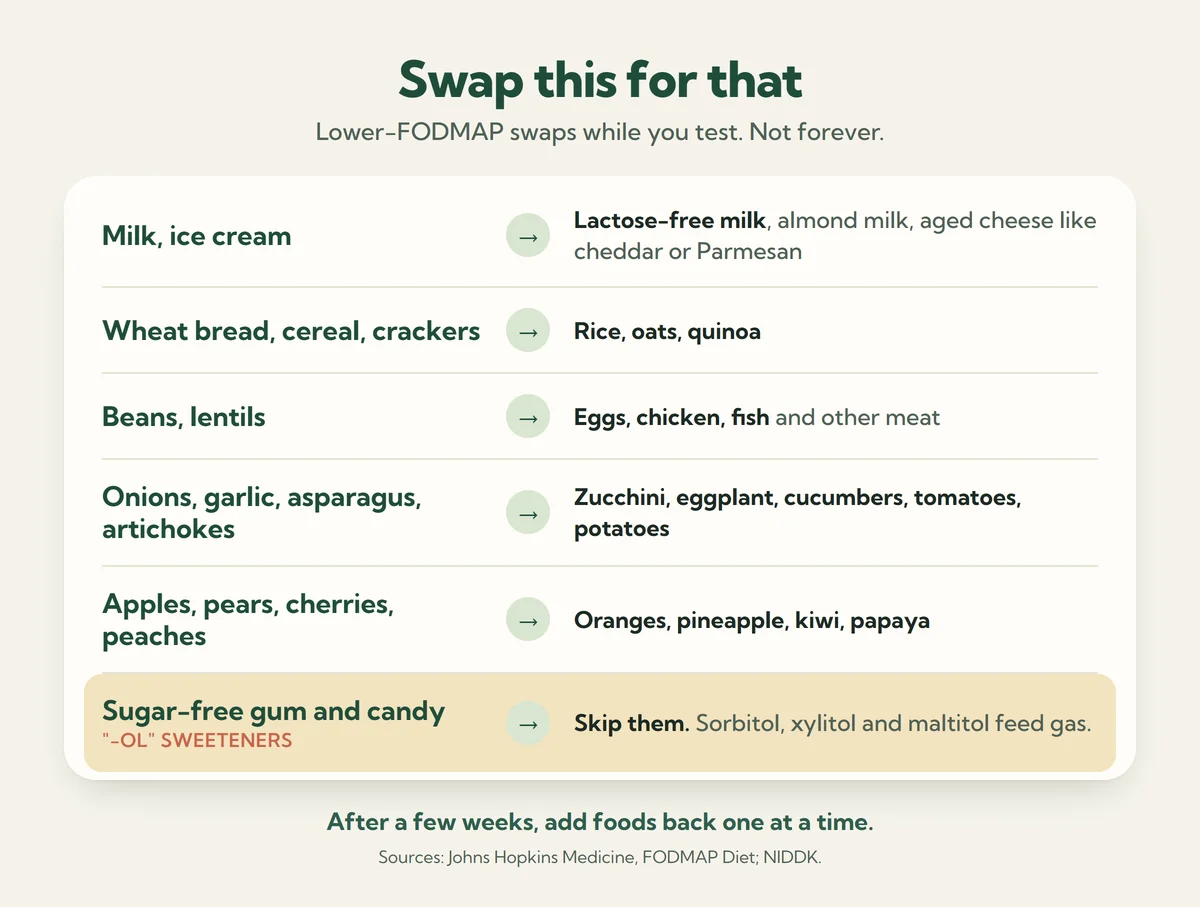
These foods tend to sit well because they’re low in the carbs that ferment [2]:
- Protein: eggs, chicken, fish and other meat.
- Starches: rice and oats are fine, and so are quinoa and potatoes.
- Vegetables: zucchini and cucumbers, plus tomatoes and eggplant.
- Fruit: I’d reach for an orange, pineapple, kiwi or papaya.
- Easier dairy: aged cheeses like cheddar and Parmesan, or lactose-free milk [2][10].
- To drink: plain water. The bubbles can wait.
And don’t forget the how. Eat smaller meals more often, sit down to eat them, and slow down. And don’t talk with your mouth full, because you swallow air when you do [1]. Turns out your mother was giving medical advice.
Foods to avoid for bloating
If you bloat after meals, here’s where I’d look first [1][8]:
- Beans, lentils and peas, the classic gas makers.
- Onions and garlic, plus cabbage, cauliflower, broccoli, asparagus and mushrooms.
- Fruit like apples, pears, peaches, cherries, mango and watermelon, and fruit juice.
- Milk, ice cream and soft cheeses, if lactose is a problem for you.
- Wheat bread, cereal and crackers [2].
- Soda and sports drinks, and juice too, when they’re sweetened with high-fructose corn syrup.
- Anything “sugar-free” that’s sweetened with sorbitol, xylitol, maltitol or another “-ol.” Check the gum, candy and protein bars [1].
- Big, greasy meals, since high-fat food can make bloating worse [1].
Notice how much of that list is healthy food? Beans and broccoli aren’t the bad guys; your colon bacteria are just loud about them. You’re not trying to cut all of it forever. You’re trying to find which ones are yours.
The best tool for that costs you nothing. Before you cut anything, write it down for a couple of weeks. What did you eat, when, and when did the bloating hit? Your doctor or dietitian will want to see that food and symptom diary anyway [1].
The case of the healthy lunch
A guy in his forties came in sure he had a gluten problem. He’d already cut bread and pasta. Still, by mid-afternoon he was blown up like a pool float, every single workday. His blood test for celiac disease came back normal.
So we walked through a normal day, bite by bite. Breakfast? Fine. After that it got interesting. He was working through a pack of sugar-free gum by noon, had a protein bar sweetened with sugar alcohols, and drank three cans of sparkling water. Then lunch: a big salad with an apple sliced on top, because he was being good. That’s a lot of swallowed air, a good dose of “-ol” sweeteners and some hard-to-digest fruit sugar, all before two o’clock [1].
We cut the gum, the bars and the bubbles first. Within a couple of weeks most of the bloating was gone, and the bread came back. He was a little annoyed the fix was that boring. I wasn’t.
The lesson I took from him: before you cut real food, look hard at the stuff you don’t even count as food.
The low FODMAP trial, done right
With IBS, a short low FODMAP trial (cutting the carbs that ferment easily, then testing them) is usually where I start. Why that one? It has the most evidence of any diet for IBS [3], and in the trials it helped belly pain and bloating in particular [9]. Doctors at Johns Hopkins say it eases symptoms in 50% to 86% of the people who try it for IBS and similar problems [2].
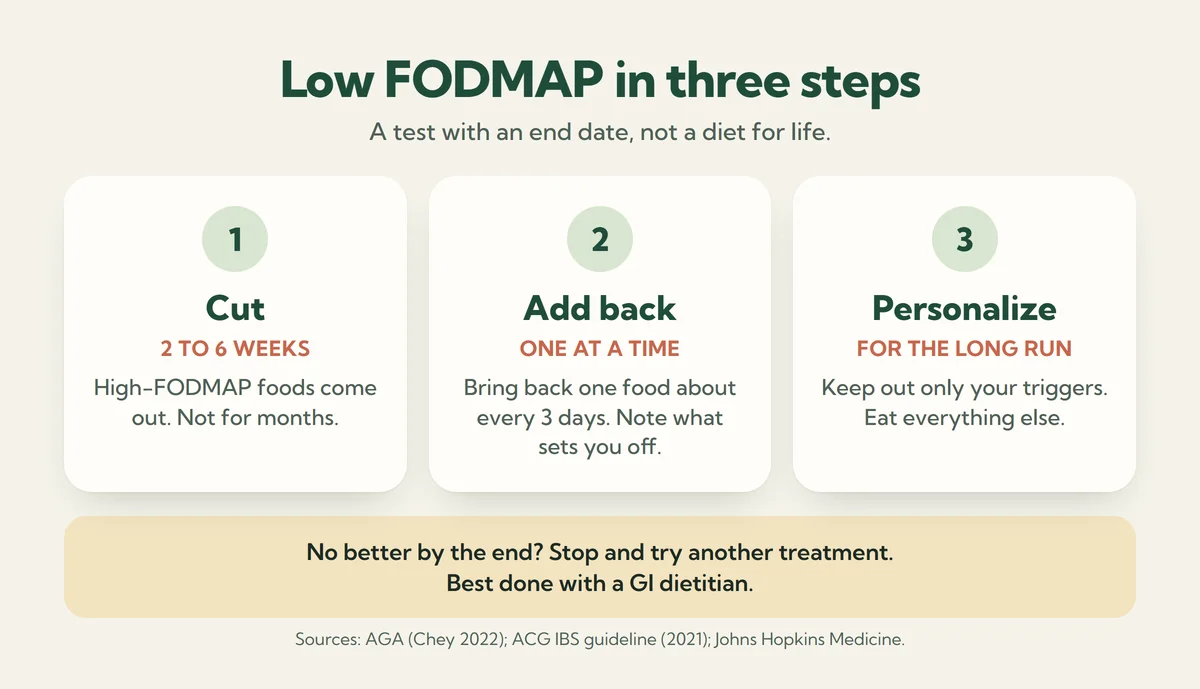
It runs in three steps [2][3]:
- Cut. High-FODMAP foods come out for two to six weeks. Not months.
- Add back. One food at a time, about every three days, to see which ones set you off [2].
- Personalize. Keep out only the foods that bothered you, and eat everything else.
Don’t skip step 2. It’s the step that actually tells you something. The folks I worry about cut and never add back, so they end up on a handful of safe foods and still feel lousy. Stay that strict for too long and you can run short on vitamins and minerals [9].
If nothing has changed by the end of the trial, drop it and move to another treatment [3]. A diet that isn’t working isn’t a diet you should keep paying for in pizza.
Do it with a GI dietitian if you can [4][9]. And some people shouldn’t do it on their own at all: anyone underweight, anyone with an eating disorder, or anyone at risk of malnutrition or not sure where the next meal is coming from [2][3].
When the cause changes the menu
Bloated and constipated
You need about 22 to 34 grams of fiber a day as an adult, with enough fluids to help it work [11]. Jump up too fast, though, and you’ll make more gas, so add 2 to 3 grams a day instead [8]. Fiber that dissolves in water, like oats and psyllium (a fiber supplement), is the kind recommended for IBS. Fiber that ferments in the colon can make bloating worse [9]. When constipation is part of the picture, treating it is one of the main ways to treat the bloating [4]. More in our article on the best diet for constipation.
Lactose
If milk is your problem, you can probably still have some. Plenty of people with lactose intolerance can take about 12 grams of lactose, roughly a cup of milk, and get mild symptoms or none. Yogurt and hard cheeses like cheddar or Swiss carry less of it, and lactase pills or lactose-free milk get around it. Cut out all dairy and you can come up short on calcium and vitamin D [10].
A slow stomach
And now the advice flips on you. With gastroparesis, the menu goes low-fat and low-fiber. You’d eat five or six small meals a day instead of two or three big ones, cooked soft. Fizzy drinks and alcohol are out [12]. The fiber that helps a constipated person can sit in a slow stomach like a brick.
Celiac disease
If celiac disease is behind your bloating, a gluten-free diet is the treatment [1]. But get tested first. Doctors don’t recommend going gluten-free before testing, because it can throw off the results [13].
SIBO
With SIBO (small intestinal bacterial overgrowth), too many bacteria have moved into your small intestine. It’s usually a complication of another condition [6], and testing makes sense only for a small group of people at higher risk [4]. If your doctor suspects it, that’s a test to run, not one more food to cut.
When food isn’t enough
Sometimes you do everything right and the bloating stays. That doesn’t mean you failed the diet.
Probiotics aren’t the shortcut. The AGA says probiotics shouldn’t be used to treat bloating [4]. I see plenty of people looking for the magic pill. For bloating, the boring basics beat the bottle.
Your brain is part of it. Stress, anxiety and depression cause real gut symptoms; I see it every day. Brain-gut therapies like hypnotherapy and cognitive behavioral therapy can help with bloating [4]. On hypnotherapy for IBS, I’ll say it the way I said it to my team: “This is not a joke… it really works.” More in is IBS all in your head? and can anxiety cause stomach pain?
Medicines. If constipation is part of it, your doctor may add a constipation medicine. Some antidepressants, used here for the gut, turn down the volume on oversensitive gut nerves [4]. Those are decisions for you and your doctor together.
When to call your doctor
Food changes are for everyday bloating. Get checked if any of these come along with it:
- Blood in your stool, black or tarry stool, or vomiting blood. Get help right away [14]. Blood always deserves a proper look, so ask for one.
- Weight loss you can’t explain, a fever with belly pain, or discomfort that lasts a week or more [14].
- Bloating plus belly pain, constipation or diarrhea [6], or symptoms that are getting worse [4].
- For women: new bloating, feeling full too fast or pelvic pain that lasts 2 weeks or more and isn’t normal for you [15].
- You have gut symptoms and a parent, brother or sister with Crohn’s disease or ulcerative colitis.
Is it more pain than puffiness? Then read what to eat when your stomach hurts. If the runs are the bigger problem, see what to eat when you have diarrhea.
Frequently asked questions
What foods don’t cause bloating?
No food is bloat-proof for everybody. The ones least likely to cause trouble are low in fermentable carbs: eggs, meat and fish, rice, oats, quinoa, potatoes, zucchini, cucumbers, tomatoes, oranges, pineapple and kiwi [2]. Aged cheeses like cheddar and Parmesan are easier on most people than milk [2][10].
What should I eat when I’m constipated and bloated?
Add fiber slowly, about 2 to 3 grams a day, and drink enough fluids [8][11]. Fiber that dissolves in water, like oats and psyllium, is the kind recommended for IBS, not wheat bran [9]. If you still bloat, ask about treating the constipation itself [4]. Our best diet for constipation article has the details.
Is yogurt good for bloating?
How long does a low FODMAP diet take to work?
Should I cut out gluten for bloating?
Cook for the diet that fits you
Once you know which foods sit well with you, the hard part is turning that list into dinner. Chef Savi, our low FODMAP recipe generator, builds a recipe from what’s in your pantry. Gutsavi made it, so yes, it’s ours. Our abdominal pain and bloating hub has more, and the Gutsavi newsletter brings new articles to your inbox.
Sources
- National Institute of Diabetes and Digestive and Kidney Diseases (NIDDK). Eating, diet, & nutrition for gas in the digestive tract. Reviewed June 2021. niddk.nih.gov
- Johns Hopkins Medicine. FODMAP diet: what you need to know. Updated June 24, 2026. hopkinsmedicine.org
- Chey WD, Hashash JG, Manning L, Chang L. AGA clinical practice update on the role of diet in irritable bowel syndrome: expert review. Gastroenterology. 2022;162(6):1737-1745.e5. doi:10.1053/j.gastro.2021.12.248
- Moshiree B, Drossman D, Shaukat A. AGA clinical practice update on evaluation and management of belching, abdominal bloating, and distention: expert review. Gastroenterology. 2023;165(3):791-800.e3. doi:10.1053/j.gastro.2023.04.039
- Oh JE, Chey WD, Spiegel B. Abdominal bloating in the United States: results of a survey of 88,795 Americans examining prevalence and healthcare seeking. Clin Gastroenterol Hepatol. 2023;21(9):2370-7. doi:10.1016/j.cgh.2022.10.031
- NIDDK. Symptoms & causes of gas in the digestive tract. Reviewed June 2021. niddk.nih.gov
- Lacy BE, Cangemi D, Vazquez-Roque M. Management of chronic abdominal distension and bloating. Clin Gastroenterol Hepatol. 2021;19(2):219-231.e1. doi:10.1016/j.cgh.2020.03.056
- NIDDK. Eating, diet, & nutrition for irritable bowel syndrome. Reviewed November 2017. niddk.nih.gov
- Lacy BE, Pimentel M, Brenner DM, et al. ACG clinical guideline: management of irritable bowel syndrome. Am J Gastroenterol. 2021;116(1):17-44. doi:10.14309/ajg.0000000000001036
- NIDDK. Eating, diet, & nutrition for lactose intolerance. Reviewed February 2018. niddk.nih.gov
- NIDDK. Eating, diet, & nutrition for constipation. Reviewed May 2018. niddk.nih.gov
- NIDDK. Eating, diet, & nutrition for gastroparesis. Reviewed January 2018. niddk.nih.gov
- NIDDK. Diagnosis of celiac disease. Reviewed October 2020. niddk.nih.gov
- MedlinePlus Medical Encyclopedia. Abdominal pain. Reviewed January 13, 2026. medlineplus.gov
- Centers for Disease Control and Prevention (CDC). Symptoms of ovarian cancer. cdc.gov
- NIDDK. Definition & facts for irritable bowel syndrome. Reviewed November 2017. niddk.nih.gov
This article is for education only and isn’t medical advice. Talk with your own doctor about your care.
This article is for education only and isn't a substitute for advice from your own doctor. If something feels off, talk to your care team.